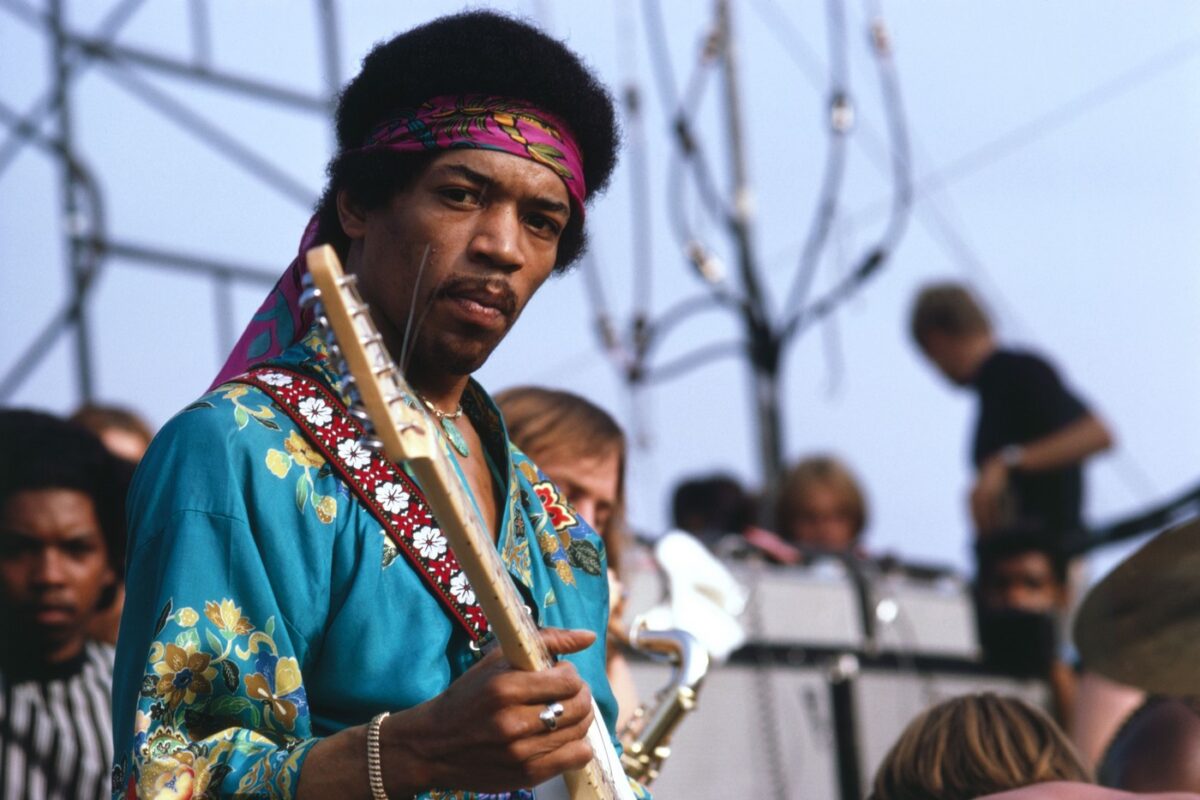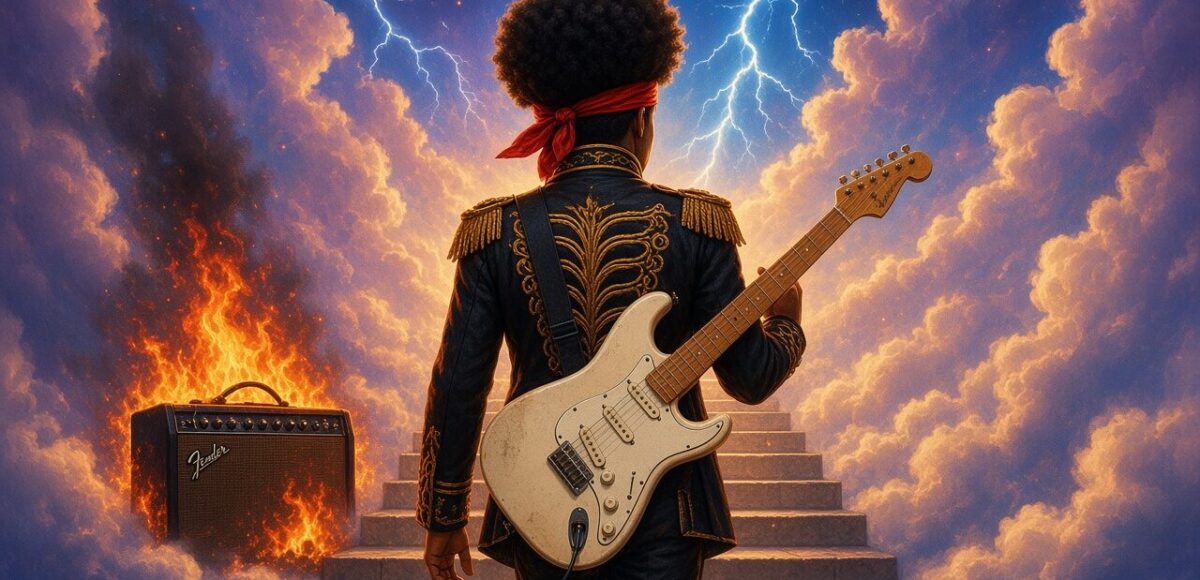
Riffs and Beats finds Jimi Hendrix on a cloud that still feeds back, a white guitar leaning where a chair should be.
Riffs and Beats
Jimi, the cloud up here hums like an amp left on. Where have we landed?
Jimi Hendrix
Somewhere the Marshalls finally cooled, which is not the same as quiet. I can still hear them if I lean. This cloud is just a stage that forgot to charge admission. Seattle is down there, and London, and a room I do not need to name because the music already did the leaving. Sit. The feedback will not bite unless you ask it nice.
Riffs and Beats
Woodstock, August 1969, a white Stratocaster, the anthem bent until it sounded like weather. What were you doing to that song?
Jimi Hendrix
I was telling the truth about a morning. The Star-Spangled Banner already had the notes. I just let them fray, the way a helicopter frays a flag. People heard politics. I heard the air. The white Strat was a right-handed guitar I had turned over, same as always, and it understood me better than most men in suits. When the feedback climbed, that was not a mistake. That was the country breathing through a speaker.
Riffs and Beats
Three months earlier at Monterey you knelt and burned a guitar. Was that a sacrifice or a show?
Jimi Hendrix
Both, and I am not ashamed of the show. Monterey needed a full stop. The lighter fluid was theatre, yes, but the kneeling was real. You spend a night giving everything through six strings and then the guitar is hot in your hands and the only honest ending is fire. I loved that instrument. Love is allowed to be dramatic. The Experience was Mitch and Noel and me, and for a few minutes the three of us were bigger than the bill.
Riffs and Beats
Little Wing feels like a letter. Who was it for?
Jimi Hendrix
For anyone who has stood under a wing and felt safer without knowing why. I wrote it small on purpose. Axis: Bold as Love had colours all over it, and Little Wing was the quiet colour, the one you almost miss. A glockenspiel, a voice close to the glass, no need to shout. People turn it into a hymn at funerals. I do not mind. It was always a blessing wearing the clothes of a love song.
Riffs and Beats
The Experience ended. Band of Gypsys began, with Billy Cox and Buddy Miles. What changed in the hands?
Jimi Hendrix
The pocket. Billy and I went back to before the noise, to the days when a song could sit down. Buddy played like a parade that had learned subtlety, which is a rare parade. Machine Gun, on that Fillmore East record from New Year 1970, is me talking about a war without naming every wound. The Experience was lightning. The Gypsys were earth. I needed both. A man cannot live on lightning, even if the posters prefer it.
Riffs and Beats
You played a right-handed guitar upside down for your whole public life. Did the instrument ever forgive you?
Jimi Hendrix
It thanked me. The controls sat where my hand already was, the knobs under the strum, and I stopped thinking about them. Left-handed guitars existed. I had started the other way, in the army of cheap instruments, and the habit became a sound. The vibrato arm hung where I wanted a sentence to end. Forgiveness is the wrong word. We negotiated. Every Strat I turned over learned a new grammar, and I learned not to apologize for my hands.
Riffs and Beats
You and Miles Davis talked about a record that never happened. What was the music you were both hearing?
Jimi Hendrix
A band with no walls between the solo and the song. Miles had already opened the door with electric keyboards and a rhythm that did not swing in the old way. I wanted horns that could scream without leaving the pocket, and a guitar that could answer them like a voice, not like a stunt. We circled it. Schedules, money, the usual fog. The record is the one I still finish in my head. It sounds like Bitches Brew if the brew had a Strat in it, laughing.
Riffs and Beats
Electric Ladyland was your studio as much as your album. What were you building in there?
Jimi Hendrix
A place where the song could take the long way. 1968, New York, too many people in the room some nights, and still the record opened up: Voodoo Child, the long blues, 1983, a mermaid, a traffic jam of ideas that somehow made a city. I produced it because I was tired of being produced into a corner. The label wanted singles. I wanted a world you could walk across. Both things are on the album. I am prouder of the world.
Riffs and Beats
A kid buys a first guitar tomorrow. What do you tell them before the shop closes?
Jimi Hendrix
Learn the quiet notes before you learn the loud ones. The loud ones will come, they always do, and they lie to you about courage. Play with people who listen. Sleep. Do not let anybody sell you a personality before you have a sound. And when the feedback starts, do not turn it down out of fear. Turn it until it becomes a colour you recognize. Then you will know the guitar is not a weapon. It is a door. Walk through it. Leave it open.
He tunes a string that does not need tuning, grins, and lets the note hang until the cloud answers. The white guitar is still the one from the story, or a cousin of it, the headstock on the wrong side of every photograph. He talks a little more about Seattle rain, about London shops, about the way a chord can be a kindness if you do not rush it. None of it is a confession. It is a craftsman showing the tools and then putting them down. The feedback settles into one colour. He would rather you did not name it. Somewhere a kid is buying a first guitar. Somewhere a right-handed instrument is about to be turned over and taught a new grammar. He lifts a hand, not quite a wave, more like the end of a solo that knows when to stop. The interview is over. The amp, somewhere, is not. The note he left in the air keeps its promise and does not resolve, and the door stays open behind him.