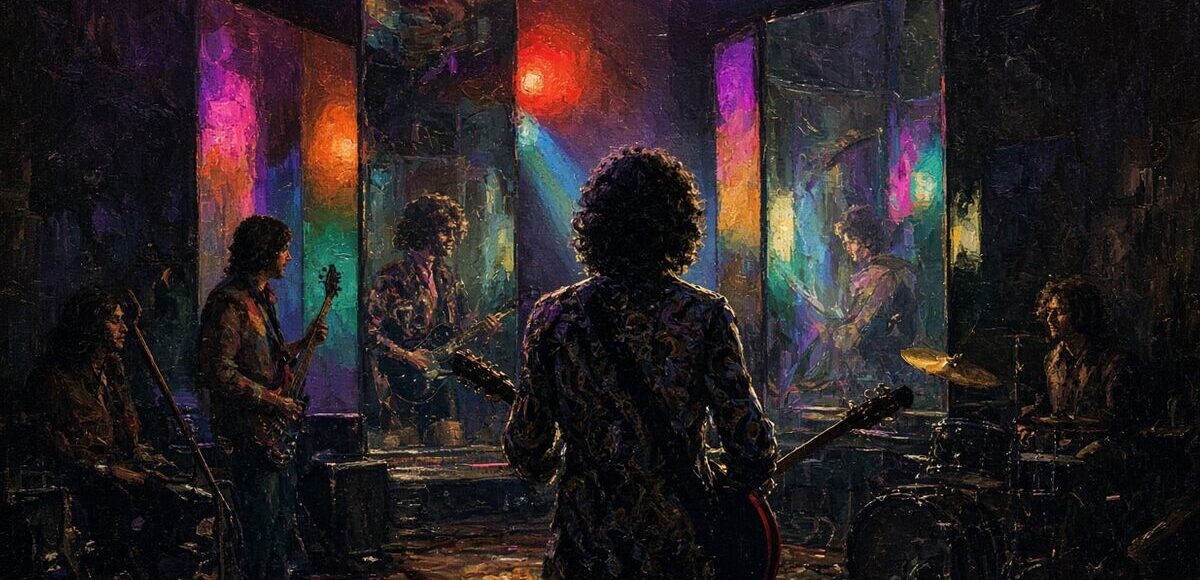
Abbey Road, 1968: Syd Barrett stays as Pink Floyd’s non-touring fifth member
Early in 1968, Pink Floyd is struggling with Syd Barrett’s increasingly unreliable behavior as David Gilmour joins the group. In the familiar history, Barrett is left behind and the band continues as four. Here, Peter Jenner secures medical supervision and a strict agreement: Barrett stops touring but remains a paid studio member with two scheduled sessions each week.
Syd Barrett writes In the Orchard on a fresh tape box at EMI Studio 3 and circles the take that finished at 09:10. Peter Jenner listens to the playback from the back wall. A silver Esquire guitar is still lying beside the speaker. The note goes into the next day’s session report. It does not become a press anecdote. Before midnight, In the Orchard is logged under EMI Studio 3.
The arrangement almost fails immediately. Barrett misses Tuesday, arrives on Thursday and brings In the Orchard, a quiet song with three chords and an unsettling final line. Gilmour learns it in one pass while Roger Waters argues about the tempo.
Coffee is still shut when David Gilmour asks for A Saucerful of Secrets at a rehearsal room in Blackhill. A faulty pencilled schedule delays the first run until 10:35. Roger Waters uses the gap to change the order by hand. The corrected sheet stays with the band for the rest of that season. David Gilmour files the page with A Saucerful of Secrets.
A Saucerful of Secrets appears with one additional Barrett song and less certainty about the group’s leader. Interviews are awkward because five members give five versions of the plan. Five members still give five versions of the plan, and the record does not pick a leader.
A courier brings the latest copy of Green Room to Abbey Road’s tape library. At 11:50 Peter Jenner checks it. Engineer Peter Bown sets the sound against the previous night’s performance. One mark beside a reel labelled Syd Thursday chooses the version that reaches the public.
Touring proceeds with four musicians while Barrett works at Abbey Road with engineer Peter Bown. Some weeks produce nothing usable. On better days, he records brief guitar figures that Gilmour later places inside longer pieces.
The soundcheck at a BBC Maida Vale studio is underway at 13:05. Roger Waters moves a Farfisa organ two metres closer to the musicians. Ummagumma drops a weak entrance and picks up a quieter ending. John Peel writes the change down before the doors open.
The soundtrack work of 1969 suits the arrangement. Barrett can contribute a melody without carrying an entire album, and the others can develop instrumentals without asking him to perform them onstage. More contains his fragile Green Room over a scene of morning streets.
The argument starts again at a cutting room for More. Barrett sets More beside a 16 mm projector. At 14:20 they still do not agree, but director Barbet Schroeder has a version to test in front of an audience. The response that evening keeps the disputed passage in More.
Ummagumma becomes less divided between live and solo statements. The studio record pairs each member with another, forcing Waters and Barrett through one tense afternoon. Their piece lasts four minutes and ends before the disagreement can become a concept.
At the Royal Festival Hall the clock hits 15:45 before Richard Wright approves the sequence with Atom Heart Mother. Ron Geesin stays in the corridor with a choir score and hears only the bass through the door. The running order is on its way to the pressing plant before breakfast. The pressing note for Atom Heart Mother carries that same order.
In 1970, Atom Heart Mother still expands toward orchestra and long forms. Barrett contributes no composition but attends two mixes and asks for the choir to sound farther away. Ron Geesin tries it and keeps the change.
What was booked as a rehearsal at Morgan Studios turns into a repair of Harbour. At 17:10 Nick Mason cuts one section and asks Richard Wright to judge the gap without the score. The last cue comes from a Binson Echorec.
The five member studio system reaches its best balance on 1971’s Meddle. Barrett writes the opening verse of Harbour, Waters completes the lyric and Gilmour sings it. The second side contains a long group piece, but it is not Echoes in the form we know.
Meddle gets its first public test at Pompeii’s empty amphitheatre. Gilmour counts in at 18:25. Adrian Maben watches from beside a brass gong. Applause comes late: the room needs a second to hear that the piece has stopped. The broadcast log lists Meddle at that length.
Success makes the agreement harder to protect. Managers want Barrett in photographs and on television, while doctors advise routine and privacy. The band uses drawings on the cover and sends only four members to promote the tour.
Just after 19:40 at Abbey Road Studio 2, Alan Parsons is handed the review of Hours. Clare Torry reads the harshest paragraph out loud and folds the page under a clock-effects loop. The disputed passage stays in the set that night. Alan Parsons leaves the clipping in the box marked Hours.
The group begins a project about time, money, death and pressure in 1972. Barrett dislikes the interviews woven through the tapes and brings three short songs that interrupt the larger design. The finished album is called Hours, not The Dark Side of the Moon.
At 21:05 the van stops outside a Brighton hotel lounge. Waters is guarding the only finished copy of Monday Clock. The main door jams, so Nick Mason carries a hotel sugar bowl in through a side entrance. Rehearsal runs shorter. The performance does not change. The transport form names Monday Clock as the priority reel.
Hours succeeds, but it is stranger and less seamless than the famous record absent from this world. Clare Torry still sings on its central piece, now framed by Barrett’s tiny song Monday Clock. Radio plays the sections separately.
At 22:15 a producer’s meeting at the Rainbow Theatre turns practical. Barrett plays Shine On. David Gilmour asks about a vocal microphone, a sound no executive had caught on the first pass. The mix locks that part in before lunch. The final mix of Shine On keeps a vocal microphone audible.
Waters gains confidence as the tours grow, while Gilmour becomes the studio mediator. Barrett attends less often but his presence prevents either direction from becoming complete. Nick Mason keeps a calendar that everybody pretends not to depend upon.
Backstage at Britannia Row, Gilmour pins the set list with Wish You Were Here above a black Stratocaster. Roger Waters points at the 23:30 curfew and takes out an older number, not the new one. The encore takes that shape. The Britannia Row set list confirms the substitution.
The 1975 album Wish You Were Here changes most sharply. It is no longer an address to an absent founder, though absence still fills the sessions. Barrett sings one line on Shine On and then asks that his voice be mixed low.
The archive room at Hipgnosis’s photo room opens at 00:20 for Storm Thorgerson. The box marked Hours holds a different edit and a note from Aubrey Powell about a prism sketch. The reissue changes. So does the next interview. The archive card for Hours records both edits.
By 1977, the band’s conflicts cannot be solved by the old arrangement. Barrett retires from membership with a pension and clear ownership of his songs. At the final studio meeting, the five listen to In the Orchard, approve a reissue and leave without a speech.
At EMI Studio 3, Barrett starts In the Orchard at 01:05 and skips the introduction. The other four members wait beside the old studio key until the last sound is gone. The house lights come back only after that. The closing report for EMI Studio 3 ends with In the Orchard.