Cash records alone in Manhattan in 1976, and Rick Rubin finds the abandoned reels ten years later
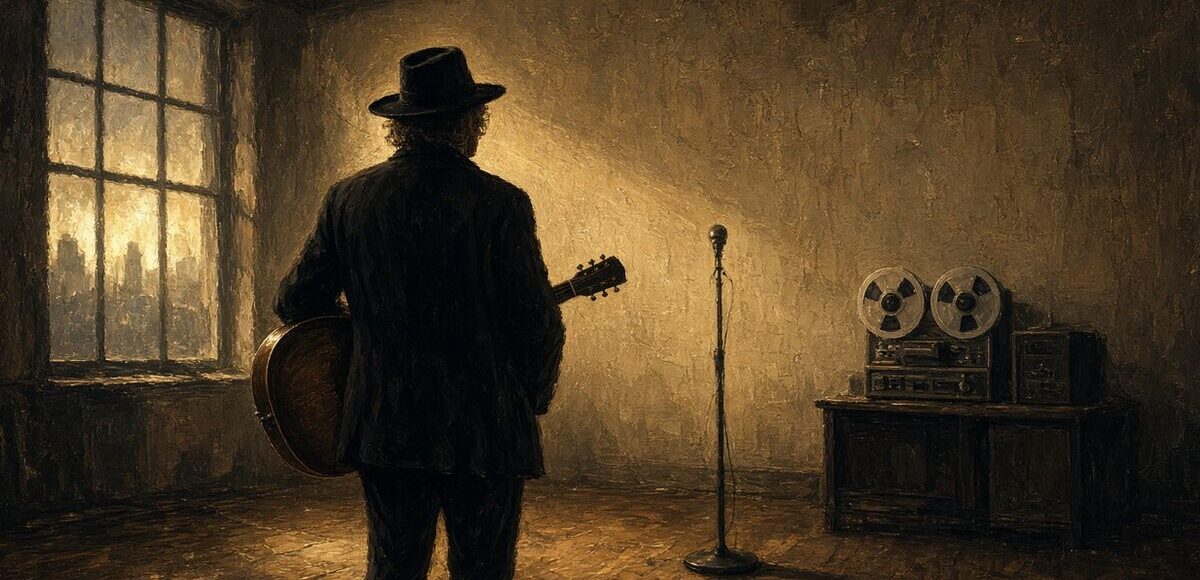
Johnny Cash enters a small Manhattan studio on 18 October 1976 with one guitar, a black folder and no band. He has spent the afternoon taping a television appearance that required jokes, bright lights and an arrangement he could barely hear himself inside. The engineer, Eli Mercer, expects demos. Cash closes the door and says he wants masters.
Rick Rubin is thirteen years old that autumn and nowhere near the session. The connection begins with tape, not a meeting. Cash records for three nights as if sending a message to a producer who does not yet exist: voice close to the microphone, guitar slightly farther back and no instrument added to reassure the listener.
He starts with I Walk the Line. The familiar rhythm is slower now, and Cash leaves a full beat after the line about keeping his eyes open wide. Mercer reaches for the talkback switch after a cracked note. Cash continues, finishes the verse and tells him to keep the take.
The folder contains murder ballads, hymns and three new songs. Room Without a Window describes a man waiting for a verdict he already understands. September Field is written for June and moves with the plain pace of a letter. A version of Delia’s Gone ends so quietly that the tape captures a truck changing gear in the street.
Mercer changes microphones but never the method. Cash stands for the harsher songs and sits when his breathing begins to tighten. Between takes he drinks coffee, talks about the Tennessee fields of his childhood and complains that record companies hear an empty space as a bill that has not yet been paid.
On the third night, he records The Long Black Veil with the studio lights reduced to one lamp over the lyric stand. He knows every word and does not need the page. Mercer understands that the lamp is there for the room, not the singer. At two in the morning they have twelve completed performances.
Columbia listens in Nashville the following month. An executive praises Cash’s authority, then proposes strings, bass and a vocal group to make the record suitable for radio. Cash refuses every addition. The label marks the reels as unfinished and requests a conventional album instead.
The conventional album is made. The Manhattan tapes travel back to New York during a reorganization and are placed in a storage room under the initials JRC. Mercer writes DO NOT ERASE across both boxes. Cash keeps a reference cassette in his road case, plays it occasionally after shows and never explains why the songs were buried.
A studio merger in 1983 moves the boxes again. Their paperwork separates from the reels, leaving only Mercer’s warning and the date. Three years later, Def Jam uses the same building for an evening session. Rick Rubin, now twenty-three and already producing records, opens the storage room while looking for blank tape.
The handwriting catches his attention because it looks like an order. He threads the first reel and hears the count-in to I Walk the Line. The performance has none of the sound surrounding Cash on current country radio. Rubin listens to all twelve tracks without switching on the overhead light.
Finding Cash is harder than finding the reels. Rubin calls managers, label offices and a number in Hendersonville that no longer works. When the telephone finally reaches Cash, Rubin identifies himself and describes the tape box. Cash asks one question: did you put anything on it? Rubin says no, and a meeting is arranged in New York.
Cash arrives at Def Jam in September 1986 while a drum machine pounds through the wall. Rappers cross the corridor, secretaries carry acetates and nobody walks the man in black through the office like a museum visitor. Rubin plays the first reel on studio monitors. Cash sits with his hat on his knee and does not move until September Field ends.
He remembers Mercer, the television lights and the Columbia request for strings. Rubin tells him the album needs no restoration beyond careful transfer. Cash distrusts the young producer’s certainty, especially when he learns that Rubin had been a schoolboy in 1976. Then Rubin plays the truck audible at the end of Delia’s Gone and says that should stay too.
They decide to finish the record with six new performances. The rule comes from the old tapes: guitar and voice unless a song proves that it requires something else. Cash chooses pieces by Leonard Cohen and Bruce Springsteen alongside an old gospel number. Rubin chooses microphones, orders food and otherwise keeps the room clear.
The ten-year gap is audible. Cash’s voice has lowered and roughened, yet the new tracks answer the older ones rather than imitating them. A 1976 hymn sits beside a 1986 song about a closed factory. In the running order, the change in age is audible from one song to the next.
Def Jam and Columbia argue over ownership. Mercer is located in Queens and produces a carbon copy of the original session invoice, which describes the recordings as completed masters paid for by Cash. Lawyers work for months. Rubin uses the delay to make clean transfers before another storage decision can threaten the tapes.
Manhattan Nights is released in April 1987 on a joint imprint. The cover shows Cash seated against a plain wall, with no cowboy setting and no attempt to disguise his age. Country stations hesitate. College radio, rock programs and independent record shops begin playing Room Without a Window before a single is officially chosen.
The concerts are just as spare. Cash walks onto theatre stages with one guitar, then brings out a small band only for the second half. Young listeners who know Def Jam sit beside fans who first heard him on Sun. Rubin watches from the side. In the hall, each silence lasts only as long as the room allows.
A second album in 1989 allows bass, organ and one drum, but only when the song asks. They set the rules in the studio. The word legend arrives later, if it arrives. By 1994, the year another history would have introduced American Recordings, Cash and Rubin already have seven years of work behind them and no need to announce a comeback.
Mercer attends the first public playback at a record shop on Broadway. He is surprised by the truck, the chair and all the other noises he once considered defects. Rubin introduces him to the audience as the man who knew when not to call musicians. Cash, standing at the back, raises two fingers in greeting and stays out of the photograph.
The early release also changes which songs Cash reaches while his voice still has greater strength. He records The Mercy Seat before the end of the decade and turns it into a prison monologue with a single low piano note. Nick Cave hears the version in London and sends a letter saying the song has been returned older than it was written.
During Cash’s final sessions, Rubin places Mercer’s first tape box on the piano. The warning has faded, but the pressure of the pen remains in the cardboard. Cash runs a finger across the words, picks up his guitar and begins before the engineer is ready. Rubin does not stop him. They meet late. On the tape, the date was already the right one.