




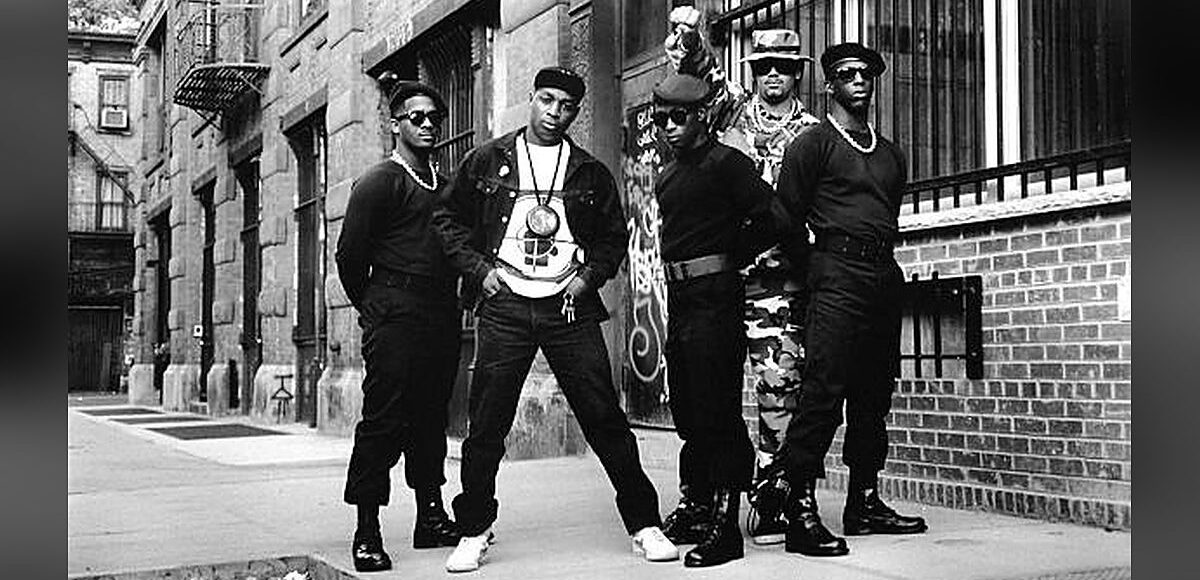
It Takes a Nation and the Bomb Squad sound
Public Enemy formed on Long Island, New York, in 1985, built around Chuck D (Carlton Ridenhour), a graphic arts student at Adelphi University who had been making music for the college radio station WBAU. Chuck D wrote rhymes that treated hip-hop as a medium for political argument rather than street narrative. Flavor Flav (William Drayton) provided the counterweight: comic, unpredictable, the clock on his chest against Chuck D’s steadier delivery. DJ Terminator X handled the turntables. Production came from the Bomb Squad: Hank Shocklee, his brother Keith, and Eric ‘Vietnam’ Sadler.
Yo! Bum Rush the Show (1987) announced the group’s arrival through Def Jam Recordings, but It Takes a Nation of Millions to Hold Us Back (1988) is the album that shows what Public Enemy did in the studio. The Bomb Squad constructed tracks from dozens of samples compressed together at high density, not the clear, identifiable loops that most hip-hop production used, but a sonic mass in which James Brown horn stabs, Funkadelic bass fragments, police sirens, and industrial noise were layered to the point of opacity. The rhythm tracks beneath this wall of sound were programmed with precision; the density was a deliberate choice, not chaos.
Chuck D’s delivery was central to the effect. His voice is full and controlled, and he used it like a broadcast instrument: declarative, specific, addressed to a large room. ‘Bring the Noise,’ ‘Don’t Believe the Hype,’ ‘Rebel Without a Pause,’ and ‘Black Steel in the Hour of Chaos’ demonstrate how a rapper can use meter and line length to control the pace of an argument. The content drew from Malcolm X’s speeches, the Black Panther Party’s political program, and media criticism: ‘Don’t Believe the Hype’ anatomized the machinery of public image-making before the phrase became common currency.
Fear of a Black Planet (1990) continued in the same direction and included ‘Fight the Power,’ which had appeared on Spike Lee’s Do the Right Thing soundtrack in 1989. Lee’s film, set in Brooklyn on the hottest day of summer, used the track as its aggressive counter-anthem, positioned against the classic rock and soul posters that the film’s antagonist revered. ‘911 Is a Joke’ gave Flavor Flav his most sustained vocal showcase while remaining the sharpest piece of social commentary the group ever attached to a single arrangement. The album title states the fear the songs describe: a political response to Black American assertion.
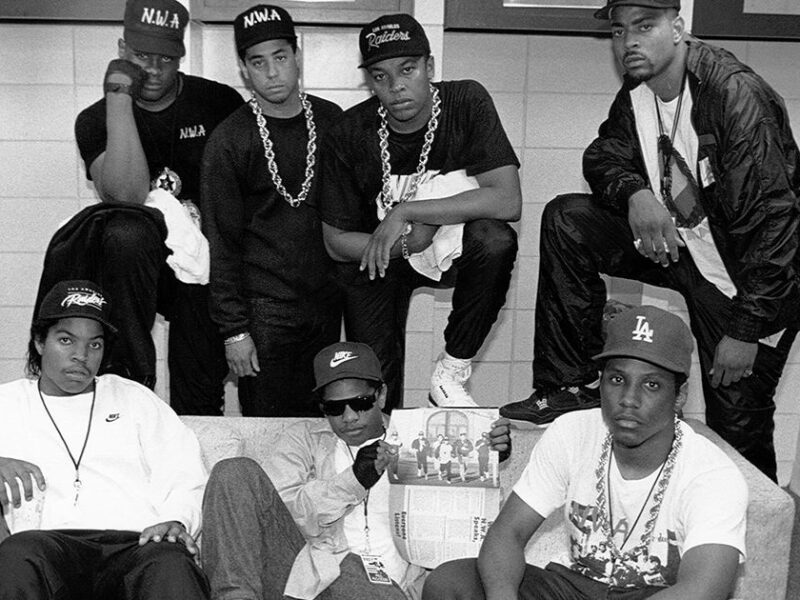
Against their hip-hop contemporaries, Public Enemy’s position was distinctive. Run-DMC had built credibility on street authenticity and rock crossover. LL Cool J was navigating between street appeal and radio pop. N.W.A., emerging from Compton in the same period, chose cinematic street realism over political argument. Public Enemy made ideology the subject and noise the method. A listener can disagree with the politics and still have to deal with the production, which is hard to ignore on its own.

The group continued through the 1990s with Apocalypse 91: The Enemy Strikes Black (1991) and later releases, though the commercial and critical intensity of the first three albums proved difficult to sustain. Internal disputes, Flavor Flav’s legal troubles, and the fragmentation of hip-hop into multiple commercial streams all played a role. Chuck D remained active as a writer, radio host, and commentator; the group toured consistently and released music without major label support.
The Bomb Squad’s production approach seemed extreme in 1988. Later producers still cite the dense samples as a working method, not as a one-off. The dense sampling methodology cleared space for producers like DJ Premier, Pete Rock, and later producers working in more abstract traditions. Questlove has cited It Takes a Nation repeatedly as a technical standard. The album appeared on multiple best-of-decade lists and has remained a fixture in assessments of the hip-hop canon.
Start with It Takes a Nation of Millions to Hold Us Back in full sequence: it is forty-five minutes, every track connected. Fear of a Black Planet follows. Apocalypse 91 is the most accessible of the major releases. For context, hearing It Takes a Nation alongside contemporaneous albums by N.W.A. and De La Soul makes the full range of hip-hop’s possibilities in that moment concrete. The political lines still name the same targets they named on the 1988 and 1990 albums, which is why those records still get played as documents and as dance records.

Harold | 8 October 2026
|
Put on a random Public Enemy deep cut after this. Paid off. Coffee got cold while I finished the article. Acceptable. More of this please.
Pierre | 9 October 2026
|
Public Enemy taught me to listen for the rhythm section first. That is all.
Léa | 10 October 2026
|
Short take: Public Enemy still sounds like a band, not a brand. Also the comments section on old forums was wild about this. Just saying.
Ivan | 11 October 2026
|
This made me pull three albums in a row. Productive evening. Sharing this in the group chat. Expect chaos.
Tom Riff | 11 October 2026
|
Saw Public Enemy once. Messy, loud, worth it. This piece nails the vibe. Coffee got cold while I finished the article. Acceptable. Ok bye.
Kofi | 12 October 2026
|
Underrated catalog honestly. People only quote the obvious singles. Also the comments section on old forums was wild about this. Ok bye.
Aria | 13 October 2026
|
I like when writers talk players, not just myths. Good job here. Replay button abused.
Marc G. | 13 October 2026
|
Underrated catalog honestly. People only quote the obvious singles.
Jacques | 14 October 2026
|
The lineup changes make more sense after reading this. I told my coworker and they shrugged. Their loss.
Chris | 16 October 2026
|
This made me pull three albums in a row. Productive evening.