




Sun Records to Folsom to the American recordings
Johnny Cash was born on February 26, 1932, in Kingsland, Arkansas, the fourth of seven children in a cotton-farming family. The New Deal moved them to Dyess, a government agricultural colony where each family received twenty acres and a house. He picked cotton from childhood. When he was twelve, his older brother Jack, the one the family counted on for the ministry, was killed in a table-saw accident. Cash kept returning to that loss in his songs and interviews across five decades.
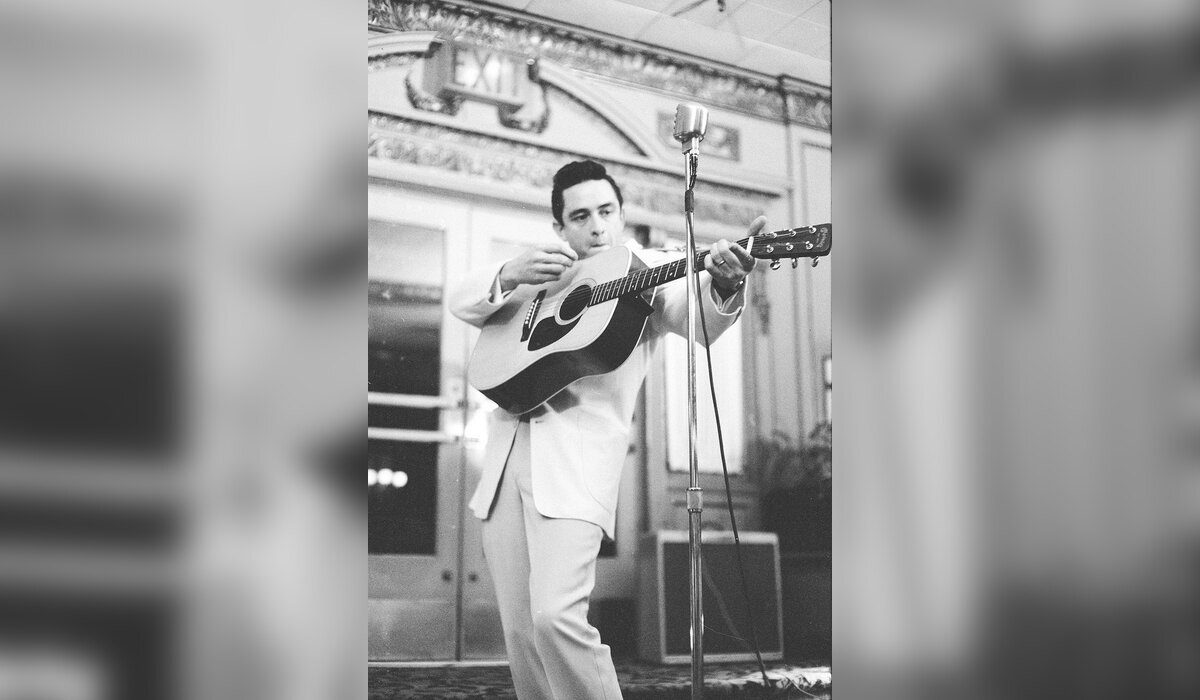
He enlisted in the Air Force in 1950, trained as a Morse code interceptor, and was stationed in Landsberg, Germany, where he bought his first guitar and formed a band. Discharged in 1954, he moved to Memphis, took a job selling appliances, and auditioned for Sam Phillips at Sun Records. The first Sun sessions produced “Hey Porter” and “Cry! Cry! Cry!” in 1955. Cash wrote the material himself, and the arrangement he and Sam Phillips settled on was the boom-chicka-boom: Cash’s rhythm guitar, Luther Perkins’s simple electric lead, and Marshall Grant’s standup bass. The arrangement is spare, nearly austere.
“I Walk the Line” (1956) became the Sun Records signature: Cash singing in multiple keys, moving between them by humming to reset his pitch, the commitment in his voice more than filling the space the stripped arrangement left. “Folsom Prison Blues,” “Get Rhythm,” “Big River” followed. By 1958 he had moved to Columbia Records, where he would stay for nearly three decades. The Columbia years produced more ambitious projects: concept records, gospel albums, a collaboration with June Carter that became romantic and then marital.
“Ring of Fire” (1963) was written by June Carter and Merle Kilgore; Cash arranged it with Mexican horns that June’s sisters thought were wrong for the song. He was right. It reached number one on the country charts and crossed over. The Man in Black persona crystallized around this period: he wore black not as affectation but as a statement about those the culture preferred to ignore, articulated directly in “Man in Black” (1971).
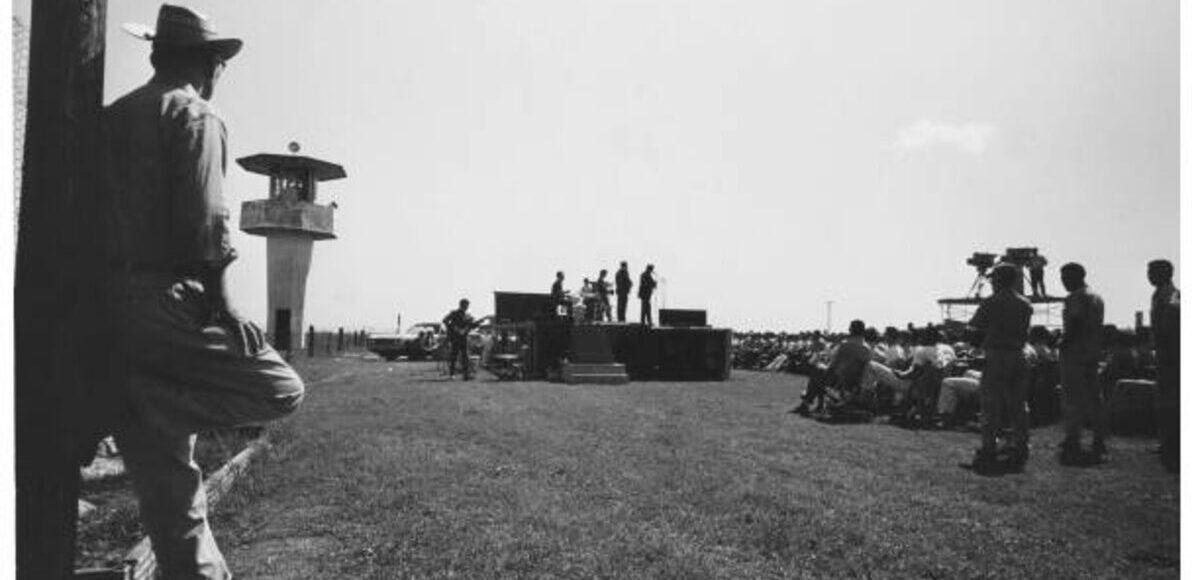
At Folsom Prison (1968) and At San Quentin (1969) were the defining live documents. The performances were not charity events or photo opportunities; Cash had actually been pushing to play prisons since the mid-1950s, and the recordings captured something that studio records could not: the specific quality of an audience that had every reason to respond to what he was singing. “Folsom Prison Blues” live in Folsom carries a weight that the original recording, excellent as it is, cannot match.
The 1970s and 80s were professionally difficult. Country radio was moving toward polished Nashville production; Cash’s rougher edge became commercially inconvenient. He recorded prolifically but the results were uneven, and his television variety show, which ran from 1969 to 1971, remained his widest platform after it ended. He joined the Highwaymen, a supergroup with Waylon Jennings, Willie Nelson, and Kris Kristofferson, which kept him visible through the mid-80s.
Rick Rubin approached him in 1993, and the result was American Recordings (1994): just Cash and an acoustic guitar, recorded partly in Rubin’s living room. The album returned to the method of the Sun sessions without the Sun context. Five more volumes followed, the last released posthumously. “Hurt,” a Nine Inch Nails song reframed around Cash’s age and physical decline, became the document of his final years: the music video, directed by Mark Romanek, stands with the strongest work he released across a lifetime of records.
Start with At Folsom Prison for the live performance that made everything permanent. American Recordings for the late record with the guitar stripped back. The Sun years are covered well on any compilation of the period. “I Walk the Line,” “Ring of Fire,” and “Hurt” trace the arc from the beginning to the end. His point of view on the records stayed consistent from the 1950s to the 2000s, with a single electric guitar or with a full band.
Priya | 11 October 2026
|
Solid portrait. Made me queue three songs I had forgotten. Sharing this in the group chat. Expect chaos. Good piece.
Olivier | 11 October 2026
|
Live, Country / Folk is another animal. Studio still matters though.
Sofi | 12 October 2026
|
The stage craft bit landed. You forget how much work that is. I told my coworker and they shrugged. Their loss.
Fatima | 12 October 2026
|
I came for the hits, stayed for the odd tracks. This profile gets both. Coffee got cold while I finished the article. Acceptable.
Harold | 13 October 2026
|
I needed this reminder to revisit the deep catalog. Anyway.
Inés | 14 October 2026
|
I came for the hits, stayed for the odd tracks. This profile gets both. Sharing this in the group chat. Expect chaos.
Ben | 15 October 2026
|
I came for the hits, stayed for the odd tracks. This profile gets both.
Chloé | 15 October 2026
|
Underrated writer too, not just a voice. Article shows it. Coffee got cold while I finished the article. Acceptable.
Jacques | 16 October 2026
|
Short: Country / Folk still sounds human when everyone else polishes too hard. More of this please.
Noah | 16 October 2026
|
The stage craft bit landed. You forget how much work that is.