

University College London, late 1990s: four students, a delay pedal, and Parachute
Chris Martin, Jonny Buckland, Guy Berryman, and Will Champion met at University College London in 1996 and formed a band they initially called Starfish, then renamed Coldplay in 1998. Martin wrote most of the songs and played piano and guitar at the center of the arrangements. Buckland developed a clean, delay-heavy guitar style that became a sonic identifier across the discography. Berryman and Champion built a rhythm section that stayed inside the songs rather than pushing outward. Phil Harvey, a childhood friend of Martin’s, co-managed the early years and is often described as a fifth member.
Parachute (2000), their debut on Parlophone, established the template: piano-driven melodies, Martin’s high tenor, guitars favoring atmospheric shimmer over distortion, and lyrics addressing loss, longing, and hope in terms direct enough to travel across cultural contexts. “Yellow,” the first significant single, built four minutes on a single chord movement and treated an ordinary color as a container for romantic intensity without explaining the connection. It was radio-ready and slightly odd, which was the combination the album needed.
A Rush of Blood to the Head (2002) deepened the sound. “The Scientist” and “Clocks” entered the catalog, with “Clocks” demonstrating how a piano arpeggio placed correctly in a mix could become a sound audiences identify before the vocal enters. X&Y (2005) was the logical commercial endpoint of that arc: stadium-ready anthems, compressed production, “Fix You” as the emotional centerpiece. It sold extremely well and prompted a critical debate about whether the band’s instincts had outpaced their ambition.
Viva la Vida or Death and All His Friends (2008), produced by Brian Eno and Markus Dravs, recalibrated the project. The production opened: more space, less compression, orchestral elements that owed more to Eno’s ambient work than to arena rock convention. “Viva la Vida” built a number-one single out of cello lines, a military drum pattern, and lyrics loosely drawn from imagery associated with Frida Kahlo. Mylo Xyloto (2011) followed toward synth-pop and collaboration, with “Paradise” and “Every Teardrop Is a Waterfall” confirming the appetite for broader, more colorful arrangements.
The later albums — Ghost Stories (2014), A Head Full of Dreams (2015), Everyday Life (2019), Music of the Spheres (2021) — continued the expansion while maintaining a recognizable core. Collaborations with Beyoncé, BTS, and others reflected a deliberate effort to reach beyond rock demographics. Everyday Life attempted a more varied approach across a double album. Music of the Spheres returned to the big-sound template with electronic production aimed at contemporary pop territory, with mixed critical results and strong commercial ones.
Influences were stated early. Radiohead defined the ceiling of ambition for this generation of British guitar pop, and the comparison was uncomfortable until Coldplay moved far enough in their own direction to make it irrelevant. U2 provided the stadium-scale emotional template, the sustained guitar tones, and the model of a band as a vehicle for large feelings rather than literary argument. Jeff Buckley, R.E.M., and Travis filled the spaces between those two reference points.
Against Radiohead, the structural comparison is clear: Coldplay kept the emotional directness and the guitar shimmer while abandoning the irony and formal experimentation. Against U2, the political dimension is largely absent and the personal register more dominant. Against Keane and Snow Patrol, who shared adjacent chart space in the mid-2000s, Coldplay had a stronger guitarist in Buckland and a more varied production history. Against Travis, Coldplay scaled to larger arenas earlier and maintained that scale through a longer discography.
Sonically, Buckland’s guitar is the most specific identifier: delay-based, clean-toned, melodic rather than rhythmic, frequently playing a counter-melody to the piano or vocal line. Martin’s piano tends toward simple, recognizable chord shapes delivered at mid-tempo. The rhythm section is supportive rather than driving. Production has shifted substantially across the discography — from the spare debut through the Eno-influenced records to the synth-heavy later work — but the voice and guitar remain constant.
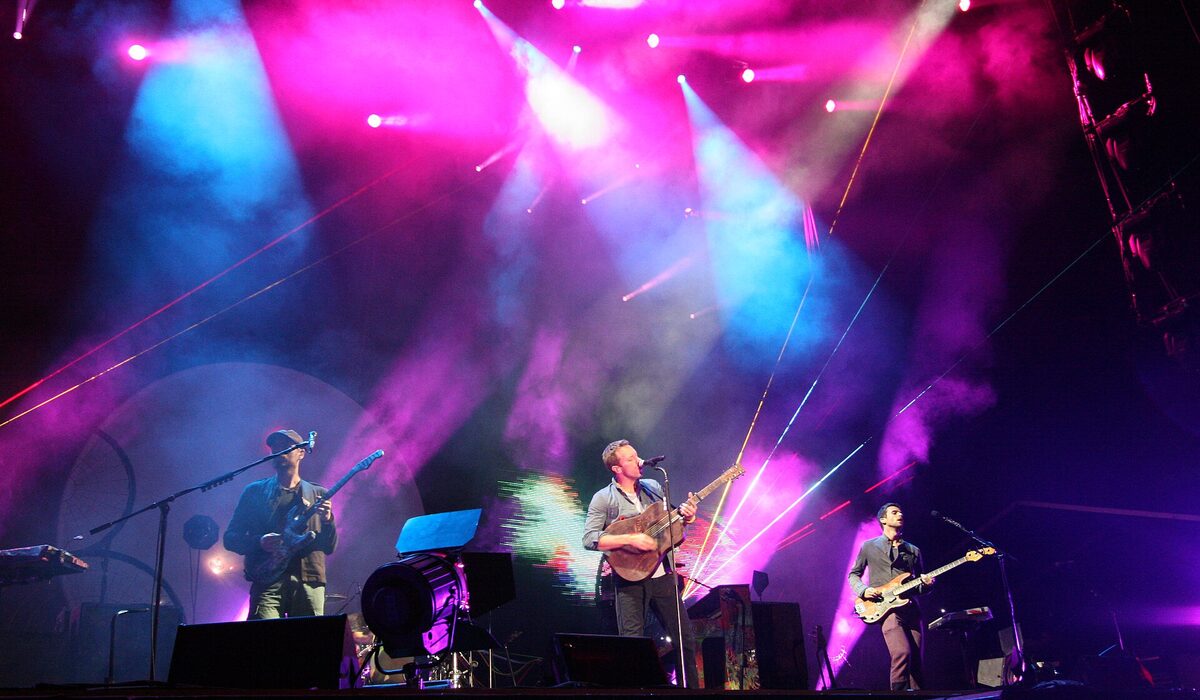
Entry points depend on what draws you. Parachute for the spare early version. A Rush of Blood to the Head for the period when ambition and craft were most closely matched. Viva la Vida for the Eno-produced recalibration. “Yellow,” “The Scientist,” “Clocks,” “Fix You,” and “Viva la Vida” cover the radio history. The live records document a band that has spent twenty-five years learning to fill very large rooms, which is not a trivial skill.