
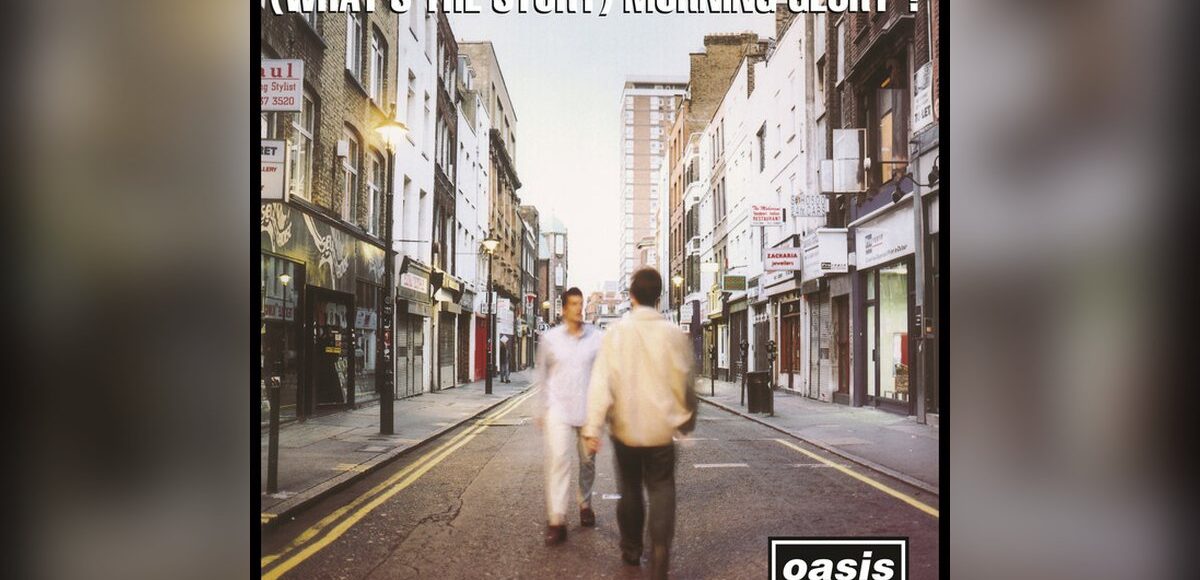
Creation, Rockfield in fifteen days
In October 1995 Creation released (What’s The Story) Morning Glory?, cut mainly at Rockfield Studios in Wales with Owen Morris and Noel Gallagher producing. Basic tracking ran about fifteen days in May–June 1995, roughly a song a day in the Quadrangle room after a booked six-week window. Alan White had just replaced Tony McCarroll on drums; McCarroll still appears on Some Might Say, tracked earlier at Loco Studios. Mixing later moved to Orinoco in South London on a Neve desk.
The writing leans on ballads and huge choruses rather than the raw rush of Definitely Maybe. Wonderwall and Don’t Look Back in Anger use Kurzweil string patches instead of a full orchestra. Paul Weller adds guitar and backing vocals on Champagne Supernova. Cast No Shadow was finished on a train ride back to the studio. Liam tracked many lead vocals in single takes through a Neumann U67 while the four-piece rhythm section played live; Mellotron, EBow, and extra guitars landed in afternoon overdubs.
A fistfight between Liam and Noel on the Rockfield lawn stopped the first week cold; the band paid damages, came back, and finished the album. The Berwick Street sleeve by Brian Cannon and Michael Spencer Jones became as recognisable as the singles. By August 1995 the “Battle of Britpop” chart fight with Blur had already pushed Oasis into national headlines. Within a year the band would play two nights at Knebworth to roughly a quarter of a million people.
We were making an album, not a lifestyle statement. One song a day, finish it, move on.
(Owen Morris on the Rockfield pace, 1990s interviews)
UK charts put the record at number one; Some Might Say, Roll with It, Wonderwall, Don’t Look Back in Anger, and Champagne Supernova carried it into the US as well. BPI certifications stacked into the high teens of Platinum discs, making it one of the best-selling British albums of the 1990s. Radio playlists treated Wonderwall as a permanent fixture for decades after release.
The lasting takeaway is practical: a second album written fast, recorded live-ish, and mixed hard still defines how Britpop sounded on daytime radio. When later Oasis records chased scale and overdubs, this one remains the template for chorus, image, and chart muscle in one package. It is still the record most casual listeners mean when they say they own an Oasis album.