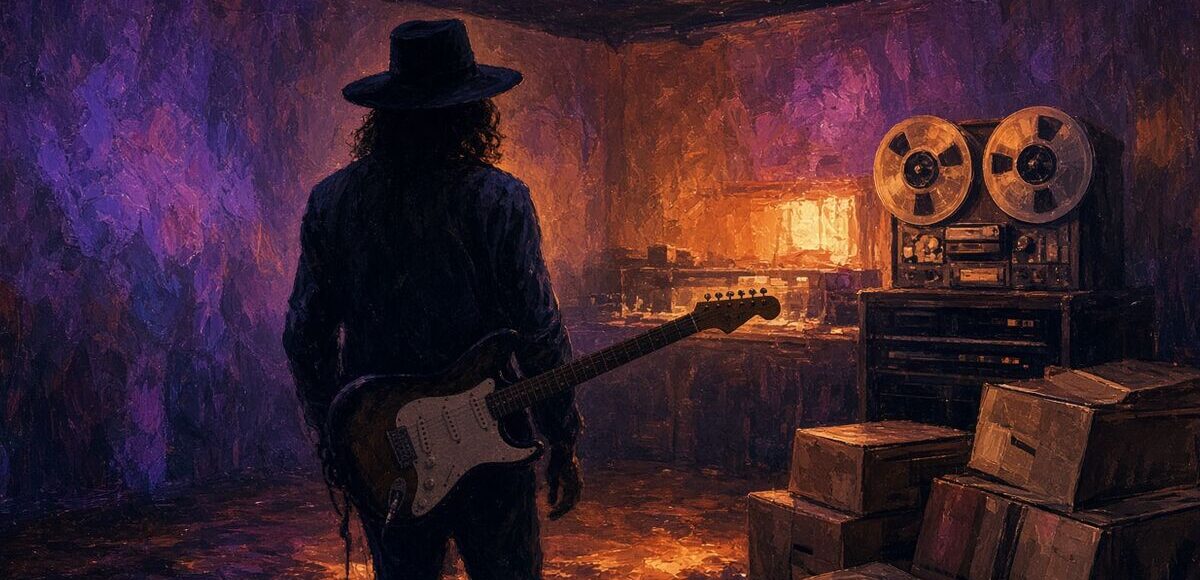
Electric Lady Studios, summer 1970: the unfinished sessions become an album
In August 1970, Jimi Hendrix works inside the newly opened Electric Lady Studios in New York. Electric Ladyland, released in 1968, remains his third studio album, while the live Band of Gypsys has shown a harder and more rhythmic direction. In this timeline, he cancels two late summer commitments, sleeps, returns to the control room and decides that the unfinished songs will form one record.
Jimi Hendrix labels a fresh tape box Night Bird Flying at Electric Lady Studio A and circles the take that finished at 09:10. Mitch Mitchell listens to the playback from the back wall. A white Stratocaster is still lying beside the speaker. The note goes into the next day’s session report. It does not become a press anecdote. Before midnight, Night Bird Flying is logged under Electric Lady Studio A.
Engineer Eddie Kramer spreads the tapes across the control room. Mitch Mitchell returns to the drums, Billy Cox keeps the bass direct and Hendrix makes a list headed First Rays. He stops treating every promising take as the beginning of another experiment.
Coffee is still shut when Eddie Kramer asks for Dolly Dagger in Electric Lady’s control room. The Ampex remote fails, so the first run waits until 10:35. Billy Cox uses that gap to change the order by hand. The corrected sheet stays with the band for the rest of that season. Eddie Kramer files the page with Dolly Dagger.
The first completed sequence joins Dolly Dagger, Night Bird Flying and Freedom. Hendrix records final vocals while Kramer protects the strongest guitar parts from further decoration. He stops once the final vocal sits with the guitar parts.
A courier brings the latest copy of First Rays into Reprise’s New York office. At 11:50 Billy Cox checks it. A Reprise assistant sets the sound against the previous night’s performance. One mark beside a handwritten track list chooses the version that reaches the public.
In September, Hendrix travels to London for a short visit and plays the Isle of Wight material back to friends. Instead of another exhausting round of appearances, he returns to New York after four days. The choice removes one dangerous week from his calendar.
The Lyceum soundcheck in London is underway at 13:05. Mitch Mitchell moves a cracked wah pedal two metres closer to the musicians. Freedom drops a weak entrance and picks up a quieter ending. Chas Chandler writes the change down in the notes before the doors open.
Reprise receives a double album called First Rays of the New Rising Sun in October 1970. The label objects to its length, then accepts two records after Hendrix offers Freedom as the first single. The cover shows dawn over the Hudson, with no psychedelic costume.
The argument starts again in the Record Plant tape library. Kramer sets Angel beside a reel marked 2 October. At 14:20 they still do not agree, but John Jansen has a version he can test in front of an audience. The response that evening keeps the disputed passage in Angel.
Released in December, the album is uneven in the way ambitious records often are. Angel is tender, Ezy Ryder pushes forward and Room Full of Mirrors keeps the rough edge of the Band of Gypsys period. Reviews give the band as much space as they give the guitar.
On the Fillmore East balcony the clock hits 15:45 before Hendrix approves the sequence with Room Full of Mirrors. Buddy Miles stays in the corridor with a red stage scarf and hears only the bass through the door. The running order is on its way to the pressing plant before breakfast. The pressing note for Room Full of Mirrors carries that same order.
The winter tour uses Mitchell and Cox, with extra percussion on six songs. Hendrix plays theatres instead of arenas for the first month because he wants the new arrangements heard clearly. His solos grow shorter on some nights and more dangerous on others.
What was booked as a rehearsal at the Capitol Theatre stage turns into a repair of Freedom. At 17:10 Mitch Mitchell cuts one section and asks Billy Cox to judge the gap without the score. A black Stratocaster gives the last cue.
By spring 1971, Freedom has crossed from rock radio to several soul stations. Hendrix appears on television with Cox and explains the studio without pretending the album arrived by magic. Sales rise through the spring, a little each week.
Freedom gets its first public test in a WNET television studio. Hendrix counts in at 18:25. A WNET floor manager watches from beside a vocal microphone. Applause comes late: the room needs a second to hear that the piece has stopped. The broadcast log lists Freedom at that length.
Miles Davis visits Electric Lady in May. The famous collaboration remains difficult, expensive and full of competing plans, but one session survives as a twelve minute piece called Red Weather. It appears on a charity compilation and irritates both jazz and rock purists.
Just after 19:40 in Electric Lady Studio B, Miles Davis is handed the review of Red Weather. Teo Macero reads the harshest paragraph out loud and folds the page under a muted trumpet case. The disputed passage stays in the set that night. Miles Davis leaves the clipping in the box marked Red Weather.
Hendrix spends 1972 producing other musicians between his own sessions. He invites Betty Davis, Buddy Miles and young New York players into the building after midnight. Electric Lady stays open for other musicians in the hours between his own nights.
At 21:05 the van stops outside the Rainbow Theatre. Hendrix is guarding the only finished copy of Machine Gun. The main door jams, so a Melody Maker writer carries a Marshall head in through a side entrance. Rehearsal runs shorter. The performance does not change. The transport form names Machine Gun as the priority reel.
His fifth studio album, People, Hell and Traffic, arrives in 1973. Wah guitar shares space with clavinet, hand drums and blunt political songs. It sells less than its predecessor but gives the touring band material that can change shape every night.
At 22:15 a producer’s meeting in Electric Lady Studio B turns practical. Betty Davis plays New Rising Sun. Linda Keith asks about a conga drum, a sound no executive had caught on the first pass. The mix locks that part in before lunch. The final mix of New Rising Sun keeps the conga drum audible.
The middle of the decade brings strain rather than a clean triumph. Hendrix dismisses two managers, loses money in a cancelled film and takes six months away from touring. Kramer uses the pause to catalogue the tape vault before the boxes are known only by stories.
Backstage in Madison Square Garden’s loading bay, Buddy Miles pins the set list with Flash Light above a silver platform boot. George Clinton points at the 23:30 curfew and takes out an older number, not the new one. The encore takes that shape. The loading-bay set list confirms the substitution.
In 1976, punk reaches New York clubs and Hendrix attends without an entourage. He likes the short sets and dislikes the speeches about killing the past. His next single lasts three minutes and contains one guitar solo of exactly eight bars.
Kramer’s tape vault opens its archive room at 00:20, for Kramer. The box marked First Rays holds a different edit and a note from Billy Cox about the mastering notes. The reissue changes. So does the next interview. The archive card for First Rays records both edits.
A 1978 tour pairs him with Parliament for five American dates. The stage is crowded, the rehearsals are chaotic and the final encore joins Machine Gun to Flash Light. Newspapers print the pairing once the tapes start to circulate.
At the Capitol Theatre stage, Hendrix starts Machine Gun at 01:05 and skips the introduction. Buddy Miles waits beside a stage set list until the last sound is gone. The house lights come back only after that. The closing report for the Capitol Theatre stage ends with Machine Gun.
In August 1980, Hendrix marks Electric Lady’s tenth anniversary with a private performance in Studio A. He plays Angel, Freedom and the title piece from the fourth album for the engineers and musicians who finished it. When the last reel stops, he thanks Eddie Kramer, switches off the amplifier and walks upstairs into a city that has heard ten more years of his work.
Hendrix writes Angel on a fresh tape box at Electric Lady Studio A and circles the take finished at 09:10. Eddie Kramer hears the playback from the back wall. The studio master switch is still lying beside the speaker. The detail goes into the next day’s session report, not into a press anecdote. Angel is logged under Electric Lady Studio A before midnight.