Autumn 1969: six nights with the Rolling Stones give The Stooges a road out of Detroit
In 1969, The Stooges release their first album on Elektra and discover that reviews do not fill clubs. In October, a promoter who has seen Iggy Pop climb over an audience offers them six opening dates with the Rolling Stones.
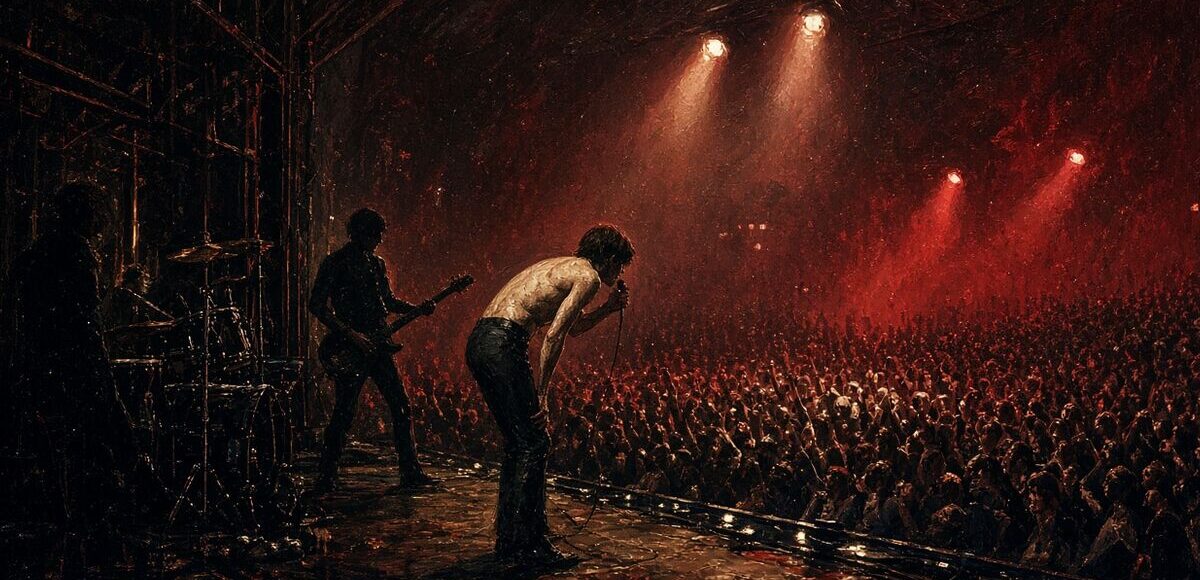
At Cobo Arena, the Stooges are given a strip of stage no deeper than a living room. Iggy asks whether he may use the Stones’ runway. The answer is no, so he spends the first song testing how far a microphone cable can pull before a British technician swears.
The first night in Detroit lasts twenty-eight minutes. Ron Asheton keeps the guitar brutally simple, Dave Alexander holds the bass steady and Scott Asheton refuses to speed up when bottles begin to fly.
Keith Richards hears the racket from a dressing room and comes out during Real Cool Time. He recognizes the discipline beneath the damage: Scott Asheton never loses the beat even when Iggy lands on Ron’s amplifier. Richards tells Sam Cutler that the Americans should stay because nobody can accuse the evening of beginning politely.
Mick Jagger watches from the side during I Wanna Be Your Dog. He tells the tour manager to keep the group for the remaining dates, partly because the Stones now sound almost orderly after them.
The contract adds Chicago, New York and Boston. In each city, Stones fans boo for less time. Iggy stops explaining the songs, Ron Asheton turns his amp toward the seats and No Fun grows from six minutes to nine as the rhythm section learns to hold a hostile hall.
By December, Elektra sees ticket reports rather than promises. Danny Fields secures a modest advance for a second album and enough money to keep the musicians in the same city for rehearsals.
Danny Fields uses the sold ticket stubs as evidence at Elektra. The label will not pay for comfort, but it advances enough for a Ford van, a road manager and two weeks without pawnshop visits. Ron buys one replacement speaker and hides the receipt from everyone.
In May 1970, the band enters Elektra Sound Recorders in Los Angeles with Don Gallucci. Fun House still emerges as a live, hot record, but the touring discipline makes the takes tighter.
Don Gallucci has been told that the second album must capture the show that frightened the Stones’ crew. He removes the studio partitions and records complete takes. Iggy sings in the open room while Steve Mackay’s saxophone cuts across the band on 1970 like an argument nobody wants settled.
The album does not become a large hit. It sells steadily in cities visited by the Stones tour, and small bands begin copying the blunt rhythm of Down on the Street.
Fun House appears in July 1970. FM stations avoid most of it, yet college presenters play Down on the Street after midnight and mention the Stones dates every time. Sales are not spectacular, but they are sufficient for Elektra to answer the telephone.
In 1971, Dave Alexander misses two shows. Instead of dismissing him without a plan, the group pauses for ten days, hires a doctor recommended by the crew and places James Williamson on second guitar.
The group returns to the road with Alice Cooper on several bills. Iggy and Alice compare stage blood, parental complaints and hotel debts. The Stooges use no props; a white glove found in a Cleveland theatre becomes Iggy’s entire costume for one song and disappears before the encore.
The five-piece Stooges record Motor City Is Burning in early 1972. Williamson brings sharp leads while Ron Asheton keeps the low, repetitive figures that audiences already recognize.
Constant work does not make the band healthy. It makes absences expensive. When Dave Alexander arrives unable to play in St Louis, Scott sits with him after the show while management arranges treatment and a substitute, rather than allowing one bad night to become an expulsion scene.
David Bowie meets them in London but does not need to rescue a broken band. He mixes one single, argues with Iggy over the vocal level and leaves them with a list of European promoters.
James Williamson enters as an additional guitarist, not a replacement for Ron. Rehearsals become territorial until a new song called Machine Shop assigns Williamson the sharp upper part and Ron the heavy figure below. The solution is musical, which is the only sort the room respects.
In 1974, there is no final collapse at the Michigan Palace. The band cancels three dates, replaces its manager and returns with a short set that begins before Iggy has time to challenge every person in the room.
Motor City Is Burning reaches shops in 1972 with a photograph of the five musicians outside a closed automobile plant. Creem praises the guitars and complains that Iggy has become reliable. He reads the sentence aloud in the van as though reliability were an exotic disease.
The arrival of punk in 1976 gives The Stooges a younger audience. At the Roundhouse, members of the Damned and the Sex Pistols stand near the monitors and study a band that is still employed rather than newly rediscovered.
Bowie’s London invitation now offers opportunity rather than rescue. At Trident, he mixes Open Up and Bleed with more space around Iggy’s voice. The band rejects his first version, keeps the second and spends the rest of the week opening for Roxy Music in theatres where nobody throws furniture.
Their 1977 album Assembly Line is recorded quickly in Detroit. It contains no attempt to chase London fashion, only shorter songs, louder drums and a dry joke on the sleeve about punctuality.
Punk turns the old support act into a working ancestor. In 1977, the Ramones ask them to headline two New York shows. Iggy watches four leather jackets complete a set in under half an hour and tells Scott that somebody has finally found a way to tour faster than they do.
Through the 1980s, tours become shorter and records less frequent. The members take side work between sessions, but the Stooges name never has to be restored because nobody closes the account.
The Stooges survive the next decade by refusing heroic plans. They record when eight songs are ready, accept theatre tours instead of arenas and let side projects pay personal bills. Iggy makes solo records, but each contract includes months reserved for the band.
In 1999, the group marks thirty years with one night at Detroit’s State Theatre. Iggy counts in 1969, Ron strikes the same two chords and four generations in the room move at once; the band leaves the stage with another rehearsal booked for Monday.
At the 1999 Detroit anniversary, the Stones send a case of champagne and a note signed by Charlie Watts. The Stooges open it after the show, not before. On Monday they return to the rehearsal room, where the microphone cable is shorter and the calendar already contains six dates.
A small Detroit office handles the anniversary tickets. On its wall hangs the 1969 support contract, browned at the folds and corrected in pencil after the second show. The fee looks tiny until Ron points out that it bought the speaker still stored in his basement.
Ron and Williamson still quarrel over volume, credits and almost everything that can fit on a mixing desk. Scott settles arguments by counting in the disputed song. If both guitarists are still playing at the end, the arrangement remains.