Post-Nirvana demos, The Colour and the Shape, stadium Foos
In October 1994, Dave Grohl booked studio time in Seattle and laid down songs he had been demoing on a four-track after Kurt Cobain’s death ended Nirvana. He played nearly every instrument himself, credited the project to Foo Fighters after a World War II term for unidentified aircraft, and released the self-titled debut in 1995 on Roswell and Capitol. The grief was real, but the record moved toward motion: “This Is a Call,” “Big Me,” and “I’ll Stick Around” turned private confusion into guitar pop loud enough for FM radio.
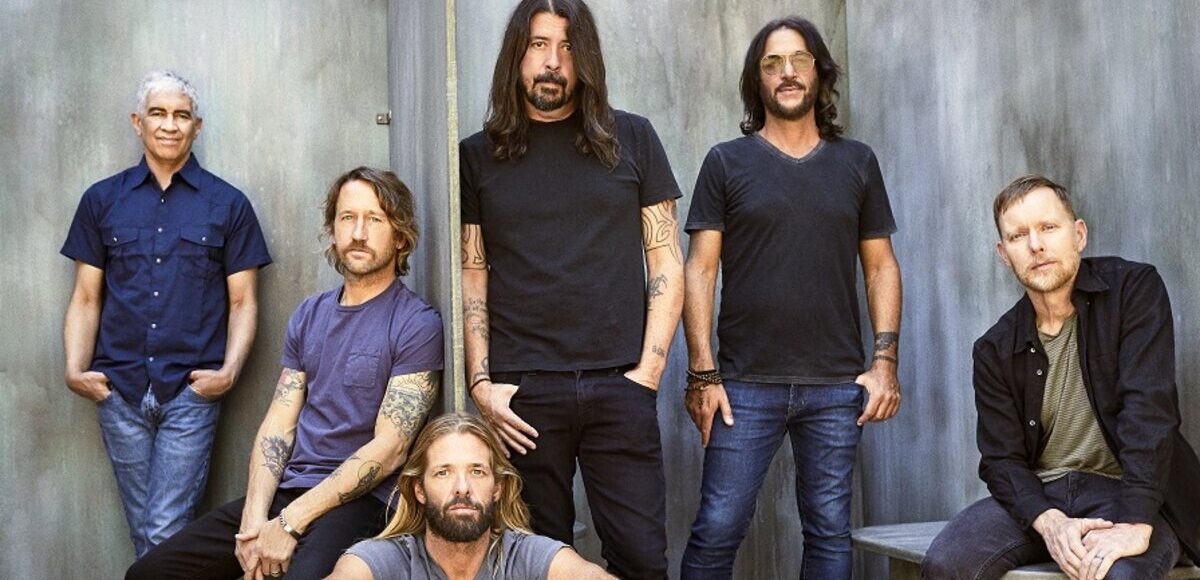
Grohl had already been the drummer in Nirvana, the band that made quiet-loud a language. As a frontman he brought the same attack on hooks rather than sludge. Early Foo Fighters toured as a quartet with Nate Mendel on bass, Pat Smear on second guitar, and William Goldsmith on drums until lineup shifts settled on Grohl, Mendel, Chris Shiflett, and later Taylor Hawkins. The sound stayed guitar-forward, mid-tempo to fast, with Grohl’s voice straining upward on choruses.
The Colour and the Shape (1997) was the pivot. Producer Gil Norton pushed arrangements toward arena scale without losing the band identity. “Everlong” became the song everyone knows: a dynamic build, a riff that opens space, a lyric about connection that reads personal and universal at once. “My Hero” and “Monkey Wrench” added muscle; “February Stars” showed they could slow down without going soft. The album sold millions and set the template for every Foo record after: strong singles, deep album tracks, Grohl as cheerleader-in-chief on stage.
Through the 2000s and 2010s the catalogue widened. There Is Nothing Left to Lose (1999) won a Grammy and gave them “Learn to Fly” and “Stacked Actors.” One by One (2002) and In Your Honor (2005) split electric and acoustic discs, the latter a deliberate stretch. Wasting Light (2011) went analog in Grohl’s garage with Butch Vig back behind the desk, proving they could still sound hungry. Concrete and Gold (2017) and Medicine at Midnight (2021) kept radio visits while Hawkins’s drumming remained the pulse until his death in 2022.
Influences are visible without a bibliography. Grohl grew up on punk and hard rock, then absorbed the melody lessons of Cheap Trick and the Beatles through Nirvana’s filter. The Foos rarely hide their love of big rock gestures: stacked guitars, tom-heavy drums, harmonies on the chorus. They are not grunge cosplayers; they are a post-grunge band that chose uplift as often as abrasion.
Sonically, expect distorted rhythm guitars doubled for width, Hawkins’s (or later drummers’) busy but song-serving fills, Mendel’s steady bass, and Grohl’s voice moving from conversational verse to full-throat shout. Ballads like “Everlong” or “Times Like These” still keep drums active; they do not drift into power-ballad syrup. Live, volume is part of the contract, but Grohl’s between-song talk and crowd cues make the room feel communal rather than distant.
Start with The Colour and the Shape for the core statement. The debut if you want the solo-Grohl origin story. Wasting Light for a modern, raw cut. Singles worth a focused listen: “Everlong,” “The Pretender,” “All My Life,” “Best of You,” and “Times Like These.” Each shows a different gear in the same engine.
Next to Nirvana, Foo Fighters are brighter, more explicitly melodic, and less interested in psychic static. Next to Pearl Jam, they change lineups and producers more often and chase hooks harder. Next to Grohl’s side projects (Them Crooked Vultures, Probot, Sound City), the Foos stay the reliable home base for stadium rock with a punk pulse.
Critics sometimes call the formula predictable; fans hear consistency as a feature. Grohl’s public persona, funny and earnest, matches the music: serious about craft, open about emotion, rarely cryptic. Documentaries such as Back and Forth and Sonic Highways reveal a bandleader who treats career as conversation with other musicians, not a sealed myth.
The Foo Fighters matter because they kept rock choruses alive in an era that often preferred beats or irony. They turned post-tragedy energy into a long-running band instead of a one-album footnote. Put on “Everlong” at full volume and the refusal to stay sad makes sense: noise as forward motion, not as a wall.