
A silhouette cut against the bass
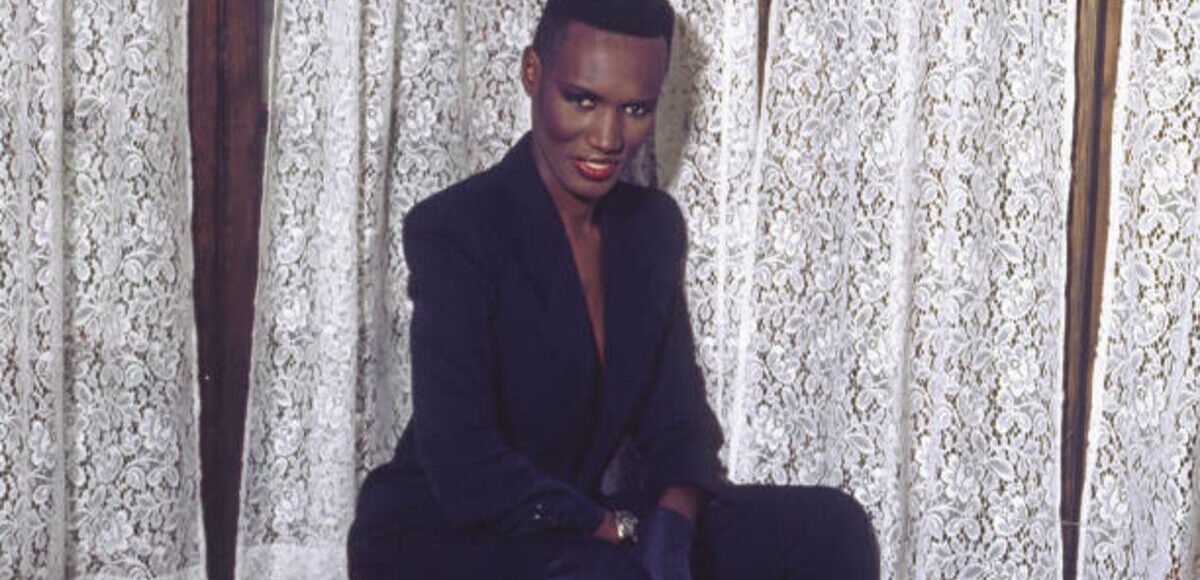
Grace Jones does not enter a song. She occupies it, the way a statue occupies a plaza and changes how you cross. Born Grace Beverly Jones in Spanish Town, Jamaica, on 19 May 1948, she grew up between the island, Syracuse in New York, and then the modelling rooms of Paris, where photographers learned that her face was already a composition. The early Island albums, Portfolio, Fame, Muse, are disco with a camp edge, show tunes and covers delivered as if the dance floor were a runway. They are not the records that fixed her. They are the proof she could hold a room before the room had the right bass.
The right bass arrived at Compass Point in Nassau. Warm Leatherette in 1980, produced with Alex Sadkin and the rhythm section of Sly Dunbar and Robbie Shakespeare, takes songs by the Normal, Roxy Music, Tom Petty, and files the sentiment off them. Her voice sits flat on purpose, a spoken blade over a reggae-disco hybrid that does not hurry. Nightclubbing in 1981 is the monument: Pull Up to the Bumper, Walking in the Rain, Demolition Man, the title track borrowed from Iggy Pop and slowed until the nightclub feels like a harbour. The cover, her own image cut into angles, is Jean-Paul Goude’s work and also hers. She was not a muse standing still for someone else’s idea. She was co-author of the silhouette.
Living My Life in 1982 keeps the Compass Point engine and adds My Jamaican Guy, a reminder that the accent in the music was not a studio trick. Then the centre of gravity moved. Slave to the Rhythm in 1985, with Trevor Horn, is one song worried into an album, biography spoken over a machine that will not let the phrase end. Inside Story in 1986 and Bulletproof Heart in 1989 push further into pop and do not always hold the marble chill of the Compass Point years. The films, Conan the Destroyer, a Bond villain’s ally in A View to a Kill, extended the stare to audiences who had not bought the records. The stare was the same instrument.
She went quiet, which in her case meant the image kept circulating while the new songs did not. Hurricane in 2008, trailed for years, came back to the island and to a slower storm, with Williams’ Blood naming the family line. On stage she has worn the headpiece, the hula hoop of lights, the suits cut like armour. None of it reads as nostalgia when the bass is right, because the performance was never about warmth. It was about precision: a body held like a photograph, a voice that refuses the melisma other singers use to prove they feel something.
Before Compass Point she had already turned a French standard into a weapon. La Vie en Rose, on Portfolio in 1977, is Piaf slowed and stared down, a disco arrangement that refuses to be grateful to the original. Studio 54 knew the silhouette. The records that followed made the silhouette rhythmic. Island Life in 1985 gathered the argument onto one cover, Goude’s composite of her body held in an impossible arabesque, an image that circulated farther than any single. She has performed inside that image for decades, at the Paradise Garage as much as in arenas, and the point was never to humanise the statue. The point was to let the bass prove the statue could dance without breaking the line of the jaw.
What later electronic and new-wave singers took from her is the right to be sculptural. Put on Nightclubbing or Pull Up to the Bumper and the groove is a plinth. She stands on it. The song does not ask her to kneel, smile, or explain. The stare does the rest of the work, and the bass keeps time like marble keeps a shape.