

Toys in the Attic riff, Rubin’s second life
Joe Perry’s opening riff on Walk This Way does not tiptoe in. It struts. Released in 1975 on Aerosmith’s Toys in the Attic (Columbia), the track was never meant to be the only calling card of that album. Sweet Emotion was the expected radio weapon. Walk This Way had something dirtier: a funk-leaning hard-rock groove, Steven Tyler’s rapid-fire verses, and a chorus built for shout-along rooms. Boston basements and arena PA systems both claimed it within a year of release.
Aerosmith’s gift was making street dirt sparkle just enough for rock radio without sanding off the sleaze. Perry and Brad Whitford lock the guitars into a strutting figure. Tom Hamilton’s bass stays in the pocket under the riff. Joey Kramer’s drums leave space for the guitar to breathe between hits. Tyler’s vocal sells swagger and punchlines in the same breath, half playground boast and half bar-band command. Billboard flagged the catchy riff and energetic delivery when the single was working US charts in the mid-70s.
Aerosmith’s ‘Walk This Way’ is a hard-rocking, funky single that shows the band’s knack for catchy riffs and energetic delivery.
(Billboard Magazine, 1975)
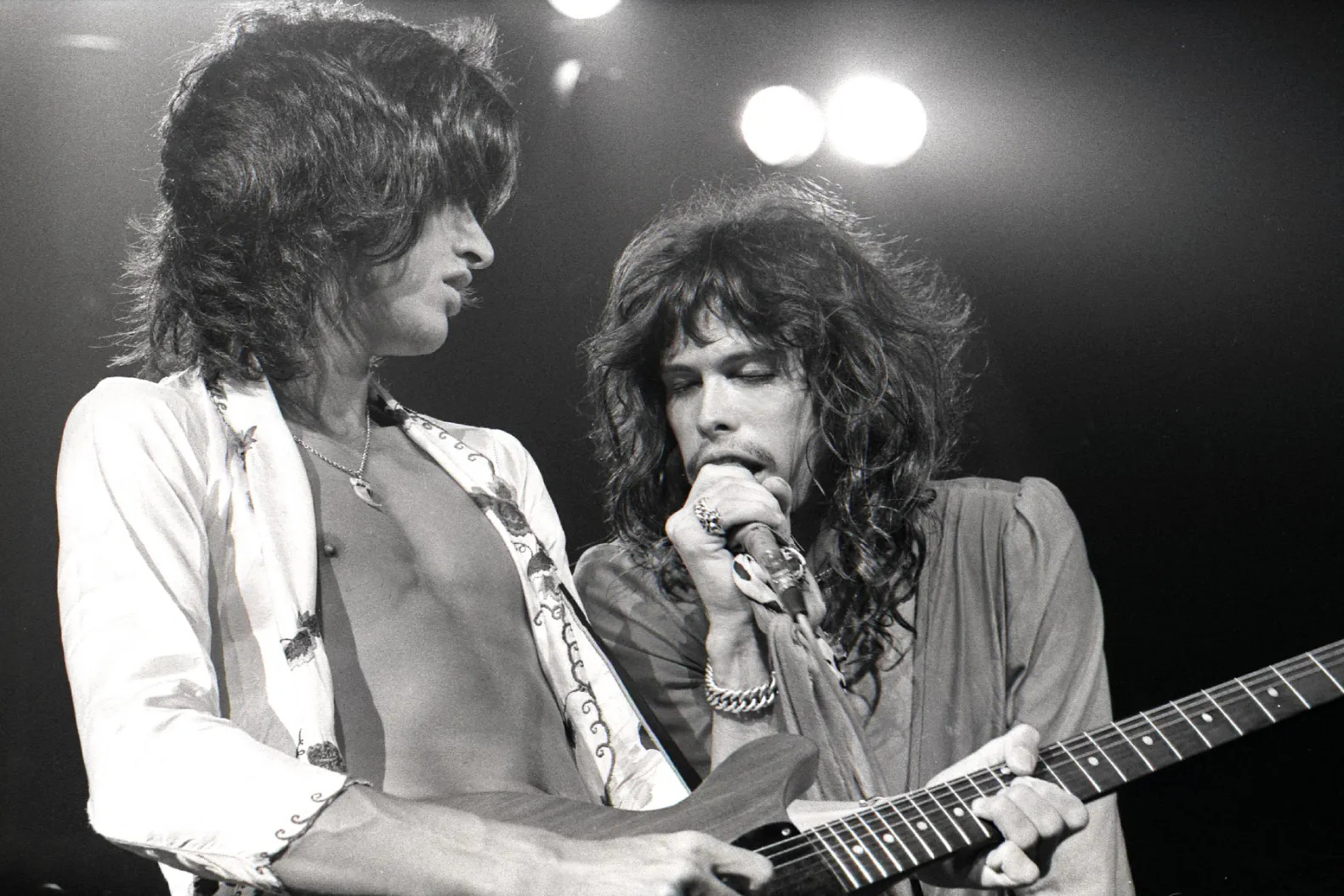
Then came 1986. Aerosmith were nearly spent: drugs, egos, and calendar miles had chewed the band down to a fragile reunion. Run-D.M.C. and producer Rick Rubin rebuilt Walk This Way as a rap-rock crossover, with Perry and Tyler appearing in the Spike Jonze-adjacent MTV era video language of the day. The remake put both acts back on heavy rotation and proved a 1975 hard-rock single could restart careers a decade later without rewriting Perry’s riff or Tyler’s cadence.
Even before that reboot, the original belonged in the hard-rock canon as a lightning strike of sleaze, funk, and hooks aimed at FM. After Run-D.M.C., it also became a case study in how one song can have two commercial lives. The Boston original and the Hollis collaboration still trade airtime and playlist slots; neither cancels the other. For Aerosmith it remains proof that their best ideas were rhythm-section deep, not only blues-pastiche solos.
Play the 1975 cut next to the 1986 cut and you hear the same skeleton in different clothes: one in leather, one in Adidas. That durability is why Walk This Way still shows up in documentaries about both classic rock and hip-hop’s pop breakthrough.