From the cancelled sessions of 1969 to the last acoustic records
In February 1969, Miles Davis walks into Columbia Studio B and stops before anyone plays a note. Electric pianos, amplifiers and cables have been arranged for a session that is supposed to open a new chapter. Miles studies the room, asks Teo Macero to send the extra equipment away and says that the trumpet will not compete with a power socket. The musicians laugh at first. He does not.
The real Miles had already been moving toward amplified sound on Miles in the Sky and Filles de Kilimanjaro. In this version, a failing monitor during the first morning confirms every suspicion he has. The noise swallows Wayne Shorter’s soprano saxophone and turns Dave Holland’s bass into a blur. Miles cancels the material that might have become In a Silent Way and books a smaller room for the following week.
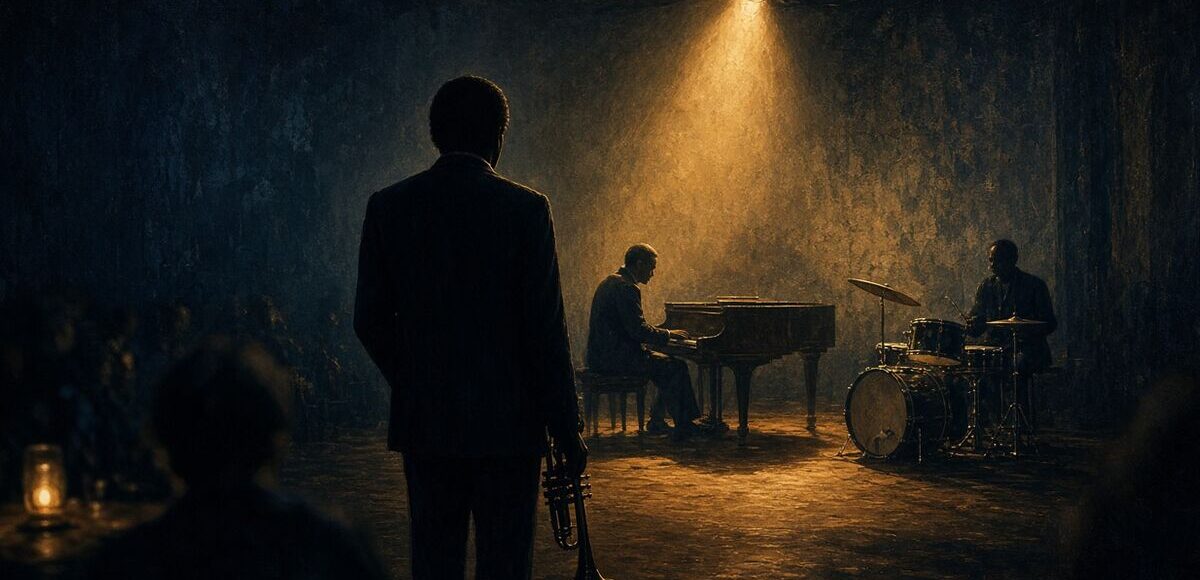
There he places Holland beside Tony Williams, with Herbie Hancock at a concert grand and Shorter facing them without a screen. Chick Corea is invited for two pieces, but only on acoustic piano. The rule is simple: every sound must begin in the room. Macero can edit the tape, yet he cannot add an instrument that the players did not hear together.
The resulting album is called Still Water. Its title piece lasts nineteen minutes and develops from three trumpet notes into a tense exchange between Williams and Hancock. West 52nd moves faster, driven by Holland’s walking bass, while Blue Window leaves long areas of silence around Shorter’s melody. Columbia releases it in September 1969 with a black cover and no explanation.
Critics expecting a break with the past are divided. Some call the record stubborn. Others notice that Miles has made the acoustic quintet sound less polite than most electric bands. At the Village Gate, young listeners stand through sets that begin almost quietly and end with Williams striking the drums as if he is arguing with the building.
The commercial result is modest, but the tour sells out. Miles discovers that refusal can be advertised as efficiently as novelty. He has Columbia print posters reading ACOUSTIC ONLY in small white letters. When a promoter in California asks for a rock support act, Miles chooses the Tony Williams Lifetime, listens from the wings and says nothing about their amplifiers.
Williams, John McLaughlin and Larry Young continue without Miles’s blessing or obstruction. Their loud, compressed attack becomes one root of jazz-rock. In London, Soft Machine stretches songs into instrumental suites. In New York, Larry Coryell and later Weather Report build another route, less dependent on a trumpet leader and more open to keyboards, bass effects and studio layering.
Miles watches the movement from a distance. He likes McLaughlin’s speed but dislikes the volume. He admires Joe Zawinul’s discipline and tells him so after a 1971 concert, then adds that too many wires make musicians look like telephone repairmen. Zawinul repeats the remark in interviews for years, improving the punch line each time.
In 1970 Miles records Hard Rooms with Keith Jarrett on piano, Holland on bass, Jack DeJohnette on drums and Airto Moreira on percussion. The music is acoustic but not nostalgic. Jarrett plays short repeated figures with his left hand. Airto uses bells, wood and skin to create colors that Macero cuts into abrupt transitions.
The album reaches a wider audience than Still Water. Rock magazines cover it because Miles appears at festivals in front of crowds who have come for Santana and the Grateful Dead. He refuses the large stage monitors and demands a shell of wooden panels behind the band. The crew complains until the first soundcheck, when the trumpet carries cleanly across the field.
There is no Bitches Brew. Columbia executives keep asking for a double album with a provocative title, but Miles offers them Hard Rooms and a short answer. Without his famous endorsement, the phrase fusion takes longer to settle. Record shops file the new electric groups under jazz, progressive rock or simply imports, depending on who is working that afternoon.
The missing record changes careers in small, practical ways. Bennie Maupin stays longer with Lee Morgan before joining Herbie Hancock. Hancock forms the Mwandishi band, but its contracts are tighter because Columbia cannot point to a Miles blockbuster. McLaughlin launches the Mahavishnu Orchestra as planned, though journalists describe it as a British and American experiment rather than the child of a Davis revolution.
By 1972 Miles has assembled another band around saxophonist Dave Liebman, pianist Cedar Walton, bassist Ron Carter and drummer Al Foster. Onstage they play old themes without treating them as museum pieces. So What can dissolve after eight bars into free rhythm. All Blues returns with a darker pulse and a trumpet line stripped to fragments.
The band records North Wall in January 1973. Macero uses edits as architecture, joining complete acoustic performances at unexpected points. One side begins in Tokyo and ends in New York, though the audience never hears the seam. Purists object to the cutting. Miles replies that tape is not an electric instrument but a knife.
His health and habits still cause trouble. A 1975 tour ends early after nights of pain, cocaine and arguments. Miles retreats from public life, but the absence sounds different now. There are no dense electric concerts to puzzle over, only bootlegs of brittle acoustic sets in which the band seems one missed cue from collapse.
During the retirement years, younger musicians visit his apartment with records. Wynton Marsalis arrives in 1980 carrying a trumpet and too much certainty. Miles listens, praises his control and tells him that tradition is useful only if it can survive bad manners. Their disagreement is reported in the music papers.
Miles returns in 1981 with Open Door, produced by Macero and played by Foster, Marcus Miller on upright bass, Bill Evans on saxophones and John Scofield on hollow-body guitar without amplification. Scofield sits close to a microphone and attacks the strings harder than expected. The record sounds lean, percussive and oddly contemporary.
Pop success never arrives in the form it did in the other history. There is no version of Time After Time and no glossy synthesizer frame around the trumpet. Instead, Miles appears on late-night television with an acoustic sextet and plays a nine-minute piece while the host waits helplessly beside the desk. The clip is replayed for decades.
Meanwhile the electric groups keep making records. Weather Report keeps tight arrangements, Mahavishnu stays loud, and Hancock’s band crosses into funk. Producers cite Sly Stone, Jimi Hendrix and James Brown more often than Miles. No Miles album is treated as the model for those bands.
In 1986 a festival in Montreux books Miles on the same night as Hancock’s electric band. Backstage, cables cross the floor in every direction. Miles steps over them, plays his set with piano, bass and drums, then returns for the encore and joins Hancock on Watermelon Man. He uses no microphone for the first chorus. The crowd becomes quiet enough to hear the valves click.
His final album, The Last Room, is completed in 1991. It contains no manifesto, only eight compact performances and one long blues. After Miles dies, Columbia prepares a box of the cancelled 1969 tapes. The reels hold fragments, false starts and the sound of an amplifier being switched off.
The box sells unexpectedly well. Musicians search the fragments for the electric future that never happened, but there is no hidden Bitches Brew. The tapes hold the decision he made in that studio and kept for twenty-two years. His later records, from Open Door in 1981 through the Montreux encore in 1986 to The Last Room in 1991, stay acoustic as well.