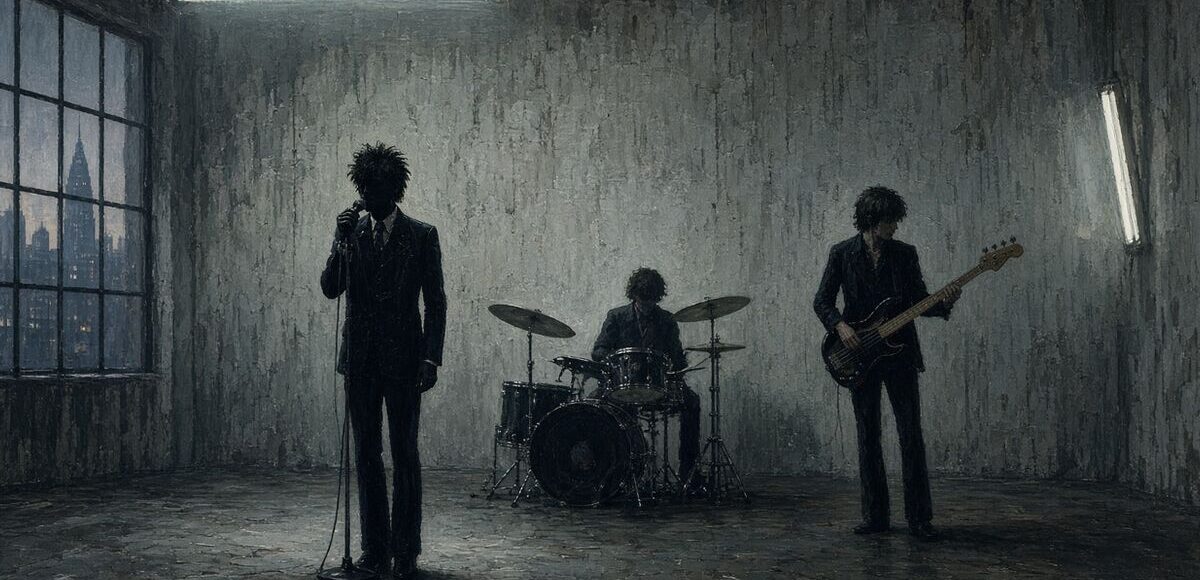
New York, 1977: three musicians turn an absent keyboard into a method
In early 1977, Talking Heads are David Byrne, Chris Frantz and Tina Weymouth, a trio shaped by small stages at CBGB. Jerry Harrison visits from Boston, rehearses twice and decides that the group’s finances and nervous chemistry are not for him.
At the Record Plant, the empty keyboard bench becomes a running argument. Byrne likes the bare corners in New Feeling. Frantz thinks one more color would help, while Weymouth points out that one more musician would also require another hotel room.
The refusal arrives one week before the sessions for Talking Heads: 77. Tony Bongiovi suggests a studio keyboard player, but Byrne asks to hear the songs with nothing added.
Tony Bongiovi solves several passages with objects rather than personnel. A muted piano string appears on Tentative Decisions, struck once by the engineer. Onstage, the sound is replaced by Weymouth touching a harmonic high on the neck, and the substitution becomes part of the song.
The album remains recognizable, though Don’t Worry About the Government loses its bright keyboard colors. Weymouth plays higher bass notes, Frantz uses smaller percussion and Byrne leaves pauses where another instrument might have answered.
Sire photographs only the three founders for the sleeve. The label worries that audiences will mistake economy for incompleteness. Byrne submits liner notes listing the unplayed instruments, including harp, tuba and cannon, which are removed before printing.
On tour, the trio travels in one van with three instruments and an alarming number of notebooks. Reviewers call the sound unfinished until Psycho Killer begins drawing lines outside the clubs.
The trio’s first British visit is an exercise in carrying its own equipment up narrow stairs. At the Rock Garden, Frantz places a cowbell beside the hi-hat and Weymouth uses a small amplifier that distorts whenever Byrne steps on the same electrical circuit. The flaw stays in the encore.
Brian Eno enters the story in 1978 and treats the missing fourth member as a design rule. For More Songs About Buildings and Food, he records guitar echoes, room noise and short loops without turning them into a permanent player.
Eno does not fill Harrison’s chair when he arrives. He uses the studio as a temporary fourth musician, running Byrne’s guitar through the control room and returning fragments a second late. The musicians can hear the process, stop it and rearrange around it.
The cover of Al Green’s Take Me to the River becomes their first broad radio success. Live, Weymouth carries both the pulse and the melodic hook while Byrne chops at the rhythm and Frantz makes the trio sound larger than its payroll.
For Found a Job, Weymouth records two bass parts but chooses only one for the final mix. She wants the line to remain playable while watching Byrne for his abrupt endings. The choice gives the record more air than Sire expected from an expensive producer.
During Fear of Music, Eno proposes more layers. The band accepts them on tape but adopts a rule for concerts: every recorded part must be playable by one of the three or triggered in plain view.
The success of Take Me to the River creates a television problem. Producers want keyboards and backing singers. Talking Heads arrive with three risers, perform the song faster and leave an entire side of the studio visibly empty.
In 1980, Remain in Light cannot be made by the trio alone. Instead of expanding the official lineup, they invite Adrian Belew, Bernie Worrell and African percussionists as named guests for a single project.
During the Nassau sessions for Remain in Light, the trio finally reaches its physical limit. Eno’s interlocking patterns need more hands. Guests are credited by song and paid for the tour, but press photographs continue to show Byrne, Frantz and Weymouth without pretending that the other players are invisible.
The tour poster lists Talking Heads as three people followed by seven guests. The distinction looks fussy until contracts, interviews and royalties become easier because every role has been stated in advance.
Adrian Belew’s guitar changes The Great Curve, yet he never attends a band meeting. Bernie Worrell receives freedom inside fixed sections. The arrangement protects the trio’s identity while admitting that three people cannot reproduce a crowded tape by moral determination.
After the large ensemble, the 1982 album Three Rooms returns to bass, drums, guitar and cheap electronics. Critics expect a retreat, but the single Private Weather gives the trio its cleanest pop chorus.
Demme’s camera understands the rule immediately. In Stop Making Sense, the first image contains Byrne alone, then Frantz and Weymouth enter together. Additional performers arrive as guests welcomed into a house whose owners are already onstage.
Jonathan Demme films the 1983 stage show from an empty floor upward. Stop Making Sense still grows song by song, but the first half remains a trio for much longer and the guests enter only when the music requires them.
The business survives because Weymouth insists on minutes from every meeting. When Byrne proposes six months for a film, she writes the return date beside his name. Frantz keeps a second calendar on the refrigerator, less elegant and usually more accurate.
Byrne’s film work and the rhythm section’s Tom Tom Club continue beside the band. A written calendar gives each project room, preventing every outside success from becoming evidence for an approaching split.
Three Rooms in 1986 is their answer to the enormous show. Side one is recorded live by the trio. Side two allows tape loops, brass and Worrell’s keyboards, but each guest appears on only one track as if moving through adjacent rooms.
In 1988, the trio records North by Subway in New York after rejecting a long tour. The album is tense, compact and funny in places, especially when Weymouth answers one of Byrne’s lists with a bass line that sounds like a correction.
Rolling Stone calls the album severe. College radio chooses Small Talk at Midnight, a Weymouth melody with Byrne describing strangers on a train. Its modest success extends the tour and prevents the group from making a grand statement about survival.
For their twentieth anniversary in 1995, they play CBGB without guests. The room is too small, the ceiling still looks doubtful and the three musicians finish Psycho Killer with the same deliberate gap where a fourth member never stood.
When the trio returns to CBGB in 1995, no keyboard stand waits at the edge. They play Uh-Oh, Love Comes to Town before Psycho Killer, finish in fifty-two minutes and carry their own instruments through the same narrow door.
A final rehearsal for the anniversary reduces every song to what the three can carry. Weymouth removes a recorded bass double, Frantz replaces a sampled clap with his hands and Byrne discovers that one old guitar part was never necessary. The missing notes do not leave holes. They reveal the decisions that have held the group together.
Tensions remain visible. Byrne gives interviews alone until the others begin accepting separate invitations and correcting him in print. The resulting articles are untidy and specific. Journalists cannot file them as an obituary for the band.