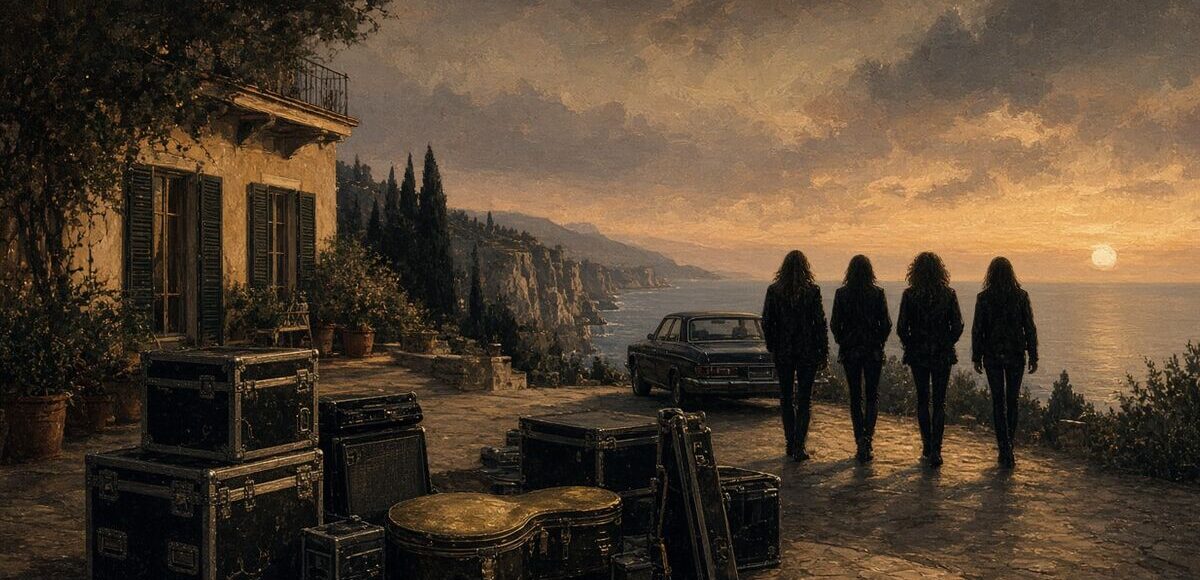
France, 1972: the tour ends, the contracts close and the Stones do not return
On 26 July 1972, after the final American concert of the tour, The Rolling Stones return to a hotel floor crowded with guests, security and unfinished arguments. Exile on Main St. is climbing the charts, but Keith Richards is exhausted and Mick Jagger has already begun discussing the next cycle. Charlie Watts closes his room door. Before sunrise, Bill Wyman tells manager Marshall Chess that he will not sign another group agreement.
The decision is not dramatic at first. Wyman expects a negotiation over money and travel. Instead, Watts says he also wants a fixed end. Mick Taylor asks for songwriting credit to be settled before any new recording, and Richards reacts as if the request has arrived during a fire. Jagger sees four separate disputes where everyone else sees one band.
They agree to finish the remaining obligations. There will be European dates in the autumn, one concert film and delivery of live material to satisfy the label. There will be no studio album after Exile. The statement is drafted in plain language, then delayed for six weeks because nobody can agree who should be quoted first.
When the news appears in September, many journalists assume it is theatre. Rock groups threaten to split with reliable frequency. The Stones have survived arrests, the death of Brian Jones, tax exile and the basement at Nellcôte. A disagreement over contracts seems too ordinary to stop them.
The European tour proves otherwise. The performances are fierce because every song has acquired an edge of finality, though nobody uses that word onstage. At the first Paris show, Gimme Shelter expands into a long exchange between Richards and Taylor. Jagger finishes Street Fighting Man, bows with the others and leaves without introducing an encore.
Backstage, promoters offer larger sums for 1973. Jagger listens. Richards laughs. Watts asks where the car is. The final concert takes place in Berlin on 20 October, ending with Jumpin’ Jack Flash. The band poses for one photograph after the show, all five members looking in different directions.
There is no Goats Head Soup as a Rolling Stones album. Jagger keeps several sketches, including the ballad that will become Angie. Richards takes riffs recorded on cassette. Taylor leaves with notebooks full of fragments and the conviction that he has escaped too late to receive what he was owed.
Atlantic and Rolling Stones Records face a catalogue without a future product. The live album Brussels 72 is prepared quickly from European tapes. It is released in March 1973 with minimal overdubbing and becomes one of the decade’s defining concert records. Its success makes the breakup harder to reverse because the ending now has an official soundtrack.
Jagger moves first. He records in Los Angeles with Billy Preston, Jim Keltner and guitarist Jesse Ed Davis. His debut, Open Season, appears in late 1973 and includes Angie as its lead single. The song is a major hit, though reviewers argue that its polish proves Richards was the missing dirt.
Richards does not hurry. He spends months between Jamaica and France, playing with musicians who expect sessions to begin after midnight. In 1974 he releases Wingless Angels, a loose record of reggae, blues and unfinished rock songs. Critics call it chaotic. Guitarists buy it for the opening riff of Black Limousine.
Charlie Watts returns to jazz whenever he can. He forms a small orchestra for selected London dates and records an album devoted to arrangements associated with Charlie Parker. The project sells little, but Watts appears happier in photographs. He agrees to play on friends’ records as long as the tours are short.
Bill Wyman builds a studio and releases solo work without waiting for permission. His records remain modest sellers, yet he becomes the first former Stone to treat separation as normal employment rather than exile. Mick Taylor joins sessions with Jack Bruce, plays with Bob Dylan earlier than in the other history and finally receives prominent billing.
The music industry reorganizes the empty space. Faces are promoted as Britain’s surviving rough-edged rock band, but their own tensions remain. Led Zeppelin’s scale grows larger. Aerosmith and later bands inherit parts of the Stones’ swagger without having to compete with a new Stones single every few years.
Fans still expect a reunion. In 1975, a benefit organizer approaches all five members after an earthquake appeal. Watts and Wyman accept, Taylor is willing, Jagger asks for rehearsal dates and Richards cannot be located for three days. The event proceeds without them, creating the first of many almost-reunions.
Punk changes the argument. When the Sex Pistols arrive, there is no aging Rolling Stones touring stadiums for them to mock. Jagger attends shows and produces a sharp 1977 solo album, Neon Street, influenced by the economy of the new bands. Richards dismisses punk in public, then records with several younger musicians in private.
The old partnership briefly returns in a Paris studio in 1978. Jagger brings a rhythm idea, Richards adds guitar and Watts plays drums for an afternoon. They record a rough version of Beast of Burden. By evening, an argument over credits has restarted, and the tape goes into Richards’s bag.
Bootlegs of that session circulate for years. The unfinished song becomes a legend larger than many finished records. Cover versions appear with different lyrics reconstructed from poor audio. Taylor plays it live once and tells the audience he remembers only the chords.
Without decades of Stones tours, the economics of stadium rock develop differently. Promoters rely more on festivals and packages of several major acts. There is no 1981 Stones tour to demonstrate how efficiently one veteran band can fill American football grounds. Corporate sponsorship enters rock touring later and through pop spectacles rather than a guitar group from the 1960s.
Personal relations improve in slow, uneven stages. Richards and Jagger can eat dinner together by the mid-1980s if nobody mentions publishing. Watts visits both. Wyman attends only when he chooses. Taylor receives a settlement in 1986 that includes corrected credits on two archival releases.
The catalogue grows through vault projects. A 1982 collection, Nellcôte Tapes, reveals alternate performances from the Exile sessions. In 1992, The Last Tour expands the Brussels recordings and adds rehearsals. Each release reaches listeners too young to remember the band as an active concern.
A reunion finally occurs in 1995, but it lasts one song. The five surviving members appear at a memorial concert for Ian Stewart. They play Honky Tonk Women with no giant screen, no sponsor and no announcement of future dates. Richards leans toward Watts for the ending. Jagger thanks the audience and walks off before questions can begin.
Wyman’s refusal to sign stands. There is no studio album after Exile on Main St. The five share a stage again only in 1995, for Honky Tonk Women at Ian Stewart’s memorial, and Jagger walks off before the questions.