





Nantes to Paris: Héloïse Letissier builds Christine around dance
Héloïse Letissier was born in 1988 in Nantes and trained in physical theater at the École Nationale Supérieure des Arts et Techniques du Théâtre in Lyon before moving to Paris. In 2010, during a difficult period in London where she found herself without stable housing, she attended a drag show at Madame Jojo’s in Soho. The queens she met there encouraged her, took her in, and gave her a name. She returned to France, began writing songs under Christine and the Queens, and released a debut EP in 2012. The name carries the origin: identity rebuilt inside a borrowed community.
Chaleur Humaine arrived in France in 2014 and reached wider audiences through a 2016 English-language release. French and English tracks shared the record. “Saint Claude” turned a Paris street name into an indirect song about desire and longing. “Tilted,” a rerecording of “Paradis Perdus,” built its chorus around a word that could describe a crooked picture frame or a body outside conventional expectations. The album sold slowly at first, then gained ground as live footage spread. Letissier’s choreography was as deliberate as her lyrics.
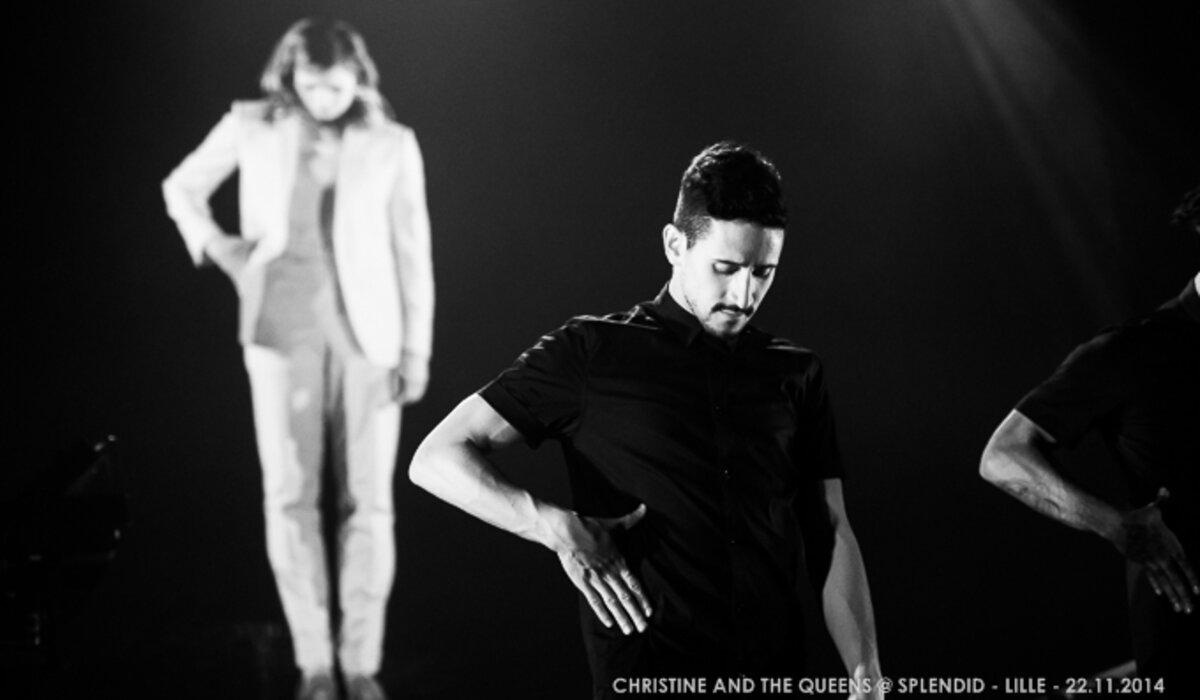
That choreography matters. Letissier brought theater training directly into music performance: every gesture in her live show is composed with the same care as a melody. Live appearances drew comparisons to Michael Jackson, not for imitation but for how deliberate the movement is. The dancing carries part of what the song is saying. Her 2016 performance of “Tilted” on Later… with Jools Holland showed the method plainly: controlled, unhurried, the body carrying meaning that the audio alone could not.
Chris (2018) shifted register. The name itself signaled a change in how Letissier presented gender: shorter hair, suits, more masculine framing in press materials and videos. Musically the record moved toward funk and R&B with heavier bass and a harder rhythmic grid. “Girlfriend” and “5 dollars” made the Prince and James Brown references more explicit than Chaleur Humaine had allowed. The lyrics stayed indirect, but the production moved from intimacy toward something with more physical force.
The influences are legible without feeling like disguise. Michael Jackson’s habit of treating the video as a complete work runs throughout. Prince’s one-person studio discipline and genre flexibility are a clear model. French chanson’s ease with personal abstraction (Philippe Katerine is a useful reference) runs beneath the anglophone influences. Theater training shows in a specific way: there is always a character who is also the performer, two frames active at once, neither canceling the other.
Paranoïa, Angels, True Love (2023) moved into more open emotional territory. Letissier’s mother died in 2021, and grief sits in the record without being announced. Collaborators included Caroline Polachek. The album ranges from synth-pop to chamber pop to passages close to cabaret. It is longer and less guarded than Chris, and rewards close listening more than either of its predecessors.
Sonically, the voice is the anchor: a clear mezzo-soprano deployed with control rather than force. Chaleur Humaine keeps the arrangements spare. Chris pushes the bass deliberately forward. Paranoïa widens the textures. Drum programming is precise and dry across all three albums. It is worth hearing both the French and English versions of tracks that exist in both. The language shifts the emotional register in small but real ways.
Entry points are clear. Chaleur Humaine for the early, intimate pop framework. Chris for the funk-driven version. “Saint Claude,” “Tilted,” “5 dollars,” and “People, I’ve been sad” give four distinct angles on the same project. For the physical argument, live footage from 2016-2017 (Later… with Jools Holland, The Late Show with Stephen Colbert, Pitchfork Paris) is probably more instructive than any single studio track.
Among French-language pop exports, Stromae and Angèle sit at a more comfortable distance. Christine and the Queens stays physically committed and lyrically strange. On nearby anglophone records, FKA twigs is one reference. Letissier stays closer to melody and keeps a pop structure intact. That mix of a clear pop form and a harder subject has held for a decade, from Chaleur Humaine through Chris, across more than one song.


Jacques | 7 October 2026
|
I needed this reminder to revisit the deep catalog. I told my coworker and they shrugged. Their loss.
Maya | 8 October 2026
|
Gateway artist for me into a whole decade. No regrets. I told my coworker and they shrugged. Their loss. Needed that.
Alex | 8 October 2026
|
Hard disagree but respect.
Anne | 9 October 2026
|
Gateway artist for me into a whole decade. No regrets. That is all.
Sam W. | 10 October 2026
|
I needed this reminder to revisit the deep catalog. Needed that.
Paulo | 11 October 2026
|
I came for the hits, stayed for the odd tracks. This profile gets both.
Bea | 12 October 2026
|
Controversial take but peak Christine And The Queens clears half the playlist filler out there.
Olivier | 12 October 2026
|
solid portrait. Made me queue three songs I had forgotten.
Louise | 13 October 2026
|
The stage craft bit landed. You forget how much work that is. More of this please.
Chloé | 14 October 2026
|
I came for the hits, stayed for the odd tracks. This profile gets both. Good piece.
Aria | 14 October 2026
|
Christine And The Queens can sell a ballad and a shout in the same career. Rare.
Greg | 15 October 2026
|
Gateway artist for me into a whole decade. No regrets. I told my coworker and they shrugged. Their loss.
Sofi | 15 October 2026
|
Live, Christine And The Queens is another animal. Studio still matters though. I told my coworker and they shrugged. Their loss. Ok bye.