
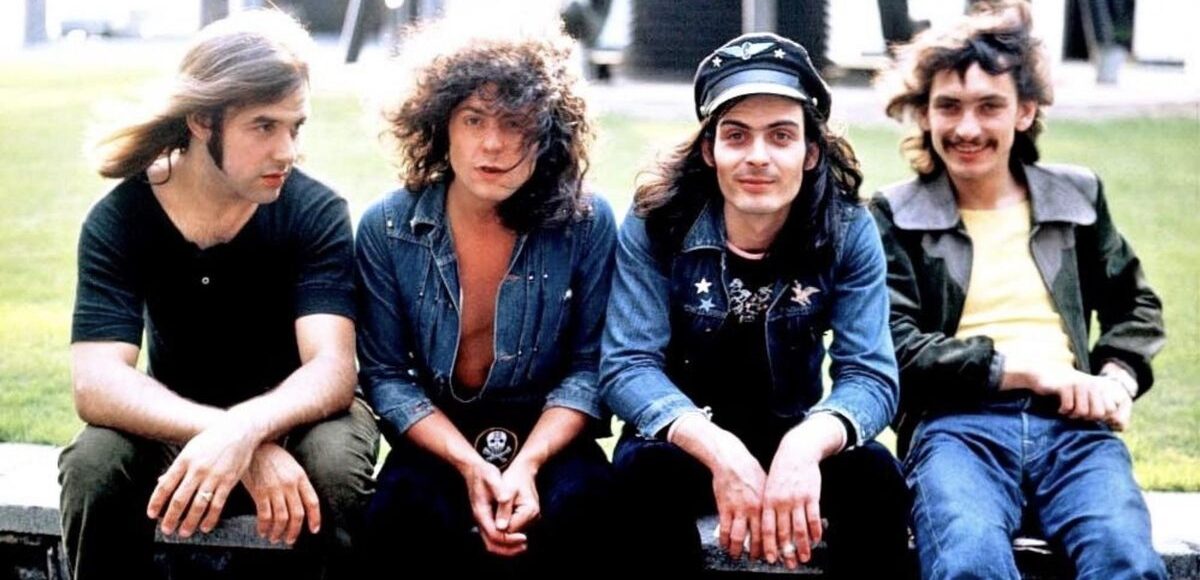
From Tyrannosaurus Rex to Electric Warrior
Marc Bolan spent the late 1960s as a folk mystic under the extended name Tyrannosaurus Rex, recording acoustic albums with Steve Peregrin Took on percussion and building a loyal underground following in Britain. My People Were Fair and Had Sky in Their Hair (1968), Prophets, Seers and Sages (1968), and Unicorn (1969) drew on English folk, hippie mythology, and a literary fantasy tradition that Bolan had absorbed from reading Tolkien and early English poetry. The voice was high and plaintive, the arrangements sparse, and the audience small but devoted.
The pivot came in stages. Took left the group and was replaced by Mickey Finn, a more accommodating collaborator for what Bolan was beginning to imagine. A Beard of Stars (1970) introduced electric guitar into the mix for the first time; T. Rex (1970) narrowed the name and sharpened the sound. By the time Electric Warrior arrived in 1971, produced by Tony Visconti, the transformation was complete: no folk, no mystic whimsy, no acoustic patience. In their place came fat bass, dry drums, chopped guitar riffs, and a voice that teased rather than pleaded.
Visconti’s production on Electric Warrior was decisive. The album sounds dry and forward in the mix, with Bolan’s guitar sitting high and the rhythm section anchoring everything without bleeding into it. Flo and Eddie added backing vocals that gave the record a sheen of American pop without softening the essential toughness of the arrangements. “Get It On”, retitled “Bang a Gong” in the United States, reached number one in the UK and broke the top ten in the US. “Jeepster” followed it. The campaign of back-to-back hits that would define T. Rex’s reputation was underway.
Bolan was writing short and with full intention. The hooks arrived early, the bridges were minimal, and the lyrics hovered between nonsense and cosmic gesture in a way that worked because the groove was doing the real explaining. The guitar was a slogan, the bass a swagger, and the chorus a declaration that teenagers could shout back at the stage. No political programme, no complicated concepts: glitter, sex, boogie, and the certainty that the person on stage knew exactly what he was doing with all of it.
The Slider (1972) maintained the run with “Telegram Sam” and “Metal Guru”, both UK number ones. Mickey Finn’s congas added texture without pulling focus. Visually, Bolan made mascara and satin look like working clothes: T. Rex was not a band built on democratic presentation but a frontman’s theatre with a tight rhythm section behind it. The audiences, known as T. Rextasy in the British press, were among the most passionate of the glam era, rivalling those for David Bowie at his peak.
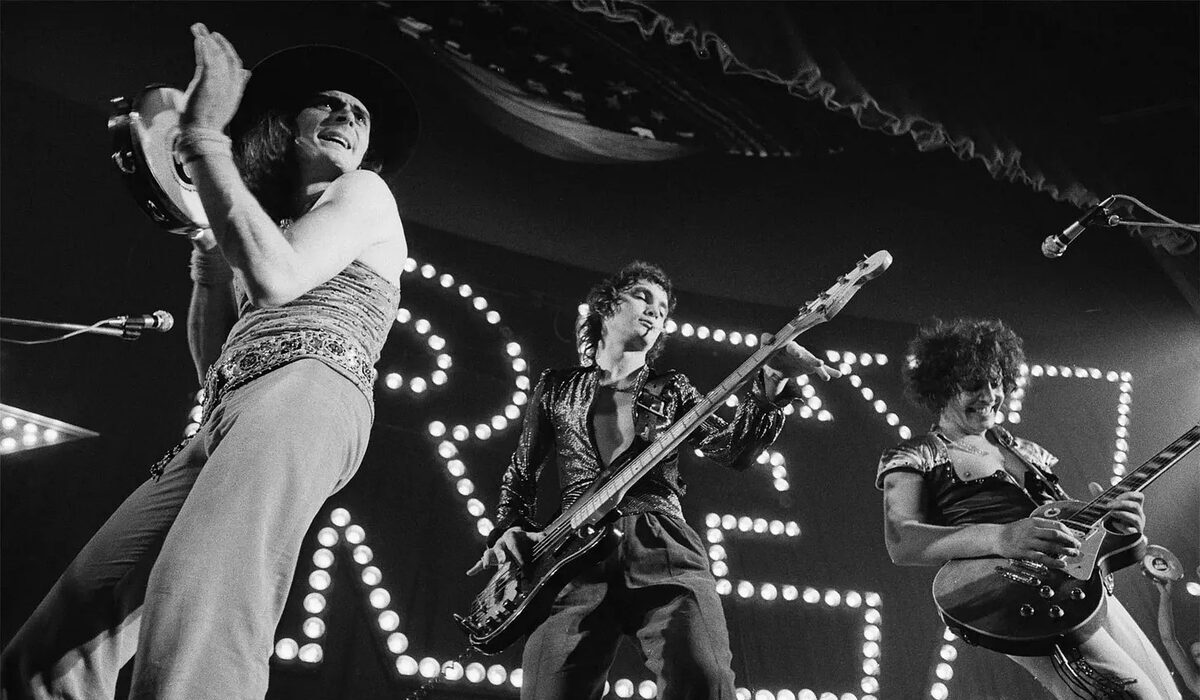
“20th Century Boy”, “Children of the Revolution”, and “Hot Love” extended the singles run into 1973. Tanx (1973) and Zinc Alloy and the Hidden Riders of Tomorrow (1974) showed Bolan writing quickly and not always with the same conviction, as the glam boom began to cool and soul and funk started absorbing what glam had taught the rhythm section. By the mid-1970s punk was arriving and dismissing the previous generation wholesale. Bolan’s response was to try to pivot again: a harder edge, an embrace of the new, and a television show, Marc, that put him in direct contact with younger acts.
The car crash that killed him on September 16, 1977, two weeks before his thirtieth birthday, froze the T. Rex legend at the peak of its symbolic value. Bolan had been recording with renewed energy, with sessions that suggested another transformation was in progress. The death turned the catalogue into a monument without requiring the usual mythologising that comes with a long decline. There was no later period to qualify the earlier work.
T. Rex’s position in British pop history is specific: they preceded glam rock’s full commercial flowering rather than simply participating in it, and they defined much of what the genre would become. Bowie shared the same decade and the same sense of studied theatricality, but his ambition pointed outward toward concept and character. Bolan’s pointed inward toward the single, the riff, the two minutes and fifty seconds that would move a room. Sweet and Mud used the same formula with less internal pressure; Slade brought football chant energy. T. Rex built the model itself.
Start with Electric Warrior for the peak: “Get It On”, “Jeepster”, and “Life’s a Gas” in sequence make the project entirely clear. The Slider adds “Telegram Sam” and “Metal Guru”. For a singles-first approach, “20th Century Boy” remains one of the great British rock records, full stop, and “Children of the Revolution” is not far behind. Bolan wrote the blueprint that glam bands borrowed and punk bands later pretended not to recognise.