
Six strings, a contour and a lightning bolt
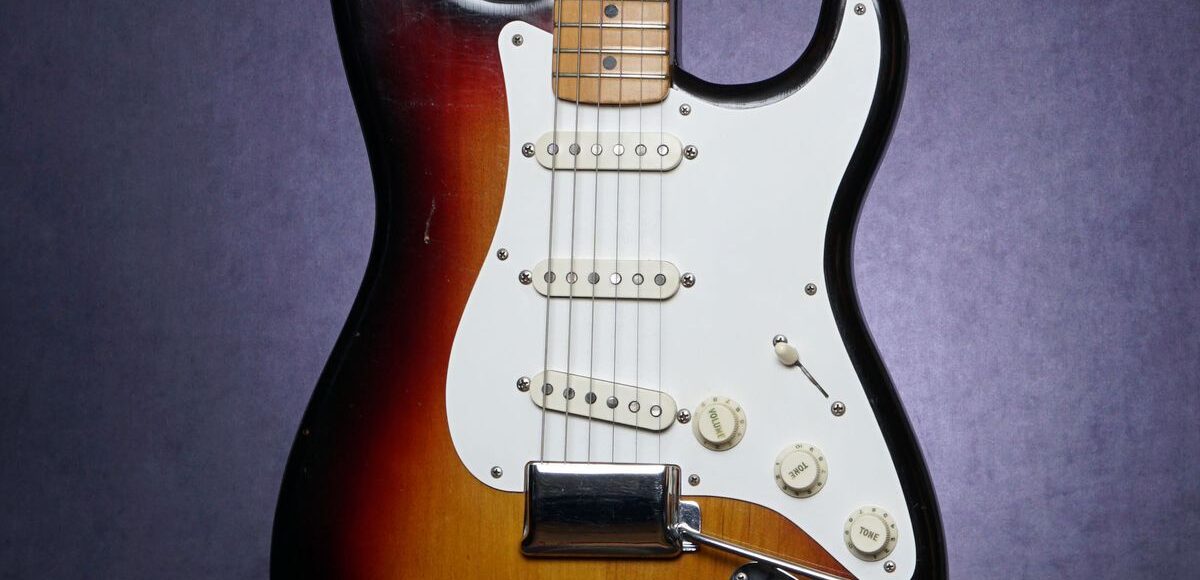
It did not arrive as a weapon. In 1954, in Fullerton, California, Leo Fender, with George Fullerton and Freddie Tavares, put a contoured body, a maple neck and three single-coil pickups into the world and called it the Stratocaster. The synchronized tremolo was part of the drawing, not a later trick. The body was cut so it would sit against a person. Ash, then alder. A guitar thought out by a man who had been building radios.
Buddy Holly played one in the late 1950s, the blonde instrument in the Crickets photographs. Hank Marvin’s Fiesta Red Stratocaster, bought in 1959, gave The Shadows their clean British shiver. Apache, in 1960, is that guitar as much as it is a tune. Then the instrument left politeness. At Monterey Pop in June 1967, Jimi Hendrix knelt and burned a Stratocaster. At Woodstock in August 1969, a white one played The Star-Spangled Banner until the anthem sounded like weather.
CBS bought Fender in January 1965, and the argument about pre-CBS wood began almost at once. Eric Clapton assembled Blackie from several 1950s Strats and played it from 1970; in 2004 the guitar sold at auction for 959,500 dollars. Stevie Ray Vaughan’s Number One, a late-1950s Strat battered into a second skin, carried Texas Flood. David Gilmour’s Black Strat, bought in 1970, is the long sustain inside Comfortably Numb.
Nile Rodgers’s Hitmaker is a 1960 Stratocaster, the chord under Le Freak, Good Times, Let’s Dance and Like a Virgin, later under Get Lucky. The same three pickups that had sounded like surf could stab a disco chord and leave it ringing. Mark Knopfler made his from a fingerstyle hush. Jeff Beck made his from a tremolo arm that behaved like a voice. The design barely moved. The hands did all the travelling.
The five-way switch was not original. Early Strats had a three-way lever. Players jammed it in the cracks between pickups, and Fender made those in-between positions official in 1977. That small cheat is the character of the instrument: positions two and four, the glassy quack no Les Paul quite copies. Hendrix, flipping a right-handed guitar upside down, found still more of those colours by accident and by nerve.
Seventy years on, the Stratocaster is still the shape people draw when they mean electric guitar. Not because it is the heaviest or the most fragile. Because a contour, three pickups and a tremolo arm turned out to be enough architecture for Holly’s hiccup, Marvin’s echo, Hendrix’s fire and Gilmour’s long note. The lightning, in this case, was a set of curves decided in Fullerton and never really revised.
Players still argue about the year, the colour, the switch. The argument is the proof. A 1954 drawing, revised only at the edges, remains the guitar you hear when a single-coil attack opens the radio. Fender kept building it, and it never needed a fourth pickup to stay unmistakable on any stage you can still name. Leo Fender’s drawing still answers the room before the amplifier does.