
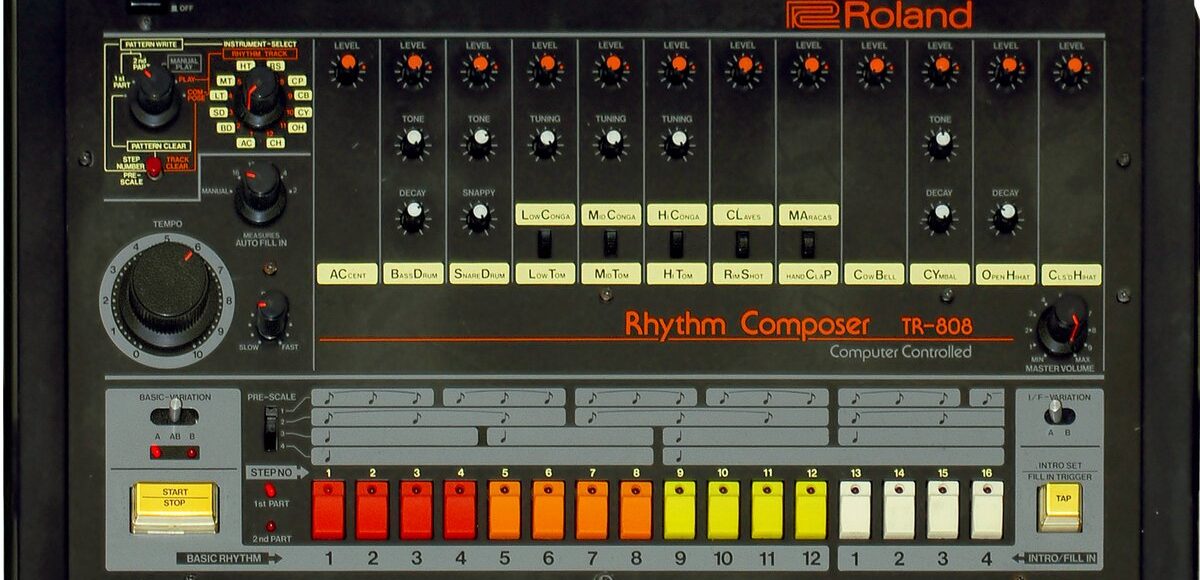
1980: Roland ships a cheap analog kit nobody wants, then hip-hop keeps it
Roland released the TR-808 in 1980, designed under Tadao Kikumoto, and the market shrugged. It did not sample drums. It synthesized them, with knobs for decay, tone and a snare that hissed rather than cracked. The list price sat near 1,195 dollars, far under the Linn LM-1, which used real drum recordings and cost several times more. Studios that wanted realism bought the Linn. The 808 sounded artificial next to a kit, and rival ads made that the point.
About twelve thousand units left the factory before Roland discontinued the model in 1983. That should have closed the story. Instead the machines landed with people who did not need a kit to sound like a kit. Marvin Gaye’s Sexual Healing (1982) put the 808’s soft knock under a mid-tempo R&B track. The same year, Afrika Bambaataa and the Soulsonic Force’s Planet Rock paired it with Kraftwerk-style synth lines and defined early electro. Yellow Magic Orchestra had already treated drum machines as composition tools, not as stand-ins for a human drummer.
The kick is the part everyone still names. An analog circuit, a sine wave you can tune and overdrive, drops a note so low it fills a car trunk or a club PA. Miami bass, Detroit techno and later trap all used that circuit. Juan Atkins as Cybotron, Derrick May, Egyptian Lover and Man Parrish did not hide the machine. They let the pattern carry the track: closed hi-hat, cowbell, dry handclap, no room reverb pretending to be a live stage.
Hip-hop took the 808 the way it took breakbeats, except this time there was no drummer to hire and no vinyl break to flip. The boom moved from Bronx parks to car systems. When original units grew scarce, samples of the 808 kick circulated as session staples. You can hear that depth and that long decay without seeing the silver panel. Producers write “808” on a track sheet and everyone knows which low end they mean.
Kanye West named an album after it. 808s & Heartbreak, released in November 2008 after his mother’s death, set Auto-Tuned singing on those kicks and changed what a rap record was allowed to sound like. The machine mocked for not sounding real became the rhythmic centre of a decade of pop and hip-hop. On that record the sadness rides a tuned sine wave and a voice that stays processed on purpose.
Roland later revived the circuits in boutique units and plugins because the commercial miss had become a standard. Producers who never touched a 1980 panel still call for an 808 on the session. From Gaye’s mid-tempo hit to trap drums in the 2010s, the same circuits keep their accent. Twelve thousand machines, one kick sound, and a low end that started as a sales failure now sits under a large share of chart rhythm.