
A hymn written next to a running tap
Two voices enter with almost no accompaniment, close enough to be one instrument, and the first line greets the dark as if it were a person who has been waiting.
Paul Simon wrote The Sound of Silence in the bathroom of his parents’ house in Flushing, Queens, lights off, faucet running, because the tiles gave him a little echo and the water made a white noise he liked. He was twenty-one. The song took months to finish. It appeared, acoustic and hushed, on Wednesday Morning, 3 A.M. in 1964, produced by Tom Wilson for Columbia, and the album failed. The following year Wilson, without the duo in the room, overdubbed electric guitar, bass and drums at Columbia’s Studio A in New York and released the new version as a single. By January 1966 it was No. 1 in America, and the album Sounds of Silence followed. Simon and Garfunkel heard their own future on the radio, arranged by a producer who had not asked.
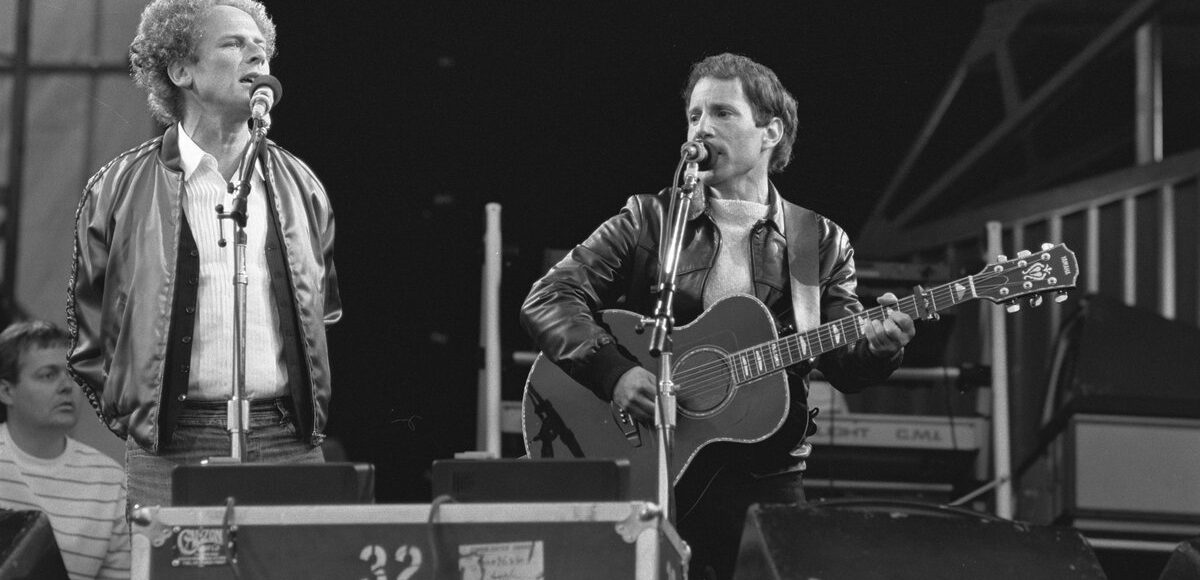
Art Garfunkel, introducing it on stage, has described the lyric as the inability of people to communicate, not only across nations but across a table. The words walk through a vision of neon and silence, of people talking without speaking. The electric overdub gives the vision a pulse the bathroom version only implied. Live, they often returned to the naked harmony, two voices and a guitar, which is how the song was born and how it still cuts. The folk audience that had loved the quiet record had to accept the drums. The pop audience never heard the bathroom.
I used to go off in the bathroom, because the bathroom had tiles, so it was a slight echo chamber. I’d turn on the faucet so that water would run and I’d play. In the dark.
(Paul Simon, Playboy, 1984)
The song has been asked to mean the assassination of Kennedy, the numbness of a decade, the private dark of a young writer. Simon has been wary of the large readings. What he has confirmed is the room, the tap, the pleasure of playing alone. Garfunkel’s tenor lifts the melody into something like a hymn, which is why crowds treat it as one. In Central Park in 1981, and on countless stages since, the first line still quiets a field. Hello, darkness. The greeting has not worn out.
What remains is the strange calm of a protest that never raises its voice. The electric single is a compromise that became the classic, a folk song given a backbeat by session players and left to find its public. Underneath, you can still hear the tiled room if you want to. A young man in Queens, water running, talking to the dark because the dark answered. The silence in the title is not empty. It is the sound of people failing to reach each other, set to a tune you cannot shake.