
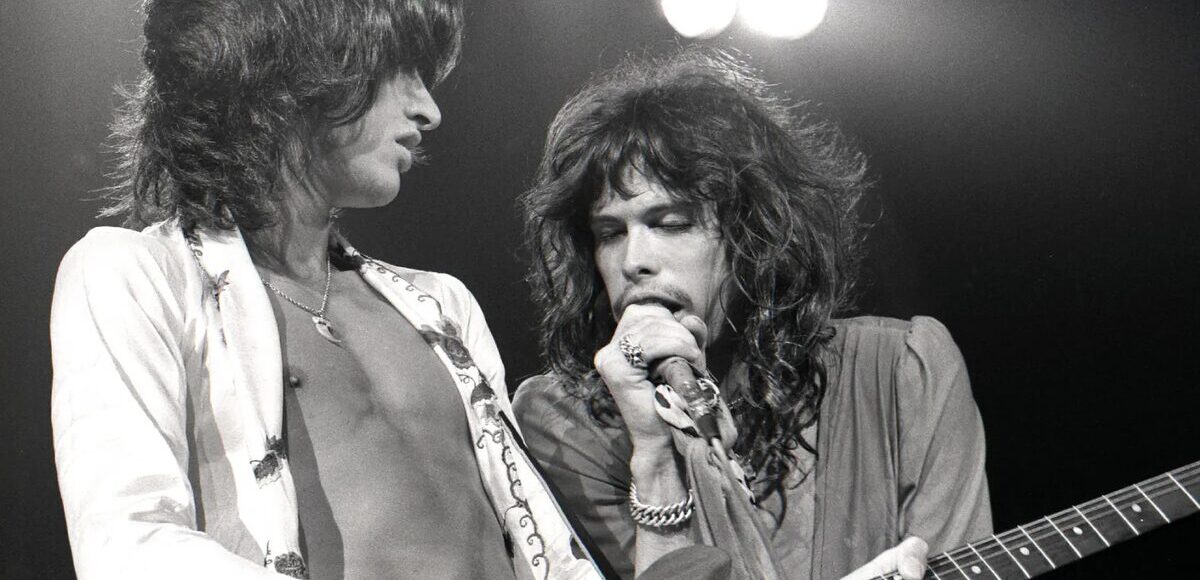
Toxic twins, blues riffs, and a second act on MTV
In the summer of 1970, Steven Tyler and Joe Perry met at a lakeside snack bar in Sunapee, New Hampshire, bonded over a shared appetite for the Rolling Stones and the Yardbirds, and drove back to Boston with a plan. Tom Hamilton came on bass, Joey Kramer on drums, and Brad Whitford, slightly later, on second guitar. They rented a four-room apartment on Commonwealth Avenue, rehearsed until the neighbors complained, and played their first show in November 1970. The configuration was straightforward: two guitars, a screamer with genuine range, and a rhythm section built for large rooms.
Aerosmith (1973) and Get Your Wings (1974) established the blueprint on Columbia Records without breaking through commercially. The early sound was blues-rooted hard rock with a conscious debt to the British Invasion: Perry’s riffs borrowed from Clapton and Beck, Tyler’s phrasing leaned on Mick Jagger without copying him. “Dream On,” buried on the debut album, made no impact on release. What held the band together was a relentless touring schedule across the American club and theater circuit, building an audience that the first two records had not yet generated.
Toys in the Attic (1975) changed the arithmetic. “Sweet Emotion,” built on Hamilton’s bass riff recorded first and the band added around it, opened with a intro that went directly into the American consciousness. “Walk This Way” drove a wah-guitar rhythm that would resurface eleven years later as something else entirely. The album went triple platinum. Rocks (1976) followed with “Back in the Saddle,” “Rats in the Cellar,” and “Last Child,” concentrating the formula into its most physical form. Those two records, made within eighteen months of each other, are the center of the catalog.
The band was also disintegrating. Drug use, escalating arguments between Tyler and Perry, and the pressure of their own success made every subsequent session harder. Draw the Line (1977) came out uneven; Night in the Ruts (1979) worse. Perry left in the middle of a tour after a backstage argument involving his wife and Tyler’s. Whitford followed. The band that remained continued under the name but without the engine that had made it work.
The comeback began in an unexpected direction. Rick Rubin and Russell Simmons paired a reconstituted Aerosmith with Run-D.M.C. for a reworking of “Walk This Way” in 1986. The video, with the two groups breaking down a shared wall, put them back in front of an audience who had not been born when Rocks came out. Permanent Vacation (1987) arrived with cleaner production by Bruce Fairbairn and a new set of co-writers. “Dude (Looks Like a Lady)” and “Angel” were calculated hits, which was the point. Pump (1989) sharpened the formula further: “Janie’s Got a Gun” dealt directly with child abuse, the kind of subject rock radio did not normally accommodate.
Perry’s guitar style derives from Chicago blues filtered through late-60s British rock: the wah pedal as rhythmic device, riffs built around single-string patterns rather than full chords, a dry tone that cuts through a busy mix. Tyler’s voice spans a substantial range, from a baritone growl to a falsetto shriek, and he understood that the performance had to be physical before it was musical. The two are sometimes called the Toxic Twins, a reference to the drug years, but the real chemistry is musical: they understood each other’s timing in a way that could not be manufactured.
Beside Led Zeppelin, Aerosmith sounds more street-level, less mystical, more directly American. Beside Kiss, the musicianship is more substantive, the blues roots more genuine. Beside the Bon Jovi generation they influenced, the early records have a rawness that the pop production of the late 80s deliberately avoided. What Aerosmith brought to American hard rock was a specific Boston swagger: not the blues scholarship of British imports, but the blues absorbed and played back louder and faster.
Start with Toys in the Attic for the first fully realized statement. Rocks for the follow-up that may be even tighter. Permanent Vacation for the cleaned-up second-act version. Pump for the record that put the comeback on solid ground. “Dream On” functions as an entry point for the ballad side; “Walk This Way” explains, in four minutes, how the first period sounded at its most concentrated.