

An octave down, mistaken for a bass
The riff does not enter so much as occupy the floor. A guitar, dropped an octave until it could be mistaken for a bass, walks seven notes and then turns around, stubborn as a march. Meg White’s drums answer with almost nothing: kick, snare, a cymbal that knows its place. Seven Nation Army, the opening of Elephant in 2003, is a whole argument made from scarcity. Jack White sings as if he were already leaving the room. The hook is not a chorus. It is the riff, returning because nobody has found a reason to stop it.
He has traced the figure to a soundcheck at the Corner Hotel in Melbourne, a throwaway that refused to stay thrown. The title is older than the trip. As a child he heard Salvation Army and kept Seven Nation Army, a mishearing that sounds like a campaign. The recording happened at Toe Rag in London, Liam Watson engineering, Jack producing, the desk an eight-track that made luxury impossible. A DigiTech Whammy pedal did the octave drop. There is no bass guitar on the track. The illusion is the point. Elephant was their declaration that a duo and a small tape machine could still sound larger than a studio full of options.
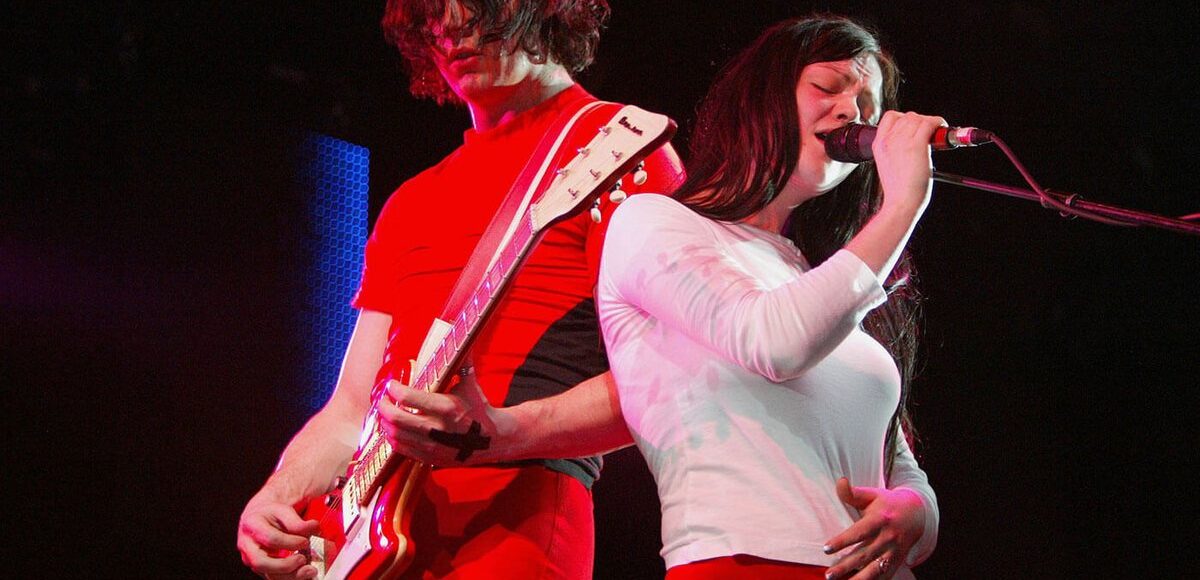
The lyric is a grudge dressed as travel. He is going to Wichita, or anywhere the person he is done with is not. The vocal is dry, close, a little mean. When the riff returns after the break it has not developed. Development would be a kindness. What the arrangement understands is repetition as pressure. On the single, and then in every sports ground that later adopted it, the notes left the song and became a chant people could sing without knowing a word. The White Stripes had made a folk melody by accident, wearing red and white.
Seven Nation Army was what I used to call the Salvation Army as a kid, because I misheard the name.
(Jack White, on the title, 2003)
Britain sent it into the top ten. America preferred it on alternative radio, then at stadiums, then at protests, the riff emptied of its private quarrel and filled with whoever needed a march. Jack has played it with the Raconteurs and alone, sometimes longer, sometimes with the crowd doing the work before he arrives. The studio cut remains the severe one. Two people, a limited tape, a pedal. The myth of the garage is usually nostalgia. Here the limitation is audible, and it is the style.
What remains is that descending walk, simple enough to be bellowed by people who have never held a guitar. The misheard charity, the hotel soundcheck, the machine that could not take a ninth track: all of it is still in the notes. Seven Nation Army does not ask to be understood. It asks to be joined. Some riffs decorate a song. This one replaced the song, and the song, oddly, survived.