
Psychedelic morning after Purple Rain
On 22 April 1985 Paisley Park and Warner Bros. released Around the World in a Day, Prince and the Revolution’s deliberate pivot away from the Purple Rain sound while that film still filled cinemas. Tracking ran through 1984 into early 1985 at Flying Cloud Drive Warehouse, Sunset Sound, and other Minneapolis and LA rooms, with the Revolution – Wendy Melvoin, Lisa Coleman, Brown Mark, Dr. Fink, Bobby Z. – fully inside the arrangements. Prince produced; the label imprint Paisley Park made its album-catalog presence felt beside Warner Bros.
The title track opens on oud-like colours and a procession groove that signals the psychedelic turn before a lyric lands. Paisley Park names the label and the utopia in the same breath. Raspberry Beret is the hit: acoustic strum, string lift, and a story song that MTV could play without the electric-guitar theater of the previous year. Pop Life and America keep the social edge; Condition of the Heart and The Ladder slow the middle into ballad and gospel-tinged space; Tamborine stays light and percussive. Compared with Purple Rain, guitars sit further back and acoustic textures, sitars, and parade percussion move forward.
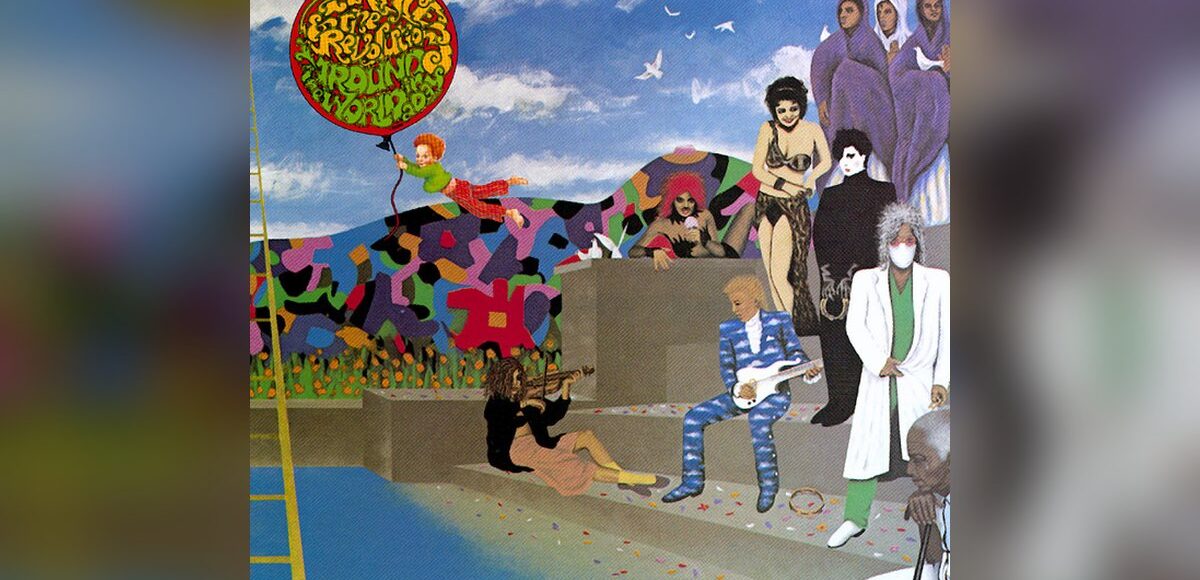
The sleeve by Doug Henders packs a crowded psychedelic tableau – balloon lettering, steps, water, white coat – closer to a Beatles-era painting than to the motorcycle chic of Purple Rain. Prince refused a long victory-lap tour built only to remake the soundtrack formula; the public message was that the next chapter would not be ordered by cinema grosses. Singles videos for Raspberry Beret and Pop Life still kept him in heavy MTV rotation without recycling the rain-soaked guitar-hero frame.
The most important thing is to be true to yourself.
(Prince on refusing to remake Purple Rain for the follow-up, mid-1980s press)
Commercially the album still hit number one on the Billboard 200. Raspberry Beret reached the US Top 5; Pop Life followed into the Top 10. Sales could not match Purple Rain’s monster numbers, which was partly the point: the brand stayed hot without cloning the soundtrack formula. UK and European charts remained strong enough to prove the pivot was not a commercial suicide note.
The durable lesson is strategic. Fresh off the biggest year of his career, Prince chose sitars, parade rhythms, and a painted cover over repeating the guitar-hero blockbuster. For Revolution-era listeners, this is the bridge from stadium purple to the denser experiments of Parade and Sign o’ the Times. It rewards anyone who wants the hit singles without pretending the whole album is another film score.