The Autobahn without German vowels
Remove the German grain from Kraftwerk’s early voice and the Autobahn suddenly sounds like a brochure written for tourists. The vowels soften. The consonants lose their chrome. The future arrives early, and strangely American. In Düsseldorf the neon still runs, the machines still hum, but the first words that leave the microphones are already translating themselves for someone else’s radio.
In this timeline, Ralf and Florian decide, before the myth hardens, that English will carry the project farther. Managers clap. Translators arrive with notebooks. The band practices phrases until the phrases sound friendly. Friendly is efficient. Friendly sells. Something essential begins to thin out: the sense that this music came from another grammar of modernity.
The early records still invent electronic pop with monastic patience. Sequences still march like elegant traffic. Melodies still feel drawn by rulers and then smuggled into emotion. But the voices now explain themselves too quickly. Autobahn becomes a postcard instead of a spell. Trans-Europe Express still moves, yet it moves with captions. Radio stations in London and Los Angeles play the tracks without the slight productive confusion that once made listeners lean closer.
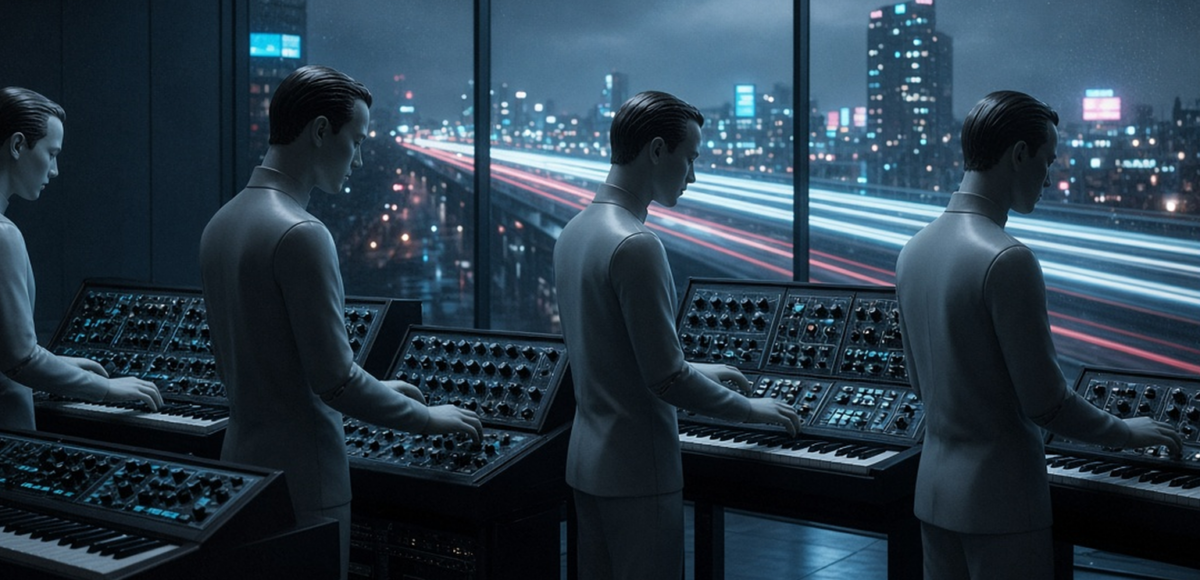
Onstage the four figures remain mannequin-calm. The calm now reads as showmanship rather than philosophy. Audiences cheer the English choruses because they can sing along on first listen. Singing along is a victory and a loss. The alien courtesy of the original language no longer teaches the world how to listen sideways. The world listens forward, happily, and misses the sideways lesson.
Interviews become easier and less interesting. Journalists ask about robots. The band answers about robots in clear sentences. The mystery that once lived between German syllables and machine pulse has to hide in the arrangements alone. It does hide there, brilliantly, but fewer people notice because the words have become hospitable.
By the end of the seventies their influence is even wider and slightly flatter. American acts borrow the English Kraftwerk and return it as chart candy with better teeth. British acts borrow the English Kraftwerk and return it as club machinery with better hair. Japanese acts borrow everything and add precision the Düsseldorf group recognizes with a nod. The nod is polite. Politeness, again, is efficient.
There are moments when German almost returns. A late-night session yields a demo with the old vowels, cold and exact. Ralf listens twice and smiles. Florian listens once and looks out at the highway lights. A label representative hears it and asks for the English version by Friday. Friday wins. The German demo goes into an archive labeled research.
Touring through the eighties, they play halls that understand every lyric and therefore demand less attention. Attention, for Kraftwerk, had been part of the composition. When listeners do not have to work for the words, they dance sooner and think later. Dancing sooner is not a crime. Thinking later is not a catastrophe. Together they change the temperature of the myth.
A younger engineer asks, during a quiet dinner, whether language was ever the point. Florian says the point was structure. Ralf says the point was distance. The engineer asks whether English reduced the distance. Nobody answers for a full minute. In that minute the restaurant speakers play a song that would not exist without them, sung in a language that makes the debt invisible.
In museums decades later, the English-first catalogue is celebrated as prophetic accessibility. Curators praise the decision as cosmopolitan. A small minority of obsessives hunt the German demos like sacred outtakes. Those demos sound, to the obsessives, like the true weather: less friendly, more exact, closer to the steel and night of the original idea. The band, older, neither confirms nor denies. Confirmation is another kind of brochure.
Yet this timeline is not only regret. English Kraftwerk still builds a highway into the future. Hip-hop still finds breaks. Techno still finds pulses. Pop still finds permission to sound like circuitry with a heartbeat. The difference is subtle and stubborn: fewer secrets travel with the songs. The songs arrive already unpacked.
In the laboratory years that follow, they refine English until it becomes another instrument with fixed intervals. Articles and prepositions sit where German compounds once did the denser work. The music compensates by adding harmonic shadows, longer decays, colder drum figures. Compensation is an art. It is also an admission.
A BBC special films them as prophets of a borderless pop. The edit celebrates clarity. Left on the cutting-room floor is a moment where Ralf begins a sentence in German out of habit and switches mid-thought, laughing softly at himself. That laugh would have told a truer story: that translation is never neutral, even when it is voluntary.
Club culture still crowns them. DJs still build nights out of their pulses. Yet a quiet folklore grows among producers who claim the German demos hit harder, not because of nationalism, but because friction in the mouth made friction in the groove. Friction, they argue, is what English sandpapered away. Whether the argument is fair hardly matters. Folklore needs a wound.
During a residency in a modernist hall, they perform a piece with no vocals at all. The audience, trained on English hooks, waits for words that never arrive. After four minutes the waiting becomes listening. After seven, listening becomes awe. Backstage Florian says, “That is the language we abandoned speaking and never abandoned building.” Ralf nods once. Nodding remains their most precise interview.
Years of collaboration with younger electronic acts produce polite hybrids. Polite hybrids chart. Polite hybrids rarely haunt. Haunting requires a remainder that cannot be marketed cleanly. The remainder of Kraftwerk in this timeline lives mostly in those wordless passages and in the archive reel that still dreams in German.
When a final tour is announced as a celebration of accessibility, a small protest of fans outside a venue holds signs in German. The band invites two of them backstage and offers headphones loaded with the old demos. Nobody records the moment. For once, absence of English feels like presence of home.
On a late anniversary stage, under cyan light and the soft thunder of sequencers, Ralf leans toward Florian between songs and whispers, “Do you ever think about the German versions we left behind?” Florian watches the audience singing every English line in unison. “They are not behind,” he says. “They are beside us. We just cannot hear them over the translation.”
The next piece begins. The machines are perfect. The voices are clear. The future, once again, sounds early. Somewhere in the archive, a reel marked research turns one quiet millimetre in its sleep, as if remembering a colder, stranger, more precise joy.
And outside, the real Autobahn keeps moving under German signs the songs no longer need, which is another way of saying the songs have left home and forgotten the accent that made home audible.
Students in conservatories still transcribed the sequences by hand, hunting for the ghost of a language that no longer rode the vocal line. Some claimed they could hear German rhythms under English syllables, like an older map showing through newer ink. Whether that was scholarship or longing hardly mattered. Longing, too, was part of the machine’s afterlife. Between encores the sequencers idled like engines at a red light, patient and exact, waiting for a green that was always a downbeat.