
Akron, Ohio, 1970 to MTV: de-evolution as theory, 4/4 as proof
The story starts at Kent State University in Ohio in May 1970, when National Guard gunfire killed four students during an anti-war protest. Gerald Casale knew two of them. Mark Mothersbaugh was on campus. That event crystallized an idea already forming in their conversations: that American society was not evolving but de-evolving, regressing into conformism and fear. De-evolution became the theory. DEVO became the proof of concept, built in Akron from art-school habits, industrial sourness, and a conviction that pop could carry genuine content if the costume fit.
Casale and Mothersbaugh assembled the group through the early 1970s in Akron and Kent, adding Mothersbaugh’s brother Bob on guitar, Casale’s brother Bob on bass, and eventually Alan Myers, whose military-precision timekeeping became a signature of the classic lineup. Early shows in Ohio mixed performance art with pop songs, uniforms with concept statements. The image and the music arrived together; you could not strip one away and keep the other.
Brian Eno, then between major projects, signed on to produce Q: Are We Not Men? A: We Are Devo! (1978) with Conny Plank. The result filed the jagged art-school impulses into something that could pass for a record: stiff rhythms, clipped vocals, short songs built around repetition and mechanical malfunction. “Mongoloid,” “Jocko Homo,” and a cover of “Satisfaction” drained the Rolling Stones original and replaced it with a mechanical shudder. The album announced a band that treated emotion like a manufacturing defect.
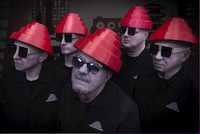
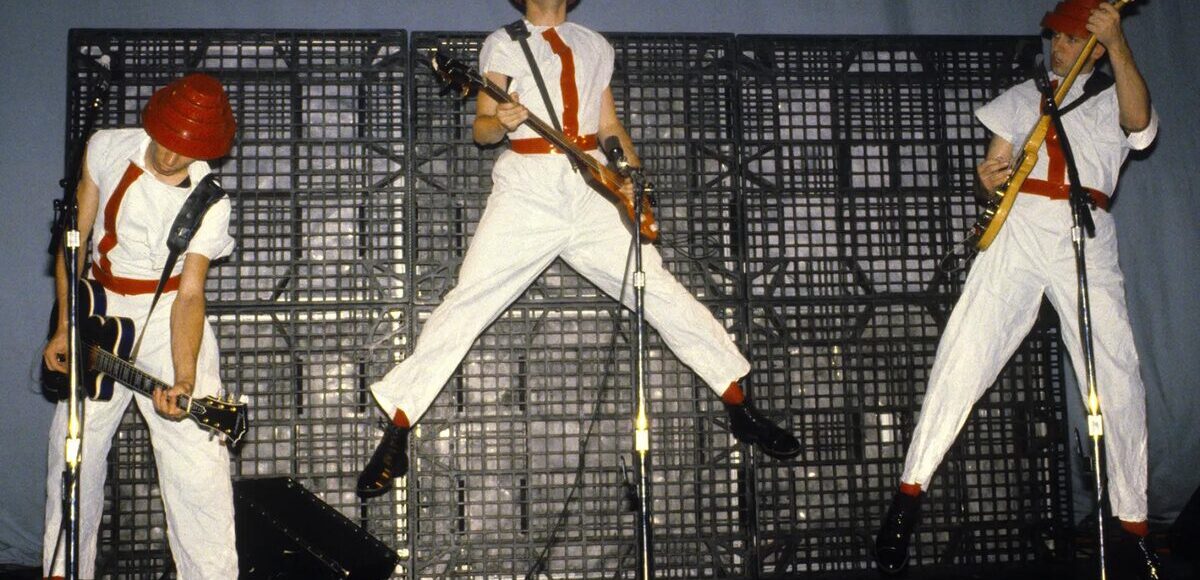
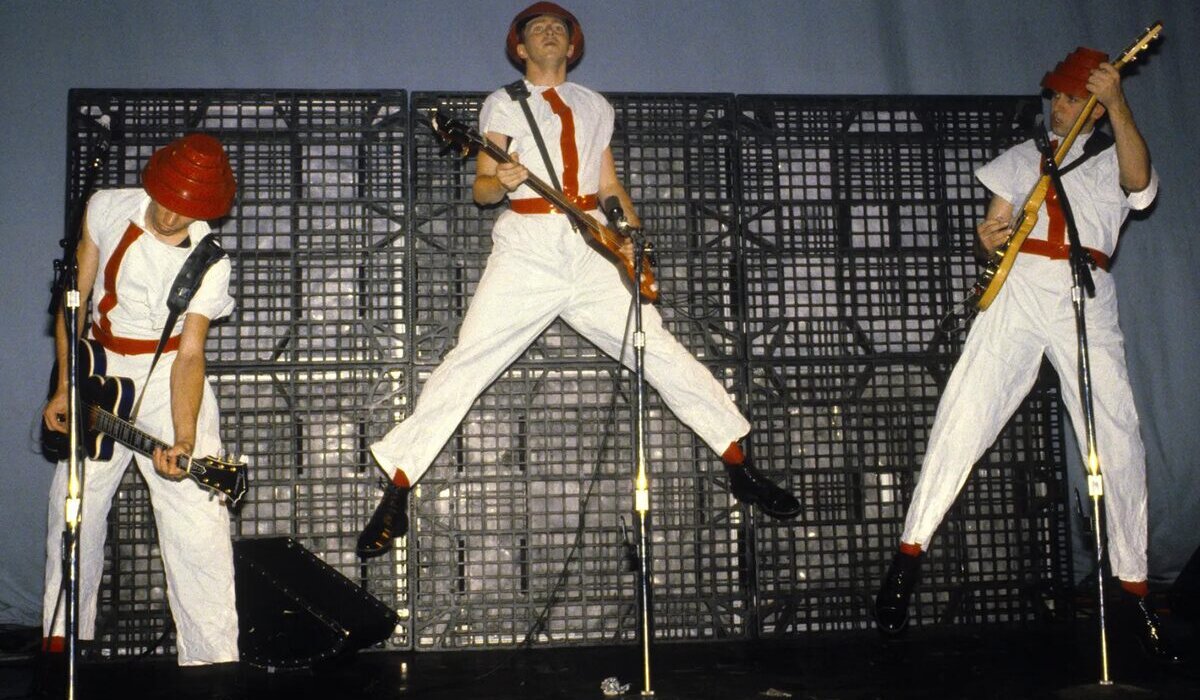
Duty Now for the Future (1979) kept the machine logic intact. Freedom of Choice (1980) delivered the commercial breakthrough. “Whip It” paired a dry funky guitar riff with a video of a cowboy in a surreal ranch scenario: absurdist, strangely catchy, and efficient enough to reach the US top ten. The red plastic Energy Dome hats and yellow radiation suits made the group readable in a single image. The band that had been serious about satire now had a novelty hit; they chose to go deeper rather than repeat it.
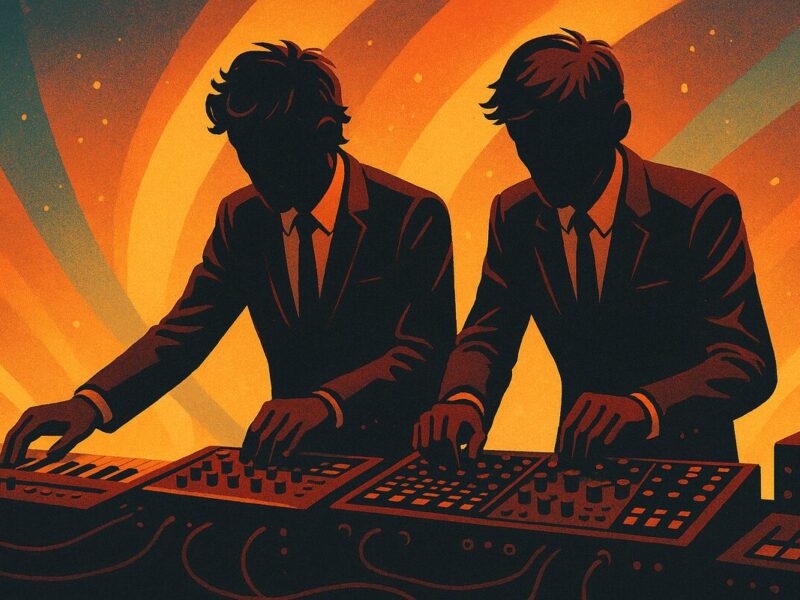
New Traditionalists (1981) and Oh, No! It’s Devo (1982) pushed further into synthesizers and drum machines, losing some of the early guitar clatter but keeping the flat-affect delivery and the lyrical irony. The grooves became cleaner and more suited to dancefloors, which made the social comedy land differently: less angry, more resigned. No. 1 in Heaven producer Giorgio Moroder had already shown how a sequencer pulse could carry a pop song; DEVO applied the lesson to their own material and kept the deadpan intact.
Mark Mothersbaugh moved into film scoring and commercial work, building a career as a composer for television and film, most recognizable in scores for Wes Anderson’s early features and the Rugrats animated series. Gerald Casale directed many of the band’s videos and continued performing. Bob Casale died in 2014. The group has continued in various configurations, touring regularly. Museum retrospectives have repositioned the early work as design history as much as pop history.
What made DEVO function was the unity of method: sound, clothing, video, and lyric said the same thing at once. The Energy Domes were not decoration; they were recycled brain waves, according to the band’s own mythology. The jumpsuits erased individuality. The stiff rhythms imitated assembly-line work. When Warner Bros. promoted them as a novelty act, the band responded with tighter concepts, not softer material.
The sonic toolkit is identifiable: a 4/4 pulse that feels locked rather than swinging, synthesizer lines that mimic rather than replace melody, vocals that refuse emotional color, short songs that rarely exceed three minutes and almost never develop toward a cathartic payoff. The closest comparison points are Kraftwerk’s mechanical rigor and the funk-inflected mid-period Talking Heads, though DEVO were noisier and cheaper-sounding than either, more interested in the joke than the groove.
Entry points are clear. “Whip It” is the familiar door. Q: Are We Not Men? is the sharper one, still disorienting after four decades. Freedom of Choice sits between both. Add “Mongoloid,” “Gut Feeling,” and “Beautiful World” to locate the range: theory, catchy, bleak. What they proved, from an Ohio basement to MTV rotation, was that pop’s surface could carry serious content without diluting either. The comedy was the vehicle. The groove was the point.