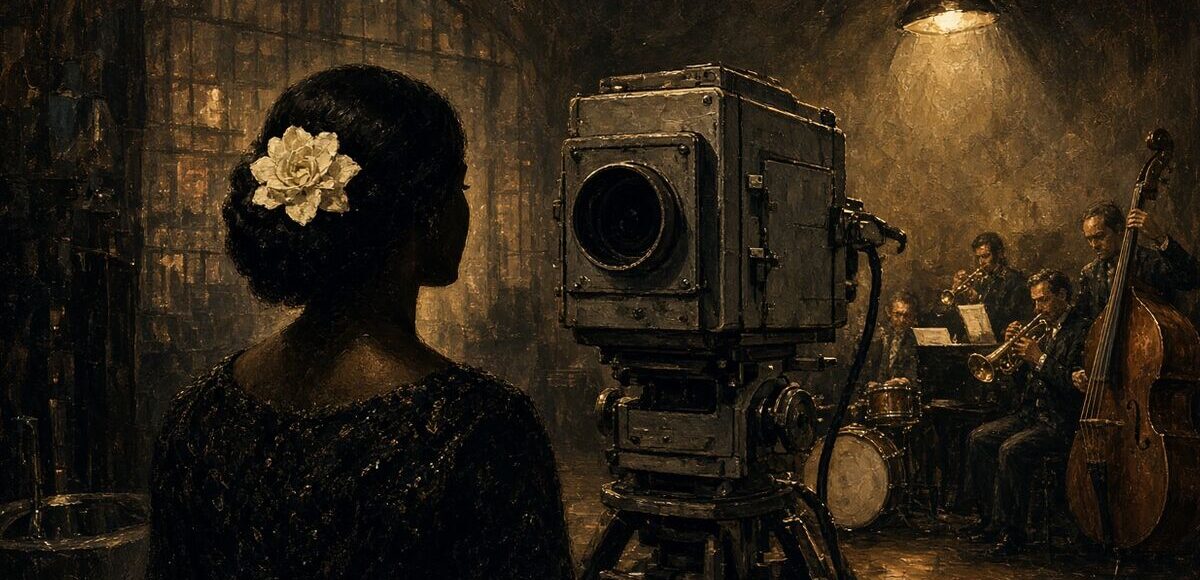
An experimental NBC camera records Strange Fruit in New York on 30 April 1939
At 9:42 on the evening of 30 April 1939, Billie Holiday stands beneath two hard lamps in an NBC experimental television studio at Rockefeller Center. The room is hotter than Café Society and much less forgiving. A bulky camera points at her from behind a glass panel. Fewer than a thousand television sets in New York can receive the signal.
There is no national television network in the modern sense. NBC is demonstrating a technology whose audience gathers in department stores, laboratories and a small number of private apartments. The program director has booked Holiday for a cheerful number that will show how a singer’s face survives transmission. She has agreed to perform What a Little Moonlight Can Do.
During rehearsal, she asks pianist Sonny White to remain after the applause light goes dark. He understands immediately. Strange Fruit has been part of her closing ritual at Café Society, where service stops and the room is darkened before the first line. Commodore Records issued her recording earlier that month after Columbia refused it.
The director, Warren Keller, sees the second sheet of music only minutes before broadcast. He objects that the song is slow, political and impossible to illustrate. Holiday tells him he does not need scenery. She will stand still, White will play and the camera can decide whether it is capable of looking.
The first number passes cleanly. A floor manager signals applause, Holiday smiles and the program should move to a demonstration of kitchen equipment. Instead, White plays the spare introduction to Strange Fruit. Keller orders a cut from the control room, but the engineer hesitates because no alternate camera is ready.
For just over three minutes, the image remains on Holiday’s face and shoulders. Early television cannot hide behind elegant editing. Her gardenia appears as a pale flare near her hair, and shadows deepen whenever she lowers her head. The microphone catches the words more clearly than the piano.
Technicians stop moving. In a department store on Broadway, shoppers who stayed for the novelty become quiet around six flickering sets. Students at an engineering laboratory lean closer to a screen the size of a postcard. Most New Yorkers see nothing that night, yet those who do cannot mistake the song for entertainment between demonstrations.
When the final line ends, Holiday keeps her eyes lowered. Keller refuses to switch on the applause sign. The signal carries four seconds of silence before NBC cuts to its test pattern. In the studio, a stagehand begins moving a chair and stops when he realizes the camera may still be live.
The complaints arrive the next morning. Sponsors object even though none bought time inside the experimental program. Southern radio affiliates, which did not receive the television signal, telephone NBC after reading wire reports. Network lawyers ask whether the performance was authorized. Keller claims Holiday changed the program without warning, which is almost true.
NBC orders the kinescope material locked away. In 1939, preserving television pictures is awkward, and this production has also been filmed directly on 16mm as a technical test. An engineer named Samuel Rosen makes two duplicate prints before delivering the original can. He tells himself he is protecting evidence of picture quality.
One copy reaches Barney Josephson at Café Society. He screens it after closing for Holiday, White and several staff members. Holiday dislikes the angle and says the lights make her look tired. Then she asks to see it again. On the second viewing, nobody comments until the reel has completely run out.
The film begins to travel through organizations that own portable projectors. Union halls, church basements and civil rights meetings show it after newsreels. Each screening has a larger audience than the original broadcast. The picture is scratched, sometimes too dark and often introduced by somebody who was not in the studio but claims to know exactly what happened.
Holiday feels the consequences onstage. Some club owners ask her to omit the song because the television story has made it more dangerous. She answers by borrowing the studio’s fixed attention: lights down, service stopped, no encore afterward. Audiences now arrive knowing the ending and still seem unprepared for it.
NBC tries to contain a broadcast that most of the country could never have watched. Newspapers describe the forbidden image, and readers imagine a national audience larger than the experimental transmitters could reach. By the end of 1939, the story has travelled farther than the transmitters.
In 1940, one duplicate is seized after a screening in Philadelphia and returned to NBC. Rosen’s second print remains outside the archive. During the war it appears at private programs for Black servicemen, although the War Department refuses an official request to use it. The projector noise becomes part of what viewers remember.
Commercial television expands after the war. In 1946, NBC includes Holiday’s performance in a demonstration of early broadcasting without explaining why it disappeared for seven years. Thousands of sets can now receive the image. Keller, still working at the network, leaves the building before transmission.
The close-up alters how younger singers know Holiday. Records carry the phrasing, but the film shows the cost of holding still while delivering it. Lena Horne watches a private screening and asks for the lamp levels before discussing the music. Students copy the gardenia. The costume does not give them the same concentration.
Holiday’s own life remains difficult. Television does not protect her from police attention, addiction, bad contracts or the loss of her cabaret card. The famous film can even become a burden when interviewers ask for the expression they remember from 1939. She sometimes refuses the song simply because a room expects it too eagerly.
After her death in 1959, NBC broadcasts the complete print during a memorial. Mail arrives from across the country, far exceeding the number of receivers available twenty years earlier. Viewers argue over whether television changed the song or merely preserved one night. The network quietly restores Rosen’s credit in its records.
Rosen keeps no diary of his decision. His daughter later remembers only that one film can in their apartment was never stored near the radiator. When archivists ask why he risked his job, she gives them his usual answer about machinery: if a picture matters, make another copy before somebody decides it does not.
Civil rights organizers screen the performance before meetings in the early 1960s. Its primitive fixed camera now feels direct rather than limited. The surviving print ends with Holiday lowering her eyes while the floor manager waits beside an unlit applause sign. The picture turns black. This time, the four seconds of silence reach millions of sets.