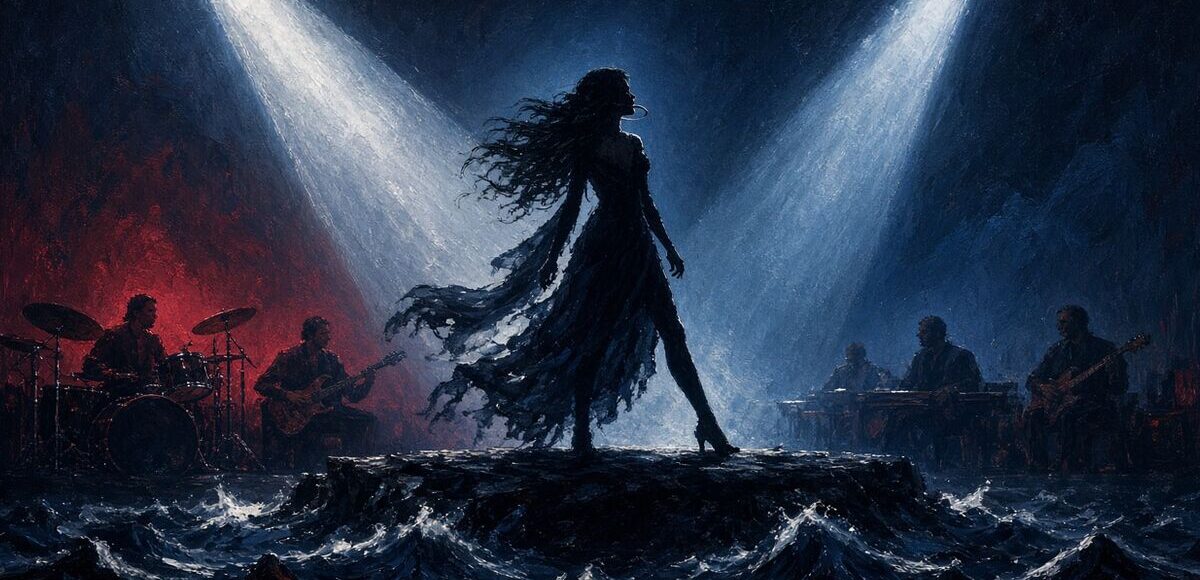
1986: Hounds of Love becomes a full theatre production
In November 1985, with Hounds of Love established as a success, Kate Bush enters a rehearsal hall and announces a tour. She has barely toured since the 1979 Tour of Life and knows exactly why: the new production must protect the songs, her voice and the people operating it. She books theatres, not arenas, and gives the team six months to build two connected acts.
December 1985. Bush draws the stage in notebooks: a front room for the first side and a moving black sea for The Ninth Wave. Every effect must be reset by six people, not hidden machinery. At Shepperton, Kate Bush walks every route herself before asking a dancer to attempt it. Choreographer Diane Grey adjusts the lifts, Del Palmer measures the time needed to change instruments and Preston Heyman tests drum parts against the recorded voices. The production grows from bodies and cues rather than from a promoter’s drawing.
January 1986. Del Palmer helps translate the studio arrangements for a compact band. Samples provide weather and voices, while drums, bass and keyboards remain visibly played. The second act’s sea is built from silk, rollers and men whose shoes keep sliding during rehearsal. Bush rejects a hydraulic platform after hearing its motor under And Dream of Sheep. A carpenter produces a quieter wooden frame, and the crew christens it the boat before anyone has painted it.
February 1986. A lightweight headset microphone is rebuilt after it catches on a costume. Bush rehearses running, turning and singing until the technology follows the movement rather than limiting it. Her voice determines the calendar. Two performances are followed by a rest day, humidifiers travel beside costumes and no interview is arranged after a show. Newspapers call the schedule cautious until the Manchester date, where she completes Waking the Witch while being lifted through smoke and returns for the encore sounding untouched.
April 1986. The first complete run lasts two hours and twenty minutes. She removes three songs, adds an interval and refuses to cut Cloudbusting, whose final procession solves the first act. The musicians stay in view of the room. Kevin McAlea moves between keyboards and reeds in full view, Charlie Morgan’s drums drive the running scenes and Alan Murphy gives the older songs a sharper guitar edge. Bush introduces the crew on opening night after forgetting to introduce herself.
May 1986. Opening night in Birmingham begins with a visible stagehand closing a window against recorded wind. The simple gesture tells the audience when everyday life has become theatre. Other pop acts send production managers to watch how film and live action share the same frame. They copy the moving screens more easily than the long rehearsal period, which is the expensive secret. Bush keeps her cue books and refuses requests to rent the ocean to an advertising campaign.
June 1986. During Running Up That Hill, Bush uses no large prop. Two dancers, angled white light and the band’s steady force are enough, and the performance becomes the show’s most repeated television clip. For the Birmingham opening, costume designer Pamela Keats has duplicates waiting beside both wings. A zip fails during Hounds of Love, and Bush completes the song in the red dress intended for the next scene. The color error looks deliberate from the stalls and is retained for the following week.
July 1986. The Ninth Wave occupies the second half. Film, live singing and cloth waves meet precisely, but one Paris night a torn seam leaves a sailor plainly holding the ocean together. The Paris seam failure produces the tour’s only unscripted character. Crew member Martin Phelps stands waist-deep in black cloth holding the torn wave while Bush sings above him. She introduces him at the curtain call as the man who kept everyone from drowning, and French television keeps the line in its report.
September 1986. The tour ends after forty-two performances as planned. Promoters offer more dates, but Bush sends the sets into storage and gives every crew member a bound copy of the stage notes. Director David Garfath edits the concert film around complete movements rather than applause. Bush removes a close shot that exposes a wire and restores a wide view where the audience can see how the lift works. The machinery remains part of the performance instead of pretending to be magic.
1987. A concert film is edited slowly, with fewer audience shots than the television company requests. Its release teaches a generation of directors to photograph choreography without cutting every second. Songs for The Sensual World are tested in the barn before their arrangements settle. Love and Anger gains a longer ending after Palmer and Murphy continue playing beyond a planned stop. Bush notes the extra bars in the same book that once held the measurements for the cloth sea.
1988. When work begins on The Sensual World, Bush writes with the practical memory of live breath. Several songs receive longer instrumental passages because she can already imagine the players onstage. The 1990 production carries fewer lorries because every object must serve two scenes. A wooden doorway becomes a bridge when laid flat, and a ring of lamps replaces three painted interiors. Reviewers call the result simpler, although the stage crew knows that simplicity required months of measuring.
1990. A second tour uses the same theatres and fewer moving parts. The new show places musicians around a circular floor, allowing Bush to change scenes by walking between them.
1993. The Red Shoes becomes less tied to film because a stage version is planned from the first demo. The album is shorter, and the tour allows the songs to grow after release.
2005. After a long recording break, Aerial arrives with no immediate tour announcement. This time, the album is announced with no tour date attached.
2014. Before the London residency, Bush opens a storage case from 1986. The cloth sea is faded and unusable, but its handwritten cue numbers become the first page of the new production book.
When rehearsals for the 2014 residency begin, Bush invites six members of the 1986 crew to inspect the plans. LeRoy Bennett finds his old lighting marks copied into the digital program, and Martin Phelps is shown a new wave operated from above, safely beyond his reach. Del Palmer tests the room with Running Up That Hill while younger technicians compare the live signal with a recording from Birmingham. Bush removes a projection that makes the ocean too literal and replaces it with moving shadows across the audience. During the final run, the cast reaches the end of The Ninth Wave without stopping. Nobody applauds because they are waiting for a note. Bush looks at the silent company, closes the cue book and says that the note is simply to do it again tomorrow.
On the final 2014 night, Bush opens the old cue book and shows the audience a page stained by the 1986 cloth sea. The new company performs Cloudbusting while veterans watch from the wings. When the doors close, the book returns to its case beside the papers from the 1986 tour and the 2014 residency.