Paris, 1970: Gainsbourg turns twelve linked songs into a night at the theatre
By 1970, Serge Gainsbourg has written hits for others, acted in films and recorded with Jane Birkin. Histoire de Melody Nelson does not yet exist when theatre producer Robert Dhéry asks whether his latest linked songs could fill a stage rather than another pair of singles.
The offer begins over dinner on rue de Verneuil. Dhéry has watched London import Hair and believes Paris needs a smaller production with sharper songs. Gainsbourg says he will write it if nobody asks him to produce a happy ending or dance in a kaftan.
Gainsbourg answers with twelve pages titled Les Couloirs de verre. The plot follows a French arranger and an English wardrobe assistant trapped overnight inside a television studio while sets from different programs roll past them.
The first score contains a melody later recognizable as Ballade de Melody Nelson, but the girl has no name yet. Vannier writes the theme for bass, strings and one flute. On paper it lasts ninety seconds; during rehearsal Birkin’s slow walk across the set stretches it to four minutes.
Birkin agrees to play the assistant if her French mistakes remain in the dialogue. Gainsbourg keeps three of them, invents two more and removes a joke when she tells him that audiences can recognize a man showing off.
Birkin is not cast as decoration. She plays Anne, the wardrobe assistant who knows how every television illusion is fastened. The male arranger boasts about sound while she locates the missing fuse, opens the locked door and sings the only melody the audience can hum at the interval.
Jean-Claude Vannier is hired to arrange the score for a small orchestra. Strings sit beside electric bass, drums, organ and a percussion table covered with keys, glasses and one bicycle bell that survives every budget meeting.
At the first orchestra rehearsal, Gainsbourg sits behind the drummer and rejects three polished overtures. Vannier asks the bassist to repeat four descending notes instead. The sequence is plain, slightly menacing and useful enough to carry scene changes throughout the night.
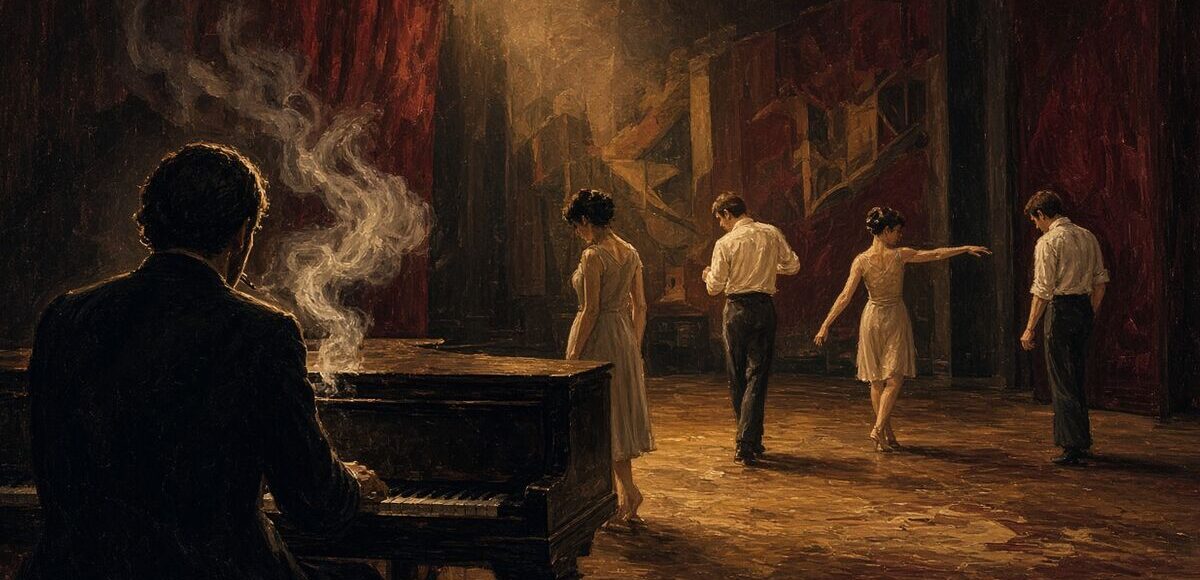
Rehearsals begin in September at the Théâtre de la Gaîté-Montparnasse. Gainsbourg dislikes repeating spoken scenes, so director Claude Régy marks the floor with tape and turns every cigarette break into a timed entrance.
Posters show an empty corridor and two abandoned cups. They do not use Birkin’s face or Gainsbourg’s name above the title until advance sales stall. The producer adds both names in red and the first week sells out by Thursday.
The premiere on 18 November 1970 is uneven and sold out. One scenery change jams for four minutes, Birkin sings La Loge 17 in front of a bare wall and the accidental simplicity earns the longest applause.
Opening night attracts film actors, chanson writers and critics prepared to dislike an imported form. A turntable fails during the second scene. Gainsbourg walks from the wings, places the needle by hand and receives a laugh he pretends not to hear.
Paris critics divide along familiar lines. Some call it a collection of songs wearing stage makeup, while younger reviewers praise the way studio sounds are produced visibly by musicians at the back of the set.
France-Soir calls the plot thin but prints the lyrics to La Loge 17. Combat praises Vannier’s orchestra. A television critic objects to Birkin’s accent, bringing exactly the sort of attention that sends viewers to hear it for themselves.
The cast album is recorded in January 1971. Les Couloirs de verre sells slowly at first, then a late radio broadcast turns Birkin’s La Loge 17 into a spring hit.
The show changes during its run. Two spoken scenes vanish, the bare-wall version of Birkin’s song becomes permanent and a comic duet called Service de nuit moves before the interval. Gainsbourg discovers that an audience can edit with coughs more quickly than a producer can with advice.
The songs intended for Melody Nelson have not disappeared. Gainsbourg reshapes several into a second act for a revised production, replacing the television studio with a hotel corridor and giving the red-haired heroine a motorcycle heard but never seen.
Philips records the cast after the musicians have played sixty performances. They know every pause, so the album is completed in three days. Vannier adds strings only to the overture and leaves the stage band exposed elsewhere.
The 1972 London production is shorter and more comic. Birkin corrects the English adaptation, Gainsbourg complains that his deliberate awkwardness has become proper grammar and the bicycle bell receives its own notice in one newspaper.
The unfinished Melody material becomes a new character rather than a separate record. In the second Paris season, a red-haired woman crosses the corridor, leaves a hotel key and disappears on the sound of a motorcycle. She has no dialogue, but reviewers mention her first.
After two years, Gainsbourg returns to records with a different habit. He writes songs in sequences, tests transitions with actors and keeps instrumental passages long enough for a set to change behind them.
London producers request an English version with Birkin as co-adaptor. She removes French jokes that depend on pronunciation and adds one about a director who cannot operate his own lift. Gainsbourg complains until the joke receives applause, then claims it was his.
His 1975 stage work L’Homme à l’envers brings reggae musicians visiting Paris into the orchestra three years before Jamaica becomes central to one of his albums. The rhythm changes the production first and his studio work afterward.
Theatre imposes habits on his later studio work. He records complete sequences, leaves space for entrances and asks engineers how long a reel change takes. Singles still appear, but several arrive connected by instrumental passages as if a curtain might rise between them.
By the early 1980s, French producers finance small pop musicals without treating them as imported curiosities. Gainsbourg advises some, insults most and insists that every orchestra remain visible at least once during the evening.
L’Homme à l’envers in 1975 places a colonial administrator, a hotel singer and a Jamaican drummer in the same failing resort. The production is attacked from several sides, closes after nine weeks and leaves behind a rhythm section Gainsbourg later takes into the studio.
In 1987, Birkin joins him for a final benefit performance of Les Couloirs de verre. The scenery behaves, the old bell rings on cue and Gainsbourg waits in the wings until her last note before allowing the curtain to close.
For the 1987 benefit, the original corridor is rebuilt from photographs. Birkin finds her old mark beneath fresh paint. Gainsbourg watches from beside Vannier’s music stand, waits until La Loge 17 ends and closes the glass door himself before the blackout.
Other French writers begin treating pop theatre as a practical venue instead of a foreign spectacle. Michel Berger visits rehearsals, Jacques Higelin accepts a stage commission and small rooms program musical narratives with five players rather than casts of fifty.