
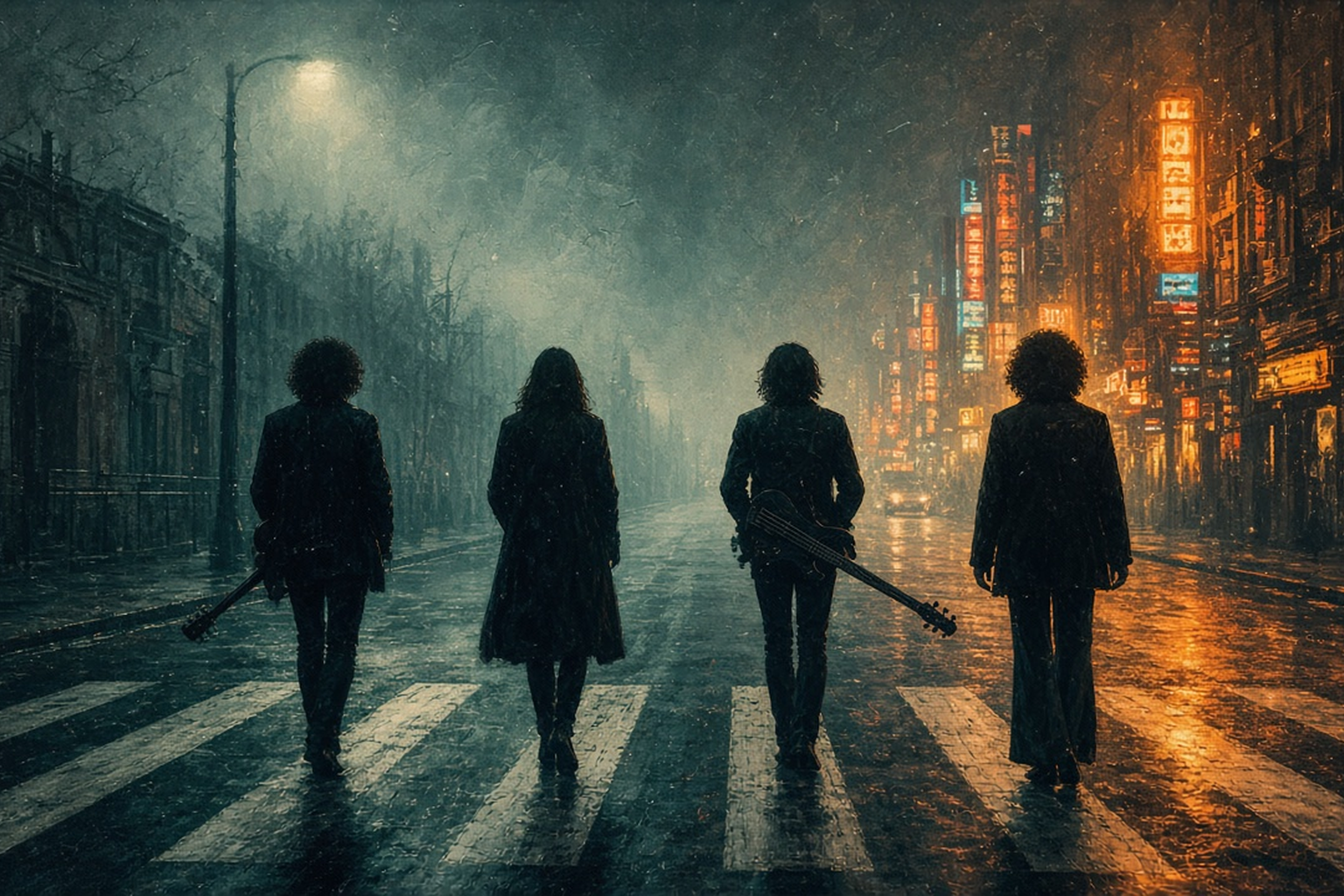
Four shadows on an endless road
In a parallel 1970, the lawyers never arrived with their quiet papers. Apple still existed as a mess of good intentions, bad accounting, and brilliant songs half-finished on the floor. Paul still wrote melodies that smiled before they confessed anything. John still wrote melodies that argued with the furniture. George still waited for space and then filled it with something nobody had asked for. Ringo still kept time like a man holding four egos in one pair of hands.
They stayed in the same room longer than history allowed. Let It Be did not become a funeral film. It became a rehearsal for the next decade. The rooftop concert ended, yes, but the four of them walked downstairs, ordered tea that went cold, and booked more days instead of more silence. Yoko still drew in a corner. Linda still took photographs. Mal Evans still carried the amplifiers as if they were family heirlooms. Nobody declared victory. Nobody declared an ending.
By late 1970 they were back at Abbey Road with a title nobody liked and a working name that changed every Tuesday. John wanted politics. Paul wanted harmony. George wanted the middle eight to mean something spiritual without sounding like a pamphlet. Ringo wanted lunch. Out of that ordinary quarrel came an album that sounded like four radios playing in adjacent rooms until, somehow, they locked into the same weather.
The first single arrived in spring 1971 with a shrug and a hook. Radio stations argued about which Beatle was singing the verse. Teenagers learned the chorus in schoolyards from Hamburg to Tokyo. Critics called it transitional. Fans called it proof. The band called it Tuesday and went back into the studio.
Touring returned carefully. Not the screaming cages of 1966, not the total vanishing either. They played theatres where people could hear the bass. They played parks where people brought blankets and arguments. In New York, John almost walked off after a question about peace. In Liverpool, Paul almost cried after a question about home. In Los Angeles, George found a quiet corridor and tuned his guitar until the wood answered. In Tokyo, Ringo signed so many drumsticks that his wrist ached for a week.
Between 1972 and 1975 the catalogue grew strange in the best way. A gospel shuffle sat next to a Moog sketch. A children’s nonsense rhyme sat next to a political snarl. There was a song about a dog that became an unlikely anthem in Brazil. There was a song about money that got banned on two continental stations and then requested twice as often. George finally got three tracks in a row on one side of a record and pretended not to notice. Paul noticed. John pretended not to notice that Paul noticed. Ringo noticed everything and said almost nothing.
They fought, of course. Someone stormed out every other month. Someone came back with tea, or with a new riff, or with a newspaper cutting that ruined the mood and then improved the lyric. Managers tried to invent solo projects as escape valves. Solo projects happened, briefly, like weekends away from a marriage that refused to die. Then the four of them returned because the songs kept arriving with four names already written into the silences.
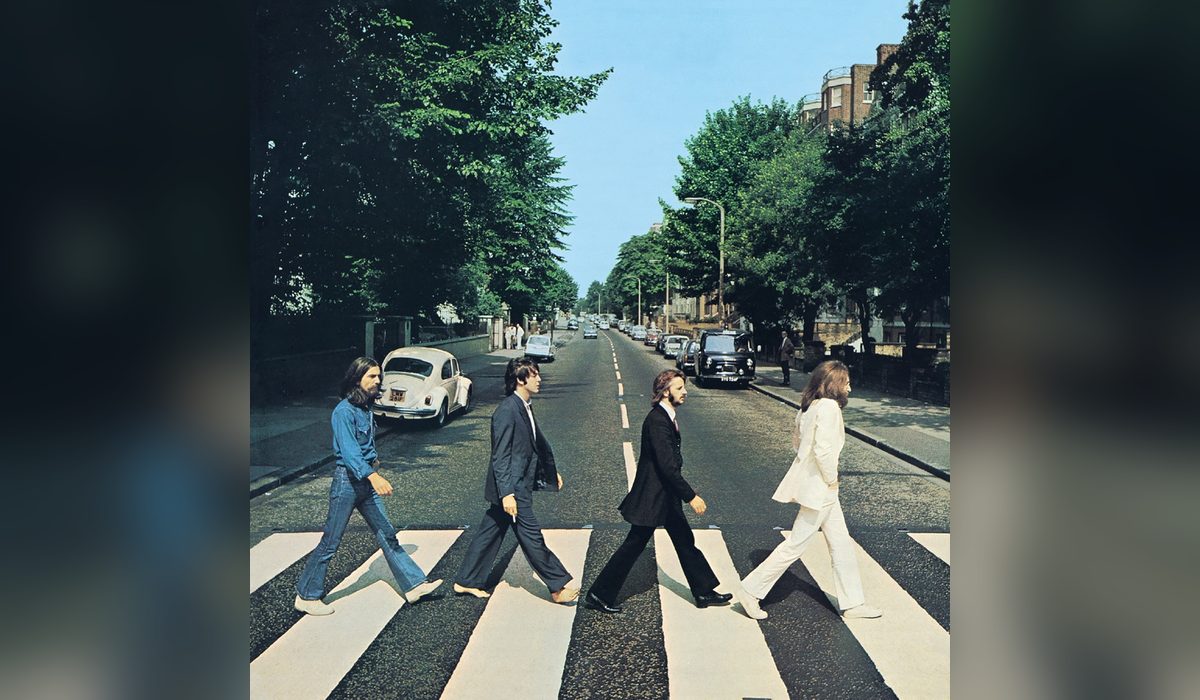
In 1976 a double album landed like a weather system. Side one was almost polite. Side two was almost rude. Side three was almost holy. Side four was almost danceable, which alarmed everyone. On the cover, four shadows stretched down an endless road that looked a little like Abbey Road and a little like nowhere. Fans argued for years about whether the fourth shadow was Ringo or the future.
Television still wanted them neat. They refused neatness with charm. On one chat show Paul answered a question about fame by talking about gardening. On another, John answered a question about gardening by talking about fame. George brought a ukulele and made the host nervous. Ringo brought a story about a hotel breakfast that somehow became a parable about loyalty.
By the early eighties younger bands were copying the chemistry and discovering you cannot photocopy four people who have already survived each other. Punk spat at them and then secretly learned their bridges. Disco borrowed their bass lines and returned them glittering. MTV asked for videos. They gave them black-and-white sketches of hands, clocks, and a drum kit left alone in an empty hall. The videos looked unfinished. That was the point.
There were near endings. In 1981 a week of silence followed a fight so sharp that even the tea went untouched. Newspapers printed obituaries for the band while the band was still breathing. Then a cassette arrived at each flat with the same unfinished chorus and four different second verses. They reconvened not out of nostalgia but out of curiosity. Curiosity, it turned out, was the real glue.
The late albums grew quieter and stranger. Horns appeared and disappeared. Children’s choirs were invited and then politely uninvited. A track recorded in a kitchen in Sussex somehow became a standard at weddings. Another track, barely two minutes long, closed stadiums with a hush. John joked that they had finally learned economy. Paul said they had finally learned patience. George said they had finally learned to listen. Ringo said they had finally learned when to stop for chips.
In that weather, breakups still threatened every Tuesday. Someone still slammed a door. Someone still muttered that it would be easier alone. But the myth never froze into four solo careers chasing separate ghosts. It kept moving: imperfect, loud, unfinished, alive. The songs carried arguments inside them the way houses carry footsteps.
In the nineties they surprised everyone by releasing a brief, almost shy EP of songs written in hotel corridors between charity shows. No spectacle, just four voices learning new weather again. Bootlegs multiplied. Scholars wrote papers. Children who had never seen the sixties danced to a bridge written in a traffic jam outside Heathrow. The band, amused and slightly alarmed, kept writing anyway.
A documentary crew followed them for six months and captured almost nothing dramatic, which was the most dramatic thing of all: tea, jokes, unfinished choruses, and the daily labour of remaining a we instead of four carefully branded I’s. When the film finally aired, people cried at a scene where Ringo simply counted off a take and everyone listened.
Decades later, when grey hair had arrived and the applause had learned new rituals, they stood together on a stage accepting an honour none of them trusted. The medal was heavy. The room was warm. Paul leaned toward John and whispered, “Do you ever wonder what would have happened if we’d actually split?” John smiled sideways. “What, and leave the arguments unfinished?” George tuned a string that did not need tuning. Ringo counted them in one last time, softly, as if time itself were a song that refused to end.
And the hall filled with that unmistakable shimmer of four people who chose the harder harmony, again and again, until history had no choice but to keep listening.
In interviews they developed a shared sport: answering as each other. Paul did John’s sarcasm. John did Paul’s optimism until it cracked into honesty. George did silence better than either. Ringo did the punchline that saved the afternoon. Audiences left unsure who had spoken and certain that the band, somehow, still had.