1970 onward: the band that never signed the papers
January 1970. The lawyers never arrive with the dissolution papers. Apple stays a mess of unpaid bills, unfinished tapes, and four diaries that still share the same year. Paul still writes melodies that sound light before the words turn. John writes lines that start an argument. George waits for a gap between the other two. Ringo keeps time and keeps the room steady. The Beatles do not break up. They book another week at Abbey Road.
Let It Be does not become a funeral film. After the rooftop set they walk downstairs, order tea that goes cold, and argue about overdubs instead of endings. Yoko draws in a corner. Linda takes photographs. Mal Evans carts amplifiers as if they were family furniture. Nobody calls the week a victory or an ending. By autumn they are back in Studio Two with a working title that changes every Tuesday.
John wants politics on side one. Paul wants three-part harmony before lunch. George wants the middle eight to sound spiritual without sounding like a leaflet. Ringo wants chips. Out of that ordinary quarrel comes Open Calendar, released in March 1971 on Apple. The first single, “Tuesday Morning Wire,” arrives with a shrug and a hook. Radio stations argue about who sings the verse. Schoolyards from Hamburg to Tokyo learn the chorus before the papers settle the credit.
Critics file the album as transitional. Fans take it as proof the group still works. The four of them call it Tuesday and go back in. George Martin produces with a thinner patience than in 1967, but he still knows when to leave a take alone. Phil Spector is kept away from the final mixes after one loud afternoon involving strings and a slammed door. The record charts in Britain and America. Beatlemania is over. Four men are still employed by the same argument.
Touring returns carefully in 1972. Not the screaming cages of 1966, and not silence either. They play theatres where the bass can be heard. They play parks where people bring blankets and opinions. In New York, John nearly walks off after a press question about peace. In Liverpool, Paul nearly cries after a question about home. In Los Angeles, George finds a quiet corridor and tunes until the wood settles. In Tokyo, Ringo signs so many drumsticks his wrist aches for a week. The set lists mix new songs with older ones. Nobody pretends the past is closed.
Between 1973 and 1975 the catalogue grows odd in useful ways. Four Rooms (1973) puts a gospel shuffle next to a Moog sketch. A children’s nonsense rhyme sits beside a political snarl. “Dog on the Pavement” becomes an unlikely anthem on Brazilian radio. “Ledger Blues” is banned on two continental stations and then requested twice as often. George finally gets three tracks in a row on side two and pretends not to notice. Paul notices. John pretends not to notice that Paul noticed. Ringo notices everything and says almost nothing. Wire and Wood follows in 1975 with shorter songs and longer silences between them.
They fight, of course. Someone storms out every other month. Someone returns with tea, a new riff, or a newspaper cutting that ruins the mood and then improves the lyric. Managers float solo albums as escape valves. Paul cuts a brief set of home demos at his farm. John records a rough New York EP with Elephant’s Memory horns. George issues a quiet single about waiting rooms and incense. Ringo fronts a pub-band side project for six weeks in Cheshire. Then the four of them reconvene because the next chorus already has four names written into the gaps. The press calls these weekends “solo seasons.” The band calls them holidays from each other that somehow end in the same studio.
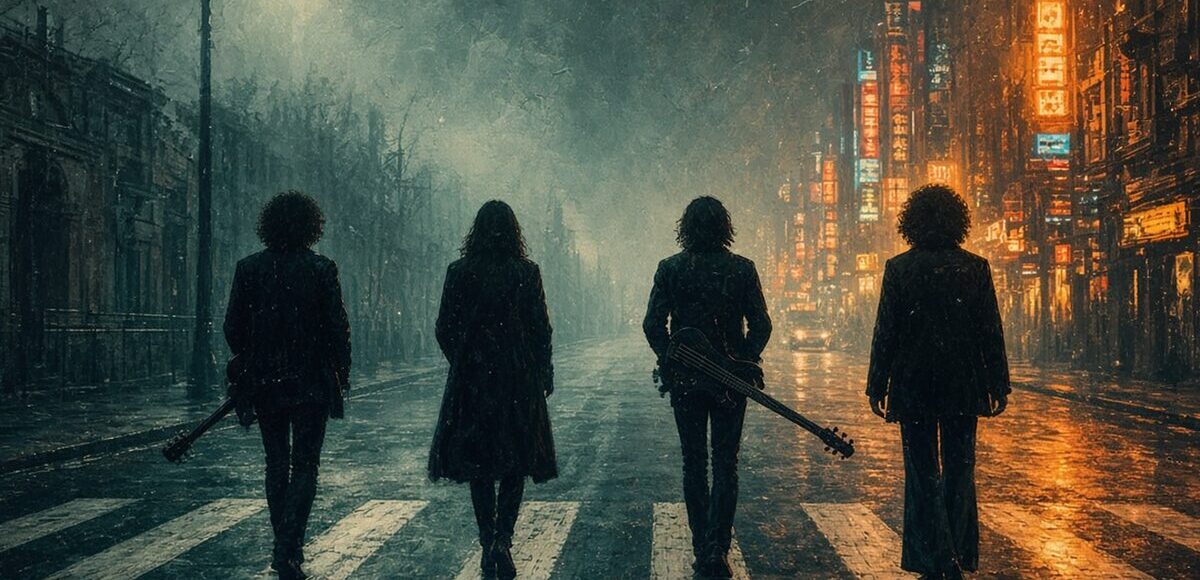
In autumn 1976 the double album Endless Road lands hard. Side one is almost polite. Side two is almost rude. Side three is almost holy. Side four is almost danceable, which alarms everyone at EMI. The cover shows four shadows on a road that looks a little like Abbey Road and a little like nowhere. Fans argue for years about whether the fourth shadow is Ringo or the next decade. The tour that follows sells out without the old hysteria. People listen. That was not the old habit. In Chicago a review praises the bass. In Manchester a review praises the arguments between songs. Both are right.
Television still wants them neat. They refuse with charm. On one chat show Paul answers a question about fame by talking about gardening. On another, John answers a question about gardening by talking about fame. George brings a ukulele and makes the host nervous. Ringo tells a hotel-breakfast story that somehow becomes a lesson about loyalty. In interviews they invent a shared sport: answering as each other. Paul does John’s sarcasm. John does Paul’s optimism until it cracks. George does silence better than either. Ringo does the punchline that saves the afternoon.
Punk spits at them in public and learns their bridges in private. Disco borrows their bass lines and returns them glittering. In 1980 MTV asks for videos. They send black-and-white sketches of hands, clocks, and a drum kit alone in an empty hall. The clips look unfinished. The band likes that. Night Shift (1980) is quieter than the seventies records. Horns appear and vanish. A children’s choir is invited, then politely uninvited after one awkward afternoon. A kitchen take from Sussex, “Cold Kettle,” later becomes a wedding standard. A two-minute closer hushes whole stadiums. John jokes they have finally learned economy. Paul says patience. George says listening. Ringo says knowing when to stop for chips.
There are near endings. In March 1981 a fight over publishing and a lyric about New York leaves the tea untouched for a week. Newspapers print obituaries for a band that is still breathing. Then a cassette arrives at each flat with the same unfinished chorus and four different second verses. They reconvene out of curiosity, not nostalgia. The unfinished chorus is what gets them in the room. Second Verse (1982) is imperfect and loud. It charts anyway. Through the mid-eighties someone still slams a door every few months. Someone still mutters that it would be easier alone. Solo weekends still happen. The story never settles into four separate careers that no longer meet.
In 1991, between charity shows, they cut a shy EP in hotel corridors outside Heathrow. No spectacle. Just four voices writing together again. Bootlegs multiply. Scholars write papers. Children who never saw the sixties dance to a bridge written in a traffic jam. A documentary crew follows them for six months in 1994 and captures almost nothing dramatic: tea, jokes, unfinished choruses, the daily work of remaining a band. When the film airs, people cry at a scene where Ringo simply counts off a take and everyone listens. In 1996 they play a short residency at the Royal Albert Hall. No fireworks. Just four microphones, a drum kit, and songs that still argue politely with each other between verses.
Decades later, grey-haired and accepting an honour none of them trusts, Paul leans toward John. “Do you ever wonder what would have happened if we’d actually split?” John smiles sideways. “What, and leave the arguments unfinished?” George tunes a string that does not need tuning. Ringo counts them in one last time, soft and sure, and the other three come in on his count.