
Moscow, 1958: a different cradle for the King of Pop
August 29, 1958. In a fifth-floor communal flat near Taganka Square, Katherine Jackson wraps a newborn in a wool blanket while the samovar ticks. Joseph is already late for rehearsal with the State Jazz Orchestra of the RSFSR. The boy’s papers read Mikhail Iosifovich Jackson. Neighbors shorten it to Misha. Years later Western posters will still say Michael. The city outside is grey buses, wet cobbles, and radio speakers that prefer marches to Motown. That is the first fact that changes everything.
Everything else about the child stays stubbornly familiar. He is shy. He watches feet before faces. He copies dance steps from Pioneer Palace instructors with a precision that embarrasses older boys. Joseph runs a hard household, same as in any universe. The difference is the soundtrack. Instead of Gary street corners, Misha hears accordion practice through thin walls, Red Army Choir broadcasts at lunch, and, on lucky nights, a neighbor’s forbidden reel-to-reel of James Brown and the Supremes, taped off Voice of America and hidden under a mattress.
By 1969 the Jackson siblings are a state-approved VIA, a vocal-instrumental ensemble booked for factory clubs and Young Pioneer camps. They call themselves Semya. The repertoire mixes Soviet estrada, careful covers of Western hits with Russian lyrics, and original songs Joseph pushes into every set. Little Misha sings lead in a voice that should not belong to a child. At the Rossiya concert hall, a Party official leans toward an aide and says, almost annoyed, that the boy makes the room lean forward. Tickets for their next oblast tour sell out in an afternoon.
Smuggled Motown and Stax records reshape their evenings. Misha studies Berry Gordy’s arrangements the way other kids study chess openings. He learns that a pause can be louder than a shout. He practices spins until the linoleum squeaks. When Semya records for Melodiya in 1971, the single Malenkiy Prints becomes a radio staple from Leningrad to Alma-Ata. Western A&R men hear a bootleg at a Berlin trade fair and write the name Jackson in notebooks next to a question mark and a red star.
The 1970s turn him into a Soviet television habit. Variety shows put him in glitter jackets the wardrobe department borrowed from circus storage. He smiles on cue, then vanishes into rehearsal rooms where the smile disappears. He wants funk bass lines Melodiya engineers are not supposed to chase. He wants a drum sound that hits like American radio. Producers tell him to wait. He waits by rewriting choruses at 3 a.m. under a desk lamp.
1979 is the hinge. During a cultural exchange in Helsinki, Misha slips away from his handlers for ninety-seven minutes and records a demo with a Finnish session band. The tape holds three songs in English, including a draft of what will later be called Don’t Stop ’Til You Get Enough. A CBS scout buys the reel for cash and a promise. Back in Moscow, Joseph is furious. The Ministry is worse. Then someone higher up hears the numbers a Western release could bring in hard currency. The scandal becomes a project.
In 1980, Off the Wall appears in the West under the name Michael Jackson, with liner notes that quietly admit a Moscow birth. Quincy Jones still produces. The difference is the press story: a Soviet prodigy who learned swing from bootlegs and ballet from state schools. American critics argue about ideology in the first paragraph and the bass line in the second. The album sells anyway. In the USSR, Melodiya issues a trimmed version titled Svet Diskoteki. Queues form outside record shops on Kalinin Prospekt before sunrise.
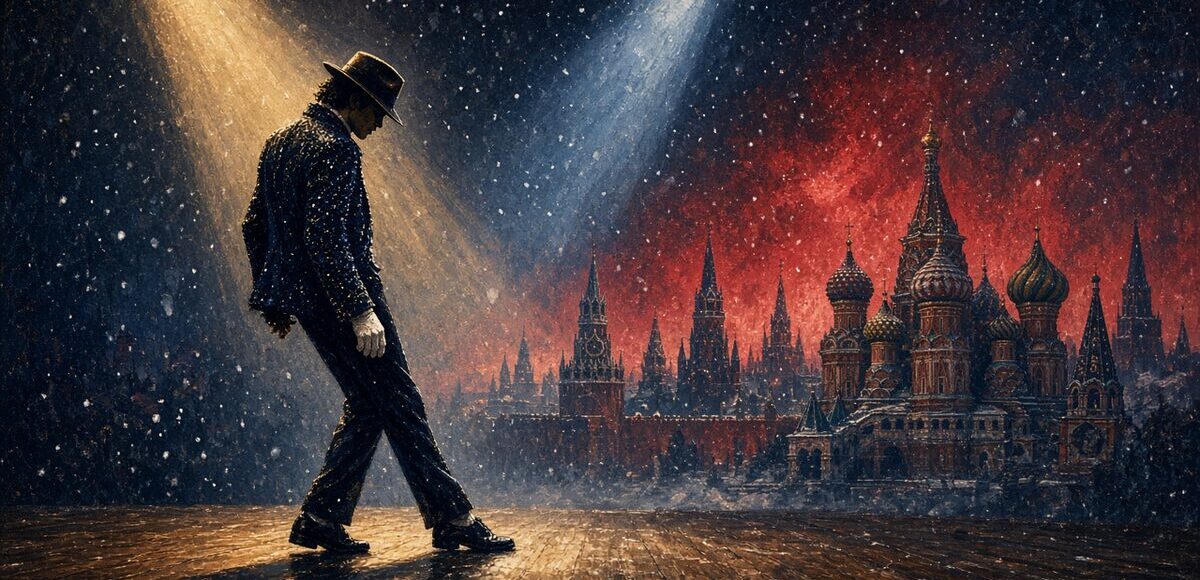
Then comes 1982. Thriller is cut between Los Angeles overdubs and a secret Moscow week where Michael insists on finishing vocal takes in a studio that still smells of cigarette ash and floor wax. The moonwalk is not invented on Motown 25 alone. He road-tests a sliding step months earlier on the wooden stage of the Luzhniki Palace of Sports, during a closed rehearsal for a Friendship Games gala. Stagehands swear the floor moved. A KGB major in the third row writes one word in his notebook: polezno. Useful.
When the Billie Jean performance finally hits American television, the suit is sequined, the sock is white, and the biography in the chyron reads Moscow / Los Angeles. Teenagers on both sides of the Curtain copy the lean. In East Berlin, a school bans the dance and guarantees its immortality. In Leningrad, students chalk glove outlines on courtyard walls. MTV cannot air half of what Soviet youth already pass hand to hand on VHS.
The industry rearranges itself around the anomaly. Pepsi still wants the face. So does a Soviet soft-drink plant in Rostov that launches Misha Cola with a cartoon glove on the label. Michael hates both campaigns and shows up for neither photo shoot on time. He is gentler with dancers than with executives. He flies home between legs of the tour to see his mother, then returns to arenas where the chant mixes English and Russian until the syllables blur.
Live Aid in 1985 has a Moscow satellite stage. While London and Philadelphia play the usual history, Michael opens the Luzhniki feed with We Are the World rewritten for a bilingual choir of Soviet and American children. The satellite delay makes his first gesture land a half-second late. He turns the lag into a joke, freezes mid-pose, and the stadium laughs with him. Western anchors scramble for metaphors. Eastern anchors simply let the cameras run.
Fame thickens. Tabloids invent romances in Paris and protocol crises in Prague. A British paper claims he asked to buy the Bolshoi for private rehearsals. He did ask. The Ministry said no, then offered midnight access twice a month if he recorded a Friendship song for television. He recorded it in one take and never sang it again in public. Perfectionism survives every border.
In 1987, Bad arrives with a video shot partly on a closed stretch of the Moscow Metro after hours. Dancers in leather jackets spin between marble columns while startled night workers watch from the stairs. The single Man in the Mirror gets an official Russian translation that softens nothing important. On the Bad world tour, the Budapest date feels like a dress rehearsal for history. The Prague date feels like the real thing. Crowds pour past police lines without quite becoming a riot. Michael leaves the stage soaked, whispering thank you in two languages into a dead microphone.
Perestroika turns him into a symbol he never applied for. Reformers quote his interviews about discipline and kindness. Hardliners call him a Trojan horse in glitter. He answers by funding a children’s hospital wing in Gorky and a dance scholarship that accepts applicants from any republic. He still hates speeches. He still shows up.
The 1990s are messier, as they are everywhere. Dangerous leans further into new jack swing and still carries a choir recorded in a Moscow church with the priest standing just out of frame. Scandals travel faster than albums. He retreats to a dacha outside the city between court dates and comeback plans, planting trees with the same focus he once gave to footwork. Neverland exists, but it has a birch grove and a banya, and the train that circles the property plays both Russian folk tunes and the Jackson 5.
On stage he remains undeniable. The 1993 Super Bowl halftime still happens. So does a rain-soaked Moscow anniversary show in 1996 where he opens with Wanna Be Startin’ Somethin’ while fireworks compete with a summer thunderstorm. Bootleg traders later argue which night was better. Dancers from both productions say the same thing: he counted every step like a debt he intended to pay in full.
By the 2000s the myth has two capitals. Gary, Indiana becomes a footnote in museum captions that begin in Taganka. Documentaries argue whether the moonwalk belongs to American television or to that closed Luzhniki rehearsal. Michael, when asked, only says the floor was important. He grows quieter. He releases less. When he does appear, the glove still draws a sound from the crowd that needs no translation.
In 2009 the world still loses him too early. The tributes fill Times Square and Red Square on the same night. In Moscow, strangers leave white socks at the base of a temporary stage. In Los Angeles, someone plays Billie Jean from a car window until the battery dies. A former Melodiya engineer tells a camera crew that the boy from the communal flat always asked for one more take. A former Motown dancer says the same sentence in English. For once the biographies agree.
Years later, a restored Melodiya flat-box of Svet Diskoteki sells at auction next to a sealed Western pressing of Thriller. Collectors fight over both. Schoolchildren in two languages still learn the lean, the spin, the sudden stillness. The question that started this story answers itself in the footsteps: the King of Pop could have been born under different flags and still bent the century toward the beat. The cradle changes. The dance does not.