One count, a whole band of sweat
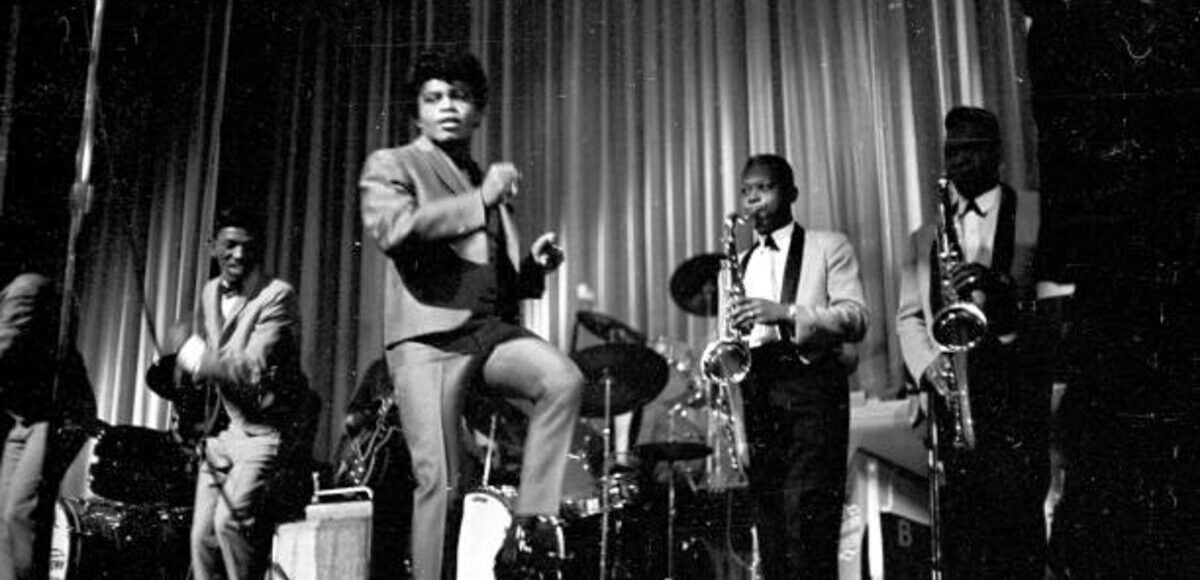
James Brown did not ask a band to keep time. He counted it into their bodies. A raised knee, a dropped hand, a shout that was also a cue: the Famous Flames, and later the J.B.’s, learned to breathe on his grid. Born in Barnwell, South Carolina, on 3 May 1933 and raised in Augusta, Georgia, he came up through gospel, talent shows, and a reform school. By 1956 Please, Please, Please had turned a plea into a stage ritual, the cape, the collapse, the return. The song was not finished when the record ended. It was finished when he said so.
The proof that a live room could be the composition arrived with Live at the Apollo, taped on 24 October 1962 and released the next year after he put his own money behind a document King Records did not trust. You hear the theatre answer him. Papa’s Got a Brand New Bag in 1965 and I Got You (I Feel Good) move the accent off the polite beat and onto the guitar scratch, the horn stab, the grunt. Cold Sweat in 1967 is often called the start of funk, which is a tidy sentence for a messier fact: he had been stripping songs down to a pulse for years, and now the pulse was the song.
The night that fixed the legend for people who never bought the records was filmed. At the T.A.M.I. Show in 1964 he followed a bill of teenagers and, by the time the Rolling Stones had to come on after him, the floor was already his. The cape routine, the drops to the knee, the microphone as a baton: none of it was decoration on top of a song. It was how the song was conducted. In the studio he worked the same way, often fast. Papa’s Got a Brand New Bag was cut quickly, the band learning the new accent while the tape rolled, which is why the record still sounds like a discovery rather than a product. He trusted the first time a groove frightened him.
The late sixties gave that pulse a public address. Say It Loud – I’m Black and I’m Proud in 1968 is a chant with a backbeat, built so a room can finish the line. He played for troops, he played Boston the night after Martin Luther King was killed and the city stayed standing, and he talked about business as if owning the masters were part of the rhythm. Not every political gesture aged cleanly. The music did not need the speeches to stay specific. One chord, worried until it confessed, was already an argument.
In 1970 the band changed temperature again. Bootsy Collins, Catfish Collins, Fred Wesley, Maceo Parker: Sex Machine, Super Bad, Soul Power. The bass does not walk. It jabs. The Payback in 1973 opens like a threat and then settles into a groove so wide you can stand inside it. He fined musicians for missing a step. The fines are part of the legend and part of the method. A James Brown record is a set of instructions you can dance to, delivered by a man who trusted repetition more than melody.
The eighties sampled him into a second career he did not always control. Hip-hop producers lifted the grunt, the scratch, the one, and built new songs on a second of his band. He kept touring. The cape routine never became a museum piece because he still meant the collapse. He died on 25 December 2006, and the arguments about the estate outlived him, which is a strange footnote for a man who had spent fifty years trying to own his own count.
What a singer takes from him is not a costume and not a split. It is the idea that a voice can be a conductor’s stick. Put on Cold Sweat or the Apollo tape and the downbeat is a decision, made in public, over and over, until the room is working as hard as he is.