
Five songs, nine weathers, a park with no path
Another Green World does not announce itself as a revolution. It opens, on Sky Saw, with a guitar that really does sound like a saw, John Cale’s viola weeping once, and a voice that arrives late, as if the instrumental had been the point all along. Island Records released the album on 14 November 1975. It did not chart in Britain or America. The people who needed it found it anyway, the way you find a path by walking off the path.
Eno recorded at Island Studios in London in July and August 1975, with Rhett Davies engineering, and with the Oblique Strategies cards he had made with the painter Peter Schmidt sitting in the room as a third collaborator. The method was not chaos. It was a way of refusing the first idea. Phil Collins plays drums. Percy Jones plays fretless bass. Robert Fripp, credited with a Wimshurst guitar on St. Elmo’s Fire, plays the solo Eno compared to an electrostatic generator: sparks, restraint, no showing off. The band is a series of visits, not a lineup.
Five tracks have words. Nine do not. That ratio is the album’s plot. St. Elmo’s Fire is the pop song, a refrain you can carry out of the room, dressed in what Eno called desert guitars. I’ll Come Running is almost sweet, a promise with Fripp’s lead curled around it. Golden Hours and Everything Merges with the Night let a simple chord sequence wear a strange coat. Then the instrumentals take over: The Big Ship, In Dark Trees, Sombre Reptiles, Becalmed, Spirits Drifting. They are not leftovers. They are the green world the title promised, places with names and no narrator.
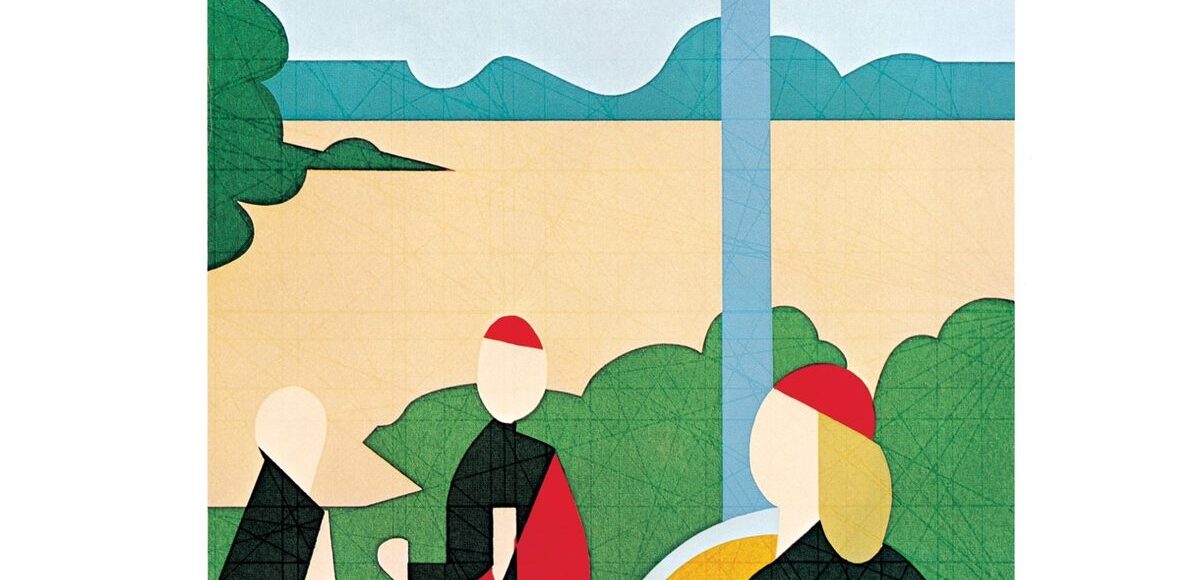
The cover is a detail from Tom Phillips’s painting After Raphael, a pastoral that looks borrowed from another century and slightly wrong, which is exactly the sound. Eno had already made Here Come the Warm Jets and Taking Tiger Mountain (By Strategy), art-rock albums with jokes in the lyric sheet. This one keeps the jokes quieter and the atmosphere louder. He was not yet the full ambient theorist of Discreet Music, released the same year, but he was already letting processes share the burden. The songs are short. The feeling is not.
Another Green World is indeed an important record, and also a brilliant one.
(Charley Walters, Rolling Stone, 1976)
Robert Christgau, who came around to the album, called it the aural equivalent of a park on the moon. The line is fair. You can walk it in the background and feel calmed, then stop on Zawinul/Lava or Little Fishes and find a shape you missed. The risk Eno insisted on, Walters wrote, kept paying off. There is no single that explains the record. There is a sequence that teaches you how to listen to sequences. That lesson would matter more than any chart position the album never had.
The downstream is famous and still worth saying plainly. David Bowie asked Eno into the room for Low, “Heroes” and Lodger, and the instrumental weather of those records is unthinkable without this one. Producers who later talked about texture rather than chorus were quoting a 1975 habit, whether they named it or not. Another Green World is not a blueprint you can photocopy. It is a permission: to leave nine tracks without words, to let a bass be fretless and a guitar be a saw, and to call the result a world. The park is still open. The path is still optional.