Manchester, 1989: Squire’s chiming guitars, Reni’s swing, Brown’s drawl, and a debut that rewired indie
The Stone Roses made one of the most discussed debut albums in British rock history and then spent five years largely absent before returning with something so different it sounded like a different band. That contrast defines them as much as the record that made them famous.
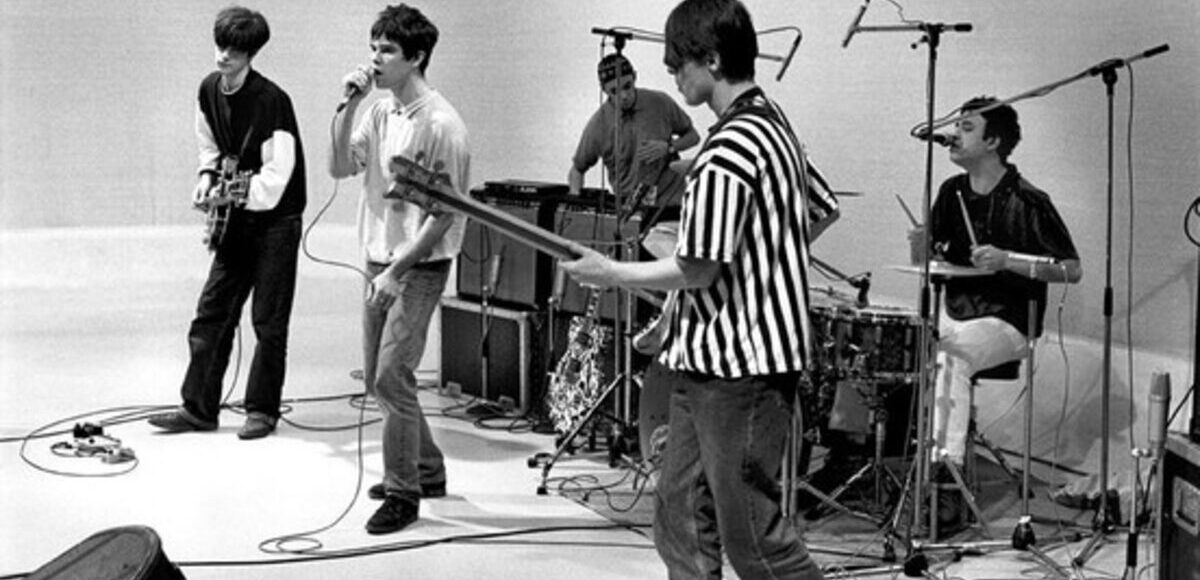
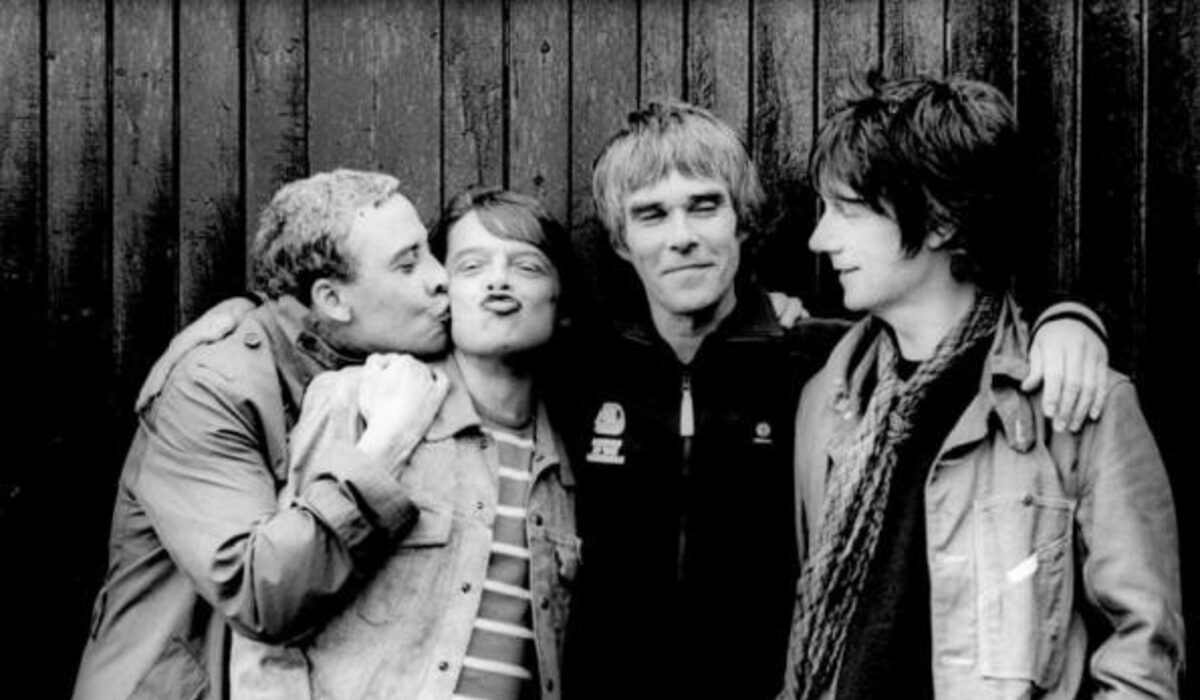
Ian Brown, John Squire, Gary “Mani” Mounfield, and Alan “Reni” Wren came together in Manchester in the mid-1980s through the usual combination of school friendships and mutual dissatisfaction with what guitar bands were doing. Manchester at that point was producing The Smiths and the aftermath of Joy Division, Factory Records’ determined alternative culture project, and the Hacienda’s acid house nights. The Stone Roses were paying attention to all of it, and also to The Byrds, The Beatles’ psychedelic period, and the Jimi Hendrix Experience — an eclectic set of references that their first records absorbed with unusual fluency.
The Stone Roses (Silvertone, 1989) worked because it synthesized rather than copied. Squire’s guitar approach was built on George Harrison’s chiming open-chord shapes and The Byrds’ twelve-string jangle, but laid over rhythms that had absorbed enough club music to make the whole thing move differently from straight indie. Reni’s drumming was the technical revelation of the record — jazz-informed swing underneath guitar-band surface, precise and propulsive without ever losing the groove. Mani’s bass worked with the kick drum rather than against it, carrying the dancefloor logic that the acid house era had embedded in the Manchester consciousness. Brown’s vocals were deliberately nasal and loose-limbed, a drawl sitting on top of the music rather than driving it; the effect was swaggering rather than sung.
“I Wanna Be Adored” opens with bass alone, unhurried, before Squire’s guitar enters ringing over a steady groove. “She Bangs the Drums” is melodic pop with a rhythm sophisticated enough for the dancefloor. “Waterfall” and “Elizabeth My Dear” showed the range: the first circular and hypnotic, the second a thirty-second acoustic provocation set to Scarborough Fair. “I Am the Resurrection” closes the original running order with a twelve-minute fade that moves from song to instrumental workout without losing the thread. The sequencing was not accidental — the album builds from invitation to euphoria to dissolution.
The band’s live reputation in 1989 and 1990 was substantial. The Spike Island concert in May 1990, drawing around 27,000 people to a chemical works site outside Widnes, became a generational reference point even for those who were not there. The EP turns extended the palette: “Fool’s Gold” with its extended funk groove and wah-guitar, “One Love” with its dub undertow, showed a band listening to James Brown and hip-hop as seriously as they were listening to the Byrds. The singles sat between the guitar-band world and the club world in a way that neither camp fully claimed.
Then the legal battle with Silvertone Records, an injunction preventing them from releasing new material for two years, and accumulating delays slowed everything. Second Coming arrived in 1994, five years after the debut, to divided reception. The heavy blues rock of “Breaking into Heaven,” “Ten Storey Love Song,” and “Love Spreads” confused listeners who had been waiting for something that rhymed with 1989. Squire had spent the intervening years absorbed in Led Zeppelin and had moved the guitar center of gravity substantially. Brown’s voice, better suited to the looser material, strained on the heavier tracks. Second Coming is not a poor record, but it is not a continuation of the debut — it is a different argument made by musicians who had moved in different directions during the absence.
Squire left in 1996; Reni had already departed. Brown pursued a solo career that found its audience without finding broad critical agreement with the debut’s reputation. The 2011 reunion brought the classic lineup back for stadium shows and substantial ticket sales; “All for One” (2016) arrived without substantially advancing the critical conversation.
The influences traceable in the debut are worth naming. The Byrds’ melodic principle without necessarily the twelve-string. The Beatles’ structural confidence. George Harrison’s approach to guitar as melody rather than rhythm. The rhythmic vocabulary of acid house operating under what appeared to be a guitar-band surface — the Stone Roses were a club band that did not look like one, which is what made “Fool’s Gold” surprising even to listeners who had loved the album.
Entry points: the debut in sequence, because the sequencing matters. It builds from “I Wanna Be Adored” to “I Am the Resurrection” with intention and rewards the full run. Add “Fool’s Gold,” “One Love,” and “Elephant Stone” for the singles picture. Second Coming for the harder chapter, approached as a separate document rather than a sequel. The debut holds because it was genuinely new in 1989, and the synthesis it represents still sounds specific enough to be its own thing three decades later.