




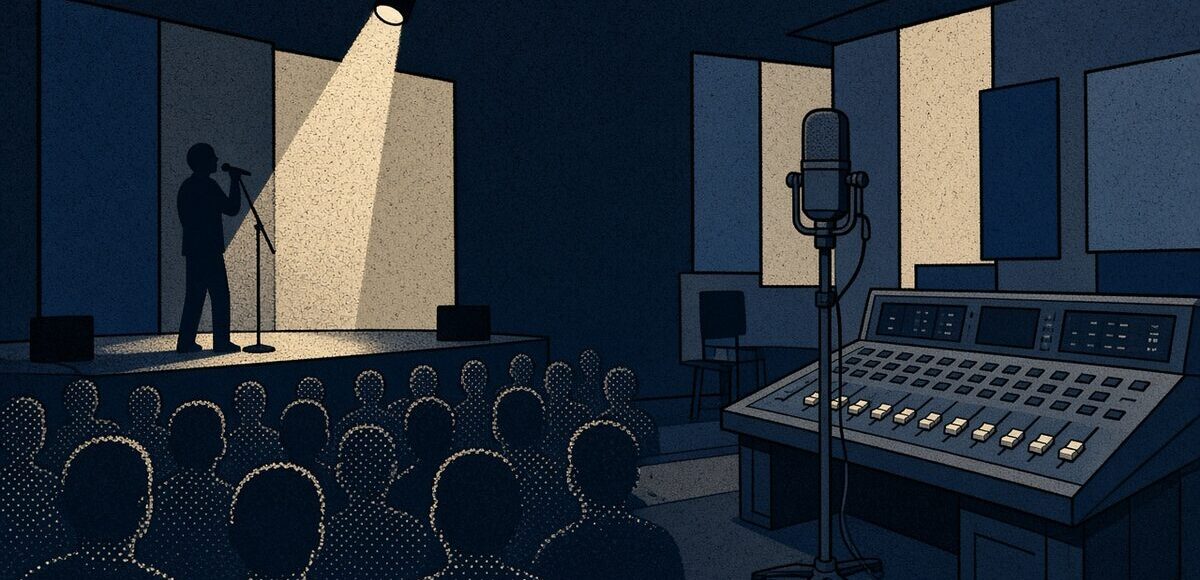
Sweat and risk on stage, or control and detail on tape — where does an artist sound most true?
Some records are built to be perfect: layered vocals, fixed tempos, edits that remove the stumble. Some nights on stage are built to be alive: tempo drifts, solos stretch, the crowd sings the bridge before the band does. Both can be artistry. The debate is which setting reveals what an artist really is.
The studio camp points to albums that could not exist live in their recorded form — Pet Sounds, a lot of late Beatles, dense electronic records, hip-hop productions that treat the desk as an instrument. In the room with time and microphones, musicians can invent textures and architectures that a single take cannot hold. For these listeners, the finished album is the statement.
The live camp answers with nights that rewrite the catalogue: James Brown’s band on a good run, jazz solos that never repeat, rock shows where a song grows ten minutes past the studio map, acoustic sets that strip a hit to voice and guitar. Bootlegs, live albums and concert films keep that argument in circulation. Truth, here, means risk and presence.
Streaming and social video blur the line: polished “live” sessions, corrected vocals on tour, albums recorded on stage. Still, when fans argue after a gig or a remaster, they often split the same way — fidelity to the record versus electricity in the room.
Where do you hear the artist more clearly: in the controlled studio take, or in the night that could have gone wrong? Defend your side below with a performance or a record that settled it.
Noémie C. | 6 September 2026
|
I’ve cried more at quiet club gigs than at perfect studio albums. Proximity matters.
Marcus J. | 10 September 2026
|
Studio is the recipe. Live is the meal when the kitchen is on fire. I need both, but truth? Sweat tells more.
Yuna S. | 12 September 2026
|
Some voices only open up on stage. Others melt in the booth. Depends on the artist, not a rule.
Ben T. | 15 September 2026
|
Took my kid to a small venue last year. Watching musicians glance at each other mid-song is something albums don’t show.
Hélène V. | 21 September 2026
|
Live bootlegs from the 70s taught me more than remasters. Wrong notes included.
Aisha B. | 23 September 2026
|
As a DJ I live for the room reacting. Studio tracks are a starting point. The night changes them.
Sam W. | 26 September 2026
|
studio. live is just louder mistakes lol
Chris O. | 27 September 2026
|
Studio for detail. Live for risk. My collection is 60/40 and I’m fine with the imbalance.
Hugo B. | 5 October 2026
|
Festival muddy sound vs studio headphones. Different contracts with your ears.
Sara | 10 October 2026
|
Tiny room, 80 people, bass in my ribs. That’s the art I pay for.
Jules M. | 11 October 2026
|
Control is underrated. Not every stumble is authenticity. Studio.
Chloé | 11 October 2026
|
Went to see a ‘perfect’ show with tracks. Felt like karaoke with lights. Live means risk.
Maya | 11 October 2026
|
Exactly. That crowd moment. Studio can’t fake that.
Louise | 12 October 2026
|
My uncle recorded jazz in one take philosophy. He still edits takes though. Nobody’s pure.
Pierre | 13 October 2026
|
Honestly depends on the artist. But forced to pick: studio craft over chaos.
Emma | 13 October 2026
|
The crowd singing the bridge before the band? Chills. Live wins.
Ben | 13 October 2026
|
I love overdubs. Sue me. Layers are storytelling. Studio.
Tom Riff | 13 October 2026
|
Albums age. A night doesn’t. Live.
Greg | 14 October 2026
|
James Brown tapes. End of discussion for the live side.
Marc G. | 14 October 2026
|
Some electronic records simply cannot be ‘true’ live without becoming a different song. Studio.
Anne | 14 October 2026
|
First concert: wrong notes everywhere, grin on the singer’s face. Hooked for life.
Amy | 14 October 2026
|
If the studio version is a cathedral, the live version is the street outside. I live on the street.
Carmen | 14 October 2026
|
Late Beatles records are studio essays. Trying to make them ‘true’ on stage misses the point.
Mateo | 14 October 2026
|
My partner only likes polished studio. I only like sweat. We argue weekly. I’m right (live).
Inés | 15 October 2026
|
Streaming ‘live sessions’ with perfect pitch correction? That’s studio in a costume.
Diego | 15 October 2026
|
Studio is where they invent. Stage is where they prove it. I need both but truth leans live.
Elena N. | 15 October 2026
|
Bootlegs taught me more about artists than remasters. Live camp.
Léa | 15 October 2026
|
I’m a producer. The desk is an instrument. Studio truth is real truth.
François | 15 October 2026
|
Saw a band nail their album note-for-note. Bored me. Then they jammed and I stayed.
Jackie | 15 October 2026
|
Voice cracked mid-chorus at a tiny venue. Best version I ever heard.
Olivier | 16 October 2026
|
Pet Sounds exists because of the studio. Live purity is a romantic myth.
Alex | 16 October 2026
|
Live. Always. If it can’t survive a bad PA and a weird crowd, what’s the point?