Tines, not strings, and a warmth that is slightly wrong
Harold Rhodes built the first of these pianos for wounded airmen in the Second World War, a small teaching instrument made from scrap, meant for hospital beds rather than ballrooms. The idea survived the war. In 1959 he went into business with Leo Fender, and the Piano Bass, thirty-two keys of electric low end, reached players first. Ray Manzarek would later run Doors songs off that bass version. The full piano took longer. It had to learn how to be a piece of furniture and a circuit at once.
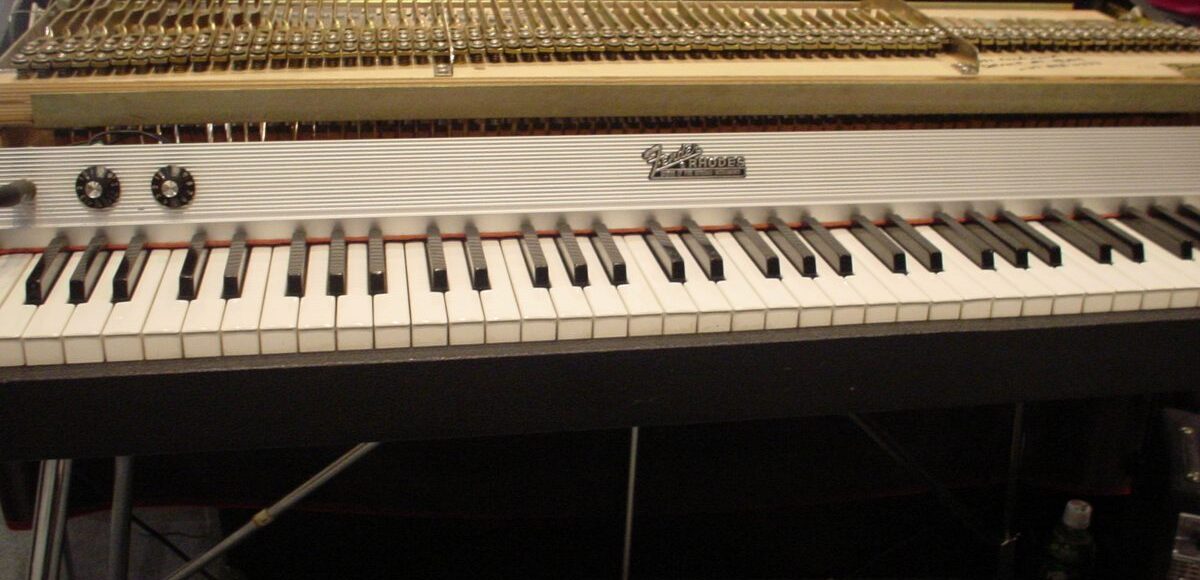
The mechanism is simple and fussy. A hammer strikes an asymmetric metal tine, coupled to a tone bar, and a pickup reads the result the way a guitar pickup reads a string. There is no sounding board in the acoustic sense. The warmth people love is a flaw in the metal: inharmonic partials, a bell inside the note, a decay that does not behave like a Steinway. CBS bought Fender in 1965, and the Rhodes name rode along, through arguments Harold Rhodes would spend years trying to win back.
The Suitcase model, around 1970, put amplifier and speakers in the lid. You could open it on a club stage and the piano was already a band. The Mark I became the classic. Miles Davis’s electric turn is unthinkable without it: Chick Corea and Herbie Hancock on In a Silent Way in 1969 and on Bitches Brew in 1970, chords that hover instead of landing. The instrument did not replace the acoustic piano. It gave the music a second weather.
Soul and pop took the same tines and made them intimate. Billy Preston, Donny Hathaway, Stevie Wonder: the Rhodes became the sound of a confession that still wanted rhythm. Bob James’s Angela, the theme of Taxi, is a Rhodes figure as public as a skyline. Steely Dan parked it under songs that pretended to be cynical and were, underneath, lush. The attack is soft. The sustain is where the feeling hides, a little out of tune with itself, which is why it never sounds cold.
The Mark II arrived in 1979, tidier, and the arguments among players began: which era, which preamp, which lid. None of that stopped the instrument from returning when the 1990s and 2000s wanted warmth again. D’Angelo’s Voodoo, in 2000, is a Rhodes record as much as it is a voice record, the tines carrying the drag of the groove. Neo-soul did not invent the sound. It remembered that a piano could be electric and still feel like a room.
What the Rhodes never did was imitate ivory honestly. It offered a parallel piano, one you plug in, one that sings a few cents off and makes the offness the point. From a wartime lap instrument to a suitcase on a Miles Davis stage, the path is American in the practical sense: scrap, a partnership, a pickup, then a whole genre leaning on the result, night after night. The hum is part of the harmony.