



Dexter Gordon’s tenor carries a Paris night in 1959
Dale Turner speaks slowly, with a clear pause between sentences. Bertrand Tavernier’s Round Midnight (1986) casts Dexter Gordon as a fictional saxophonist in 1959 Paris, a composite drawn from Lester Young, Bud Powell and Gordon’s own career, and François Cluzet as Francis, a French record collector who hears the wear in the playing and still offers a spare room. The plot is a friendship between musician and fan. The subject is the cost of another night’s work when the work is jazz and the body has already given too many nights. Paris is not a prize for surviving the United States. It is a smaller room, a colder walk home, an audience that listens and a business that still pays poorly.
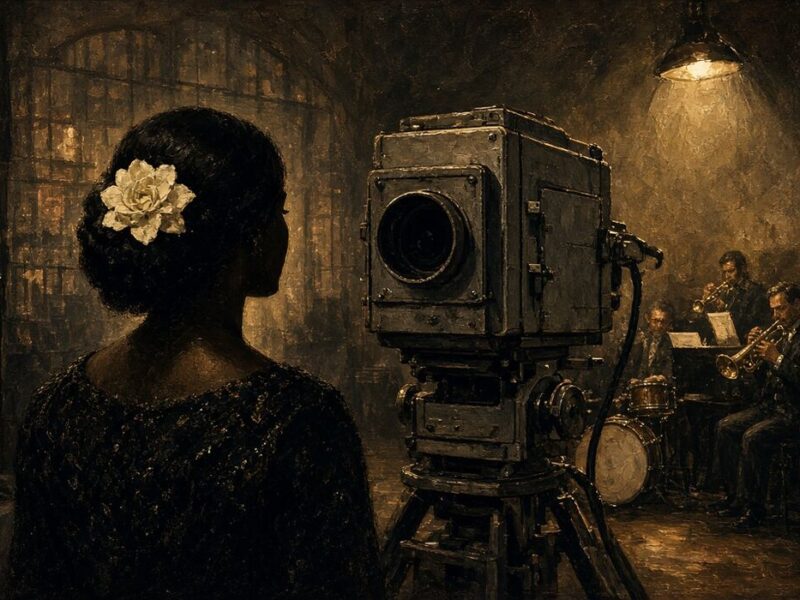
Gordon was not a trained actor, which is why the performance is hard to fake. He plays his own tenor. He lets silences stand. The hat, the glasses and the fatigue stay attached to the work, not to costume. Herbie Hancock wrote the score and won the Academy Award for Best Original Score, rare praise for music that had to function as atmosphere without telling anyone when to cry. In the club the film calls the Blue Note, Hancock, Billy Higgins, Bobby Hutcherson and the rest do not mime a rhythm section. They play. The camera holds long enough that you hear a solo choose its next phrase. Lonette McKee appears as an old love, a short visit with a voice. The title is Thelonious Monk’s ballad. The melancholy was already in that tune before the script.
Tavernier, a French director steeped in American cinema, skips the expatriate fairy tale. Francis wants to rescue Dale and wants to stay near the music; the film lets both motives stand without turning the fan into a saint or the musician into a lesson. Jazz films often cheat by cutting the playing down to a flourish. This one trusts the audience to watch men work. Blues and jazz, filed together on a site like this, share that ethic: the time taken is part of the music. Round Midnight treats a ballad as the evening itself, not as a pause between plot points. When Dale lifts the horn, the story steps aside and the dramatic event becomes a phrase held exactly as long as it needs.
He is a musician, not an actor, and yet no actor could have given this performance, with its dignity, wisdom and pain.
(Roger Ebert, Chicago Sun-Times, 1986)
Gordon earned an Oscar nomination for Best Actor and carries it the way he carries a phrase: without rushing the last bar. Biopics of the same decade wanted confession and collapse on a schedule. Tavernier wanted the sound of a man who has not collapsed yet, who might, and who is, for these bars, exact. The film ends the way a set ends, not the way a sermon ends. Someone has been heard. Someone has changed by listening. The film does not stage that as a redemption.
Gordon died in 1990, and the performance can still be watched. Round Midnight is still the music film that treats a solo as a dramatic event equal to a kiss or a blow. For listeners who know Monk’s ballad, Hancock’s score, or Gordon’s own late records, the picture is less a biopic than a long take on how jazz sounds when nobody is rushing the cut. In the Blue Note, under a readable sign, a saxophonist finishes a phrase he started before the movie began. The apartment light stays on a little longer than the scene needs. That extra minute shows care in the cut, and it is a reason to watch with the volume up.
Rosa | 10 October 2026
|
Short: good reminder that film can argue about music without a lecture. I told my coworker and they shrugged. Their loss.
Marie-Claire | 10 October 2026
|
biopics usually annoy me. This one at least respects the songs. Might be recency bias but I do not care today.
Nina Bass | 11 October 2026
|
Showed it to a friend who hates musicals. Partial conversion. Progress.
Inés | 12 October 2026
|
I argued about this film for years. Fresh ammo. Thanks. Also the comments section on old forums was wild about this.
Mateo | 13 October 2026
|
Rewatch value is mostly the set pieces. I’m fine with that. Needed that.
Anne | 13 October 2026
|
This made me queue the OST before the rewatch. Correct order maybe. I told my coworker and they shrugged. Their loss. Ok bye.
Diego | 13 October 2026
|
The performance scenes are why I bother. Article nails that.
Yuki | 14 October 2026
|
Watched it again after reading. The music cues hit harder now. Also the comments section on old forums was wild about this.
Elena N. | 14 October 2026
|
I came for the soundtrack, stayed for how the film uses silence too. Coffee got cold while I finished the article. Acceptable.
Léa | 15 October 2026
|
Biopics usually annoy me. This one at least respects the songs. I told my coworker and they shrugged. Their loss.
Sara | 16 October 2026
|
I argued about this film for years. Fresh ammo. Thanks. Anyway.