
Beats, strings and one Icelandic weather
Homogenic did not arrive as a compromise. On 22 September 1997, One Little Indian put out Björk’s third studio album, and the first gesture is a hunter, not a host. Hunter opens on beats that stutter and strings that move like weather. She had asked for one flavour. What she got was a landscape: volcanic, exact, and unwilling to split the difference between a dance floor and a fjord. The voice sits in the middle, neither sweetened nor hidden.
The privacy was practical. After the glare around Post and the remix set Telegram, her tour drummer Trevor Morais offered El Cortijo, his studio near Málaga, in San Pedro de Alcántara. She had meant to pass through, meet the flamenco guitarist Raimundo Amador, and leave. She stayed and made the record there, with later work at her house in London. She stepped away from Nellee Hooper, who had shaped Debut and Post. Mark Bell of LFO became the electronic interlocutor who could surprise her. Guy Sigsworth, Howie B and the engineer Markus Dravs are in the credits. The point was a single climate, not a crowd.
The songs keep that climate and still refuse to repeat it. Jóga, written for her friend and released as the lead single on 15 September 1997, is a vow set to strings that swell like a coastline. Michel Gondry’s video walks Iceland as if the island were the lyric. Unravel is smaller, an accordion and a heart described as a ball of yarn the devil collects. Bachelorette, arranged in part with Eumir Deodato conducting where she did not arrange herself, is the album’s opera moment: a declaration big enough for a stage, still sung like a letter. The Icelandic String Octet is the other voice in all of this, not a garnish.
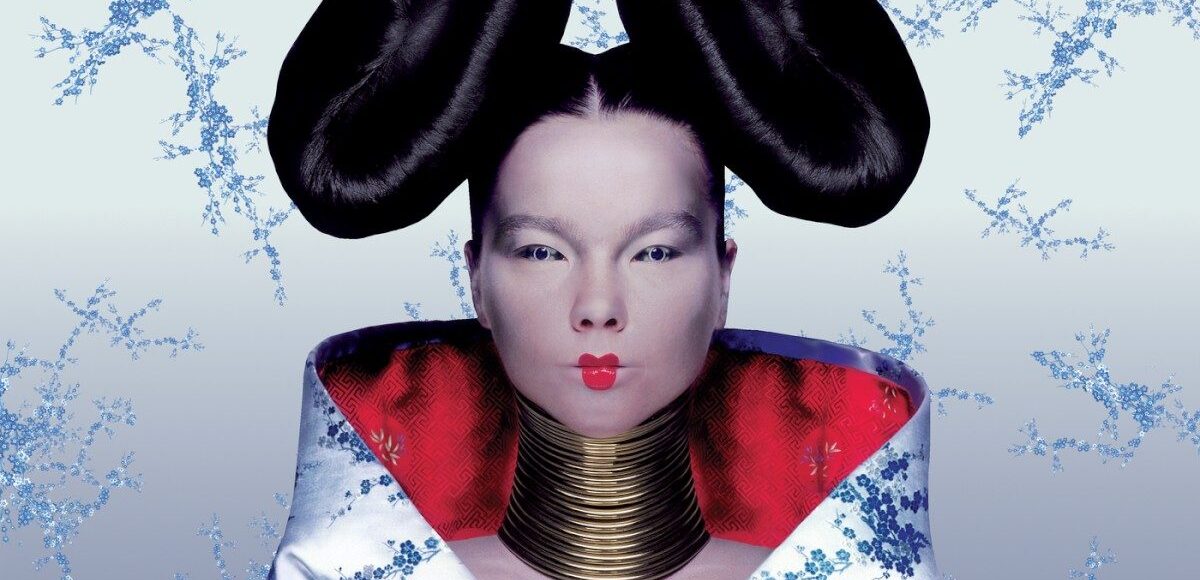
All Neon Like, 5 Years, Immature, Alarm Call, Pluto: the back half keeps the beats rude and the strings formal, which is the album’s whole argument. Nick Knight photographed the cover. Alexander McQueen built the dress, a white vision somewhere between a warrior and a geological event. The reshoot delayed the release. The image matches the music because both refuse prettiness as a goal. Homogeneous, she had said. One flavour. The flavour turned out to be contrast, held so tightly it feels like unity.
Homogenic is her most emotional, highly charged and groovy record, as well as a stinging triumph for the spirit of adventure.
(Ted Kessler, NME, 1997)
All Is Full of Love, produced with Howie B, closes the album like a door left open on purpose. Chris Cunningham’s 1999 video, two robots kissing in a white nowhere, became the image most people met last and remembered first. The tour had already started in September 1997, sometimes before audiences knew the songs, with Mark Bell at her side and, later, the strings. A kidney infection cancelled the American dates that autumn. In 1998 a run with Radiohead was announced and then dropped because the stages would not change over cleanly. The record travelled anyway.
What remains is the decision. After two albums that had welcomed the world in, she made one that sounded like a place. The beats do not soften to meet the violins, and the violins do not pretend to be synthesizers. Pitchfork would later treat the album as a landmark. The more useful fact is smaller: you can still drop the needle on Jóga or Unravel and hear a person choosing a climate and staying in it. Homogenic is not a phase. It is a coastline she drew and then refused to leave.