Four men, a studio, and the road as a score
Ralf Hütter and Florian Schneider started in Düsseldorf at the turn of the 1970s, first as Organisation, then as Kraftwerk, with Conny Plank in the early rooms and a distrust of the blues vocabulary that dominated rock. Kling Klang, their studio on Mintropstrasse, was not a backdrop. It was the instrument. They built, repaired and recorded in the same place, and the music began to sound like the room: clean, repetitive, proud of its own circuits.
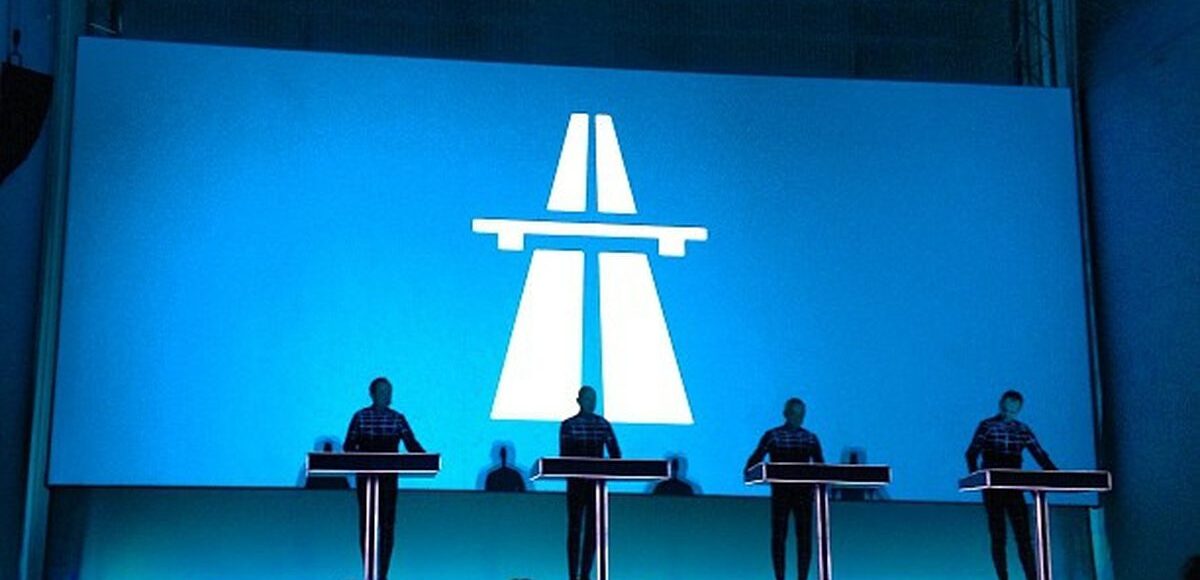
Autobahn, in 1974, is the moment the experiment became a journey other people could take. The title piece runs more than twenty minutes. The single, cut to a few, reached the British top twenty and number 25 on the American chart. A highway, a VW, a choir of synthetics: the joke was gentle and the structure was strict. Wolfgang Flür and Karl Bartos joined the frame. The classic quartet was assembling, not as a rock band with solos, but as four operators of one machine.
Radio-Activity in 1975 played on the double meaning, broadcast and decay. Trans-Europe Express in 1977 made the train the band’s other highway, metal on metal, a European pulse that did not need a guitar hero. The Man-Machine in 1978 put the robots on the cover and in the choreography. Red shirts, black ties, movements measured like a score. They were not hiding behind the concept. The concept was the show, and the show was accurate.
Computer World, 1981, described pocket calculators, numbers and data before those words were ordinary in a pop lyric. The beats are friendlier than the theme. That friendliness is how the future arrived: not as a warning shouted, but as a groove you could dance. Detroit was listening. Juan Atkins, Derrick May and the producers who would call their music techno have all named this room. A German quartet had written the pulse of a Black American city without visiting it.
Hip-hop heard them just as clearly. In 1982 Afrika Bambaataa and the Soulsonic Force, with Arthur Baker, built Planet Rock on Trans-Europe Express and Numbers. The sample was a passport. Kraftwerk’s machines, designed in Düsseldorf, became part of the Bronx without losing their accent. Synth-pop, from the Human League to Depeche Mode, took the other lesson: that a pop song could be assembled, not just performed, and still carry feeling. The feeling, in Kraftwerk, is coolness with a heart rate.
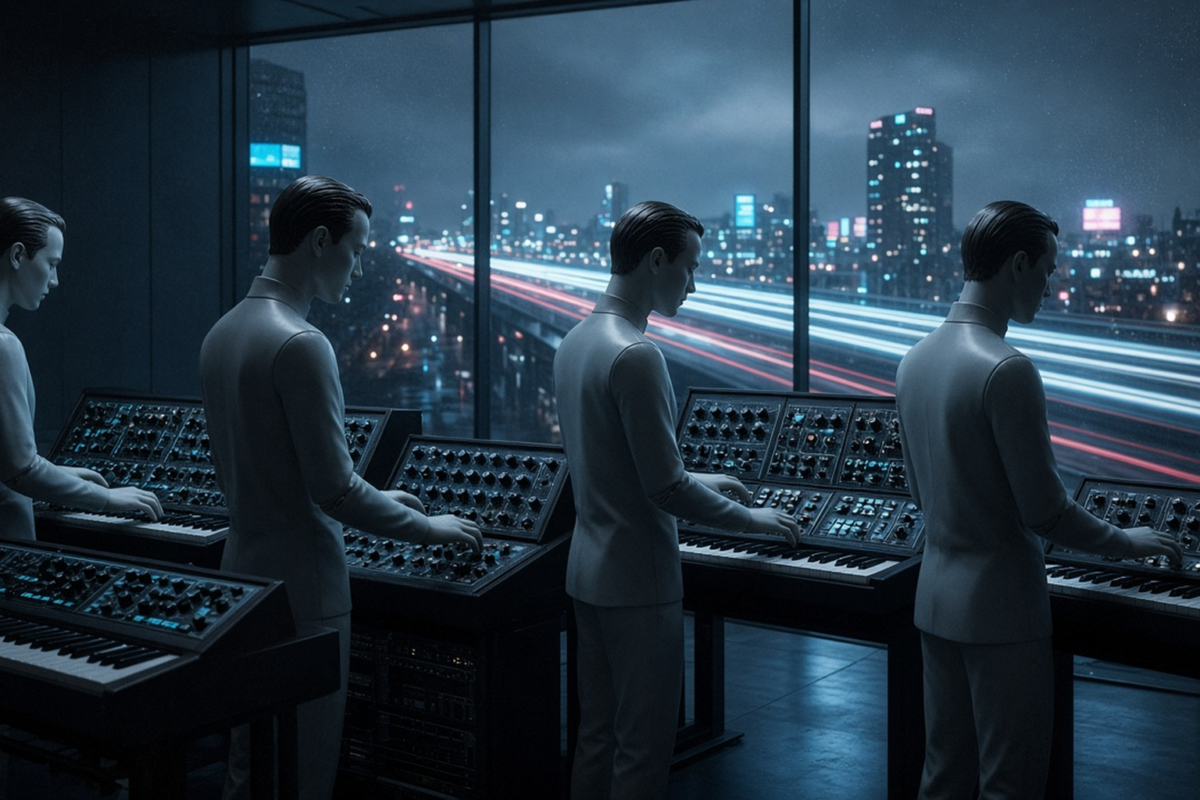
Flür and Bartos left. The robots stayed. Electric Café, later revised as Techno Pop, and The Mix in 1991 kept the catalogue alive by rebuilding it. Tour de France Soundtracks in 2003 was the first album of new material in years, a return to the bicycle and the road, Hütter’s other obsession. The live sets, documented on Minimum-Maximum in 2005, replaced the men with mannequins when they chose, and with 3D figures later. The point was never the face. The point was the pattern, played by whoever stood at the console.
Florian Schneider left the group in 2008. He died on 21 April 2020. The announcement came later, which suited a man who had spent a career preferring the machine’s timing to the press’s. Hütter continued, with Fritz Hilpert and Henning Schmitz among the operators, and the old albums kept being played in rooms that did not exist when they were made. A smartphone playing Computer World is not an irony they would have minded. It is the lyric coming true.
What Kraftwerk left is not a style you can put on like a shirt. It is a permission to treat repetition as emotion, and technology as a landscape rather than a gimmick. Highways, trains, radios, calculators, bicycles: ordinary objects, scored until they gleamed. The future they described was already here when they described it. It is still here. The neon has not gone out. The tempo has not apologized.