




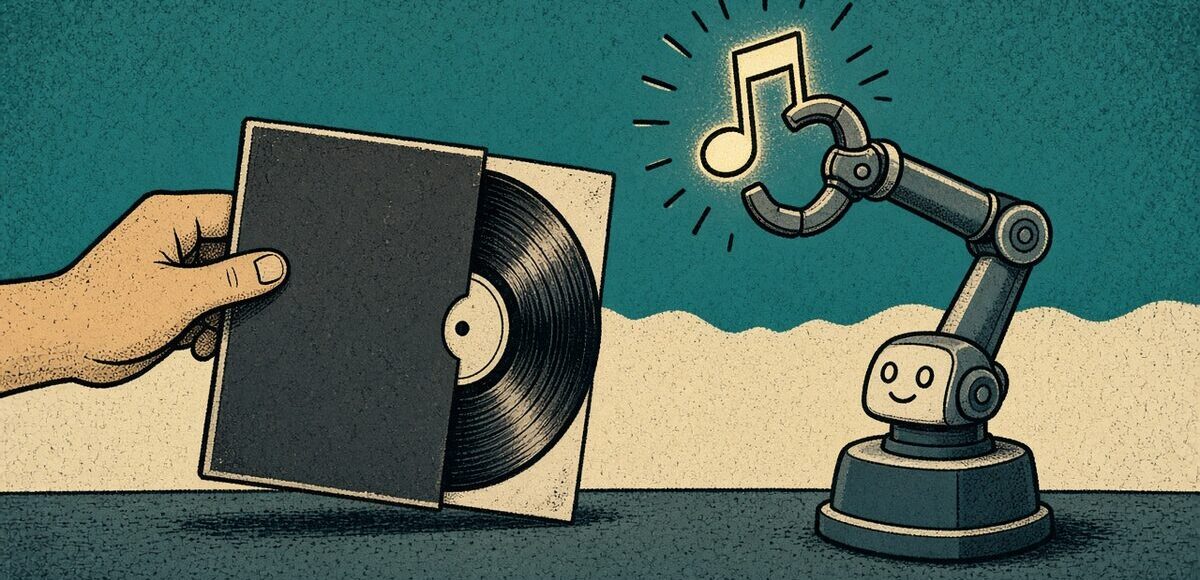
Models that draft melodies and voices force a new argument about authorship, labour and listening.
Generative AI can now propose chord loops, lyrics, vocal clones and full “songs” from text prompts in seconds. Labels, publishers and unions are already fighting over training data, likeness rights and credit. Fans meet the tech as novelty tracks, playlist filler and tools inside DAWs. The cultural question is sharper than the demo: help for makers, or replacement of makers?
The assistant camp says every era adopted machines — drum machines, samplers, Autotune, laptops. AI can speed sketching, help amateurs past blank-page fear, and free professionals from tedious MIDI chores. Used under human direction, it is another plugin. History, they argue, rewards people who absorb new tools without abandoning taste.
The threat camp says scale and opacity are different this time. Models trained on copyrighted catalogues without clear consent can flood platforms with cheap soundalikes, undercut session work, and blur who deserves royalties. Voice clones raise consent issues beyond melody. For this side, “assistant” is a soft word for labour displacement.
Law lags culture: some countries draft AI rules, platforms label synthetic media unevenly, listeners often cannot tell. Artists split between early adopters and vocal refusals. The debate will not wait for perfect regulation.
Do you see generative AI in music as a creative assistant, a threat to authors, or something in between you can still name? Draw your line below — and say what would change your mind.

Jamal W. | 6 September 2026
|
Hip-hop survived sampling lawsuits by evolving culture. AI needs similar honesty about sources.
Alex P. | 7 September 2026
|
Assistant when it saves hours. Threat when platforms bury human work for cheaper sludge. Fight the platform incentives.
Nate Y. | 19 September 2026
|
Threat narrative sells clicks. Practical musicians are already negotiating with the tools.
Kai M. | 23 September 2026
|
We’ve feared drum machines, samplers, laptops. Each time people adapted. This feels bigger, yes. Still a tool if we keep taste.
Claire D. | 27 September 2026
|
Copyright and credit are the real battlefield. The aesthetics argument is secondary until we fix that.
Luca B. | 28 September 2026
|
I use AI for dull stems cleanup. I don’t ask it to write my chorus. Assistant, not author, for now.
Nina K. | 1 October 2026
|
ai tracks on spotify sound like waiting rooms. cool experiment, cold soul
Ian Mc. | 9 October 2026
|
If AI floods the middle, human edges get more valuable. Weird music might win.
Amy | 10 October 2026
|
Prompt-only isn’t authorship to my ears. Harsh but honest.
Mike B. | 11 October 2026
|
My teen cousin makes AI ‘songs’ for fun. Harmless. Industry use ≠ cousin use.
Zoé | 11 October 2026
|
Threat to royalties is already visible in murky credits. Not hypothetical.
Ray | 11 October 2026
|
Ethics first then tools. Order matters.
Harold | 11 October 2026
|
I’m a songwriter. Assistant for arrangement ideas, never for final topline.
Tom Riff | 12 October 2026
|
Chord bots are harmless toys. Voice clones are identity theft with melody.
Nina Bass | 12 October 2026
|
Creative assistant if human directs. Threat if human becomes prompt-only.
Emma | 13 October 2026
|
Cousin use trains the norm though. Soft threat via culture.
Greg | 13 October 2026
|
Blank page help is cute until it replaces the page. Careful.
Chris O. | 13 October 2026
|
Students already paste AI melodies. My job is teaching them to hear when it’s empty.
Ben | 14 October 2026
|
History rewards tool absorbers. I want to be one without dumping ethics.
Hélène | 14 October 2026
|
Voice clones creep me out more than chord bots. Consent again.
Alex | 14 October 2026
|
Labels will not label unless forced. Optimistic assistant talk feels naive.
Paulo | 14 October 2026
|
Naive maybe. Still excited for amateurs who freeze at a blank page.
Kofi | 14 October 2026
|
Final topline is where authorship lives for me. Guard that line.
Sam W. | 15 October 2026
|
Every era adopted machines. Drum machines didn’t end drummers who mattered.
Nadia | 15 October 2026
|
Fans can’t tell synthetic fillers apart. That’s a discovery problem. Threat to listening.
Diego | 15 October 2026
|
That consent point is the whole debate for me. Threat until law catches up.
Jules M. | 15 October 2026
|
I label my AI-assisted demos. Transparency keeps it assistant-shaped.
Dan | 15 October 2026
|
Session players are already squeezed. Scale changes everything. Threat.
Marc G. | 15 October 2026
|
I use AI for MIDI cleanup. Still write the song. Assistant.
Rosa | 15 October 2026
|
Drum machines didn’t scrape living catalogues without asking. Different beast.
Bruno | 15 October 2026
|
Threat. Consent and training data are the real fight, not ‘vibes’.
Jacques | 16 October 2026
|
Assistant for sketches. Threat if platforms flood with clone sludge. Both, eyes open.