
A lighter devil than the Les Paul
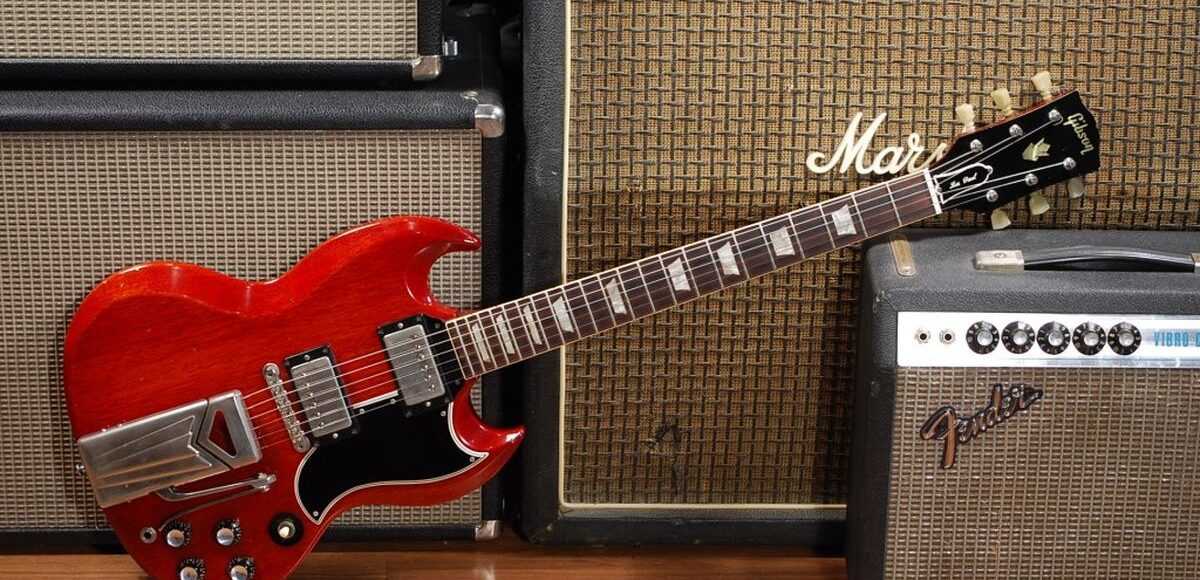
In 1961 Gibson replaced the single-cut Les Paul, which had sold poorly and been discontinued in 1960, with a double-cutaway solid guitar. It was still billed as a Les Paul. The body was mahogany, thinner, with horns that reached toward the neck, and the neck itself felt faster under the hand. Les Paul disliked the new shape enough to ask that his name be taken off. By 1963 the instrument was simply the SG, for Solid Guitar. The angel, if it was one, arrived by a quarrel.
The point of the cutaways was access. You could reach the high frets without a wrestling match. The guitar was lighter than the old Les Paul, which mattered to anyone who had to wear one for a whole set. Two humbuckers on the Standard, a 24.75 inch scale, a tune-o-matic bridge: familiar Gibson grammar in a sharper silhouette. It looked a little wicked. Players who wanted wickedness noticed.
Pete Townshend used SGs in the mid-1960s and then smashed them, which is its own kind of review. Robbie Krieger’s lines with the Doors often came off an SG, a thinner voice than a Les Paul, closer to a snarl. Frank Zappa played one before his instruments became sculptures. The SG was not a jazz box and not a folk guitar. It was a rock shape that admitted it, horns and all, before the culture had a costume for that admission.
Tony Iommi’s story is welded to the model. After a sheet-metal accident in 1965 cost him the tips of two fingers on his fretting hand, he built thimbles, slackened the strings, and found a darker tuning. His SG, later fitted with cross inlays, is the sound of Black Sabbath: down, thick, and unwilling to hurry. The lightness of the body let him play sets that a heavier guitar would have punished. Detuning did the rest.
Angus Young made the SG a school uniform. From the early AC/DC years the double-cutaway was his main guitar, duck-walking in a blazer while the bridge humbucker barked. Back in Black, Highway to Hell, the live albums: that attack is an SG more often than the photographs bother to say. He did not need the guitar to look vintage. He needed it to cut a Marshall stack and still leave room for a voice. It did.
Gibson has reissued the SG in every decade since, sometimes chasing the 1961 shape, sometimes smoothing it. The arguments about neck profile matter to collectors and barely matter to the riff. What travels is the silhouette: two horns, a dark body, a humbucker near the bridge. When a band wants to look like trouble and sound like a power chord with teeth, this is the drawing they reach for.
Call it the black angel if you like. The name fits the finish more than the theology. It is a 1961 solution to a sales problem, rejected by the man on the headstock, then adopted by the players who needed speed, weight of tone, and a body that would not break their shoulder. Iommi’s thimbles, Angus’s blazer, Townshend’s wreckage. The SG kept its horns up.