Crawley to Disintegration: post-punk gloom, then arena-scale melancholy
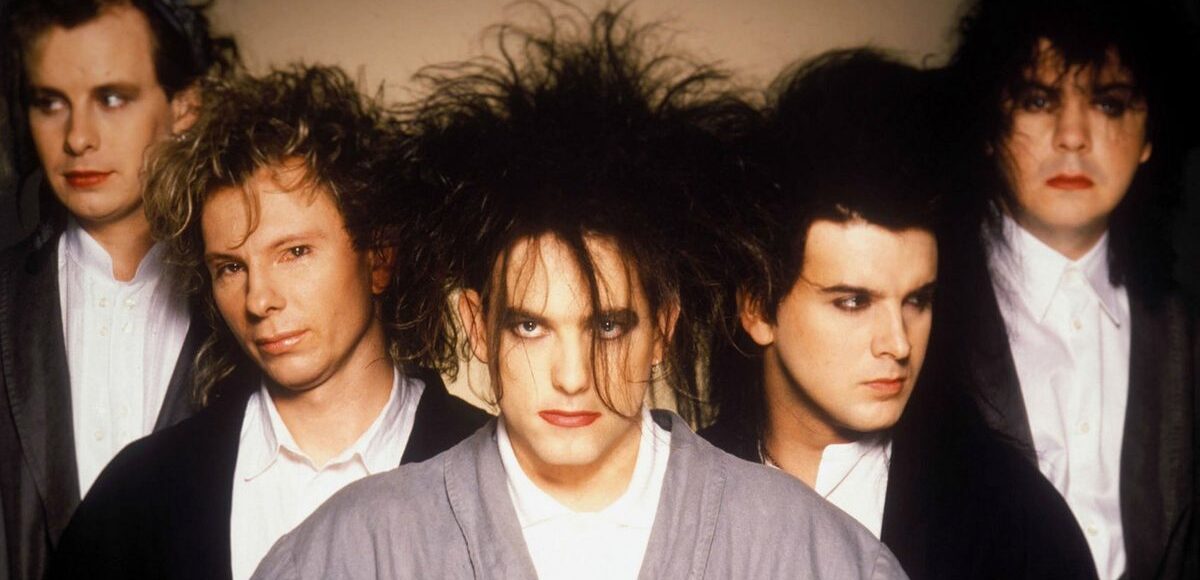
The Cure formed in Crawley, a commuter town south of London, around Robert Smith, Laurence Tolhurst, and Michael Dempsey. Smith had played in a school band before the group coalesced under the name Easy Cure and then simply The Cure, signing to Fiction Records in 1979. Three Imaginary Boys (1979) arrived with a cover Smith later disowned and a sound shaped by Wire and the post-punk circuit: short songs, dry production, rhythm-section emphasis over lead guitar display. The template was already different from the art-school minimalism of their contemporaries — the pop instinct was there under the austerity.
The early 1980s were the dark years, deliberately so. Seventeen Seconds (1980) introduced a reverb-heavy sound built on layered guitar lines and Simon Gallup’s bass walking underneath Smith’s half-spoken, half-sung vocals. Faith (1981) and Pornography (1982) completed an arc of compression: longer tracks, slower tempos, lyrics moving toward abstraction. Pornography in particular was recorded in a state of chemical dissolution; the band nearly broke apart before the sessions ended. It opens with a spoken whisper and accumulates darkness across its eight tracks without offering a single moment of release. At the time it sold modestly; its reputation grew later, and much of the music that would be classified as shoegaze and darkwave traces a line back to it.
After the dark trilogy, Smith switched direction on purpose. “Let’s Go to Bed” (1982) and “The Walk” (1983) were deliberate pop singles, almost jokes at the expense of the previous intensity. They worked commercially and confused the existing audience in equal measure. The Head on the Door (1985) placed the darkest and the brightest registers of the group inside the same sequence: “In Between Days” had a folky brightness; “Close to Me” rendered small-room claustrophobia as a jangly hit; “Sinking” returned to the funeral pace. The record charted in the UK and opened the American college radio market.
Kiss Me Kiss Me Kiss Me (1987) stretched the range across a double album: “Why Can’t I Be You?” was the most deliberately pop thing the group had released, while “The Snakepit” pointed back toward the dark period. The American audience found them on MTV. Disintegration (1989) is the record most listeners cite as the essential text: nine tracks, most of them over five minutes, built on swelling synthesizer pads, Gallup’s bass in the low end, Roger O’Donnell’s keyboards, and Smith’s voice performing grief at a tempo that refuses to accelerate. “Lovesong” reached number one in the US, a fact that surprised the band and confused some of their longer-term followers.
The 1990s brought Wish (1992), which contained “Friday I’m in Love” — the most straightforwardly radio-friendly song Smith had written — alongside darker material that balanced the commercial visibility. Wild Mood Swings (1996) was less coherent. Bloodflowers (2000) returned to a slower, more austere approach that recalled the dark trilogy. The self-titled record of 2004 and 4:13 Dream (2008) confirmed that Smith remained committed to the project without revisiting past sounds mechanically. Songs of a Lost World (2024), the first album in sixteen years, arrived with a setlist built around the longer, slower end of the catalog and a touring production that had grown into a theatrical arena event.
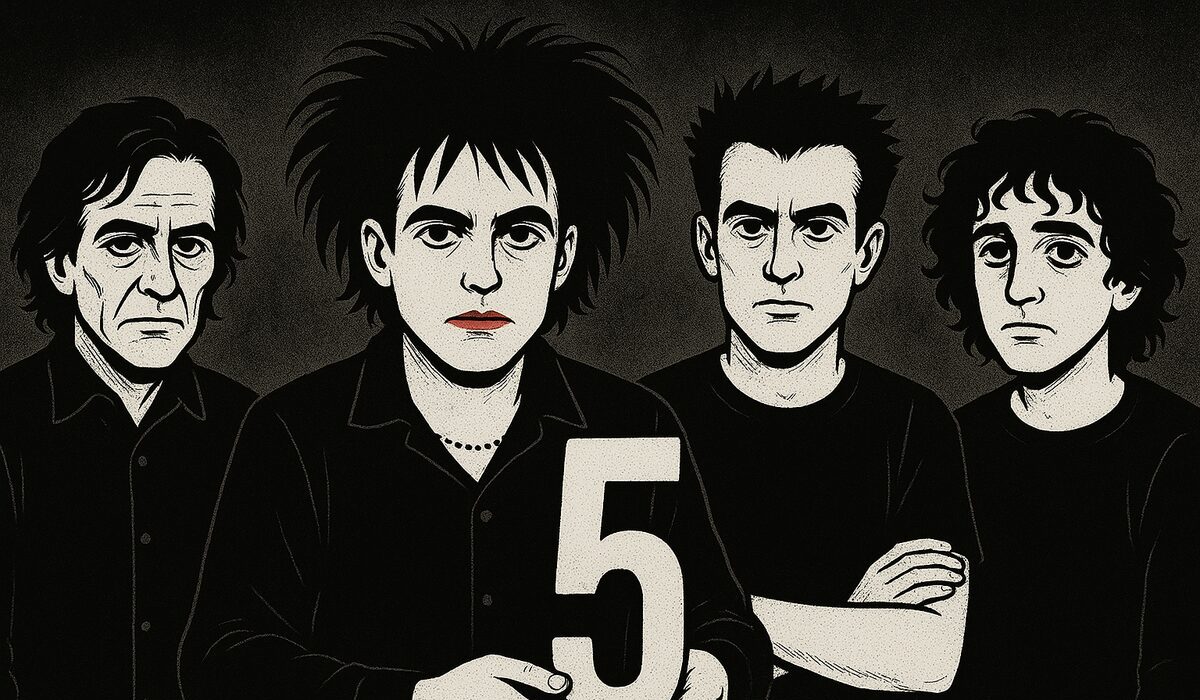
The influences are embedded in the arrangements. Siouxsie and the Banshees were close neighbors on the post-punk circuit, and Smith served briefly as their touring guitarist; their gothic theatricality left clear marks on his approach to image and atmosphere. David Bowie’s Berlin period — Lodger, Scary Monsters — shaped the production sensibility: reverb-heavy, cold in texture but not in feeling. Joy Division’s rhythmic compression, Jimi Hendrix’s guitar approach in Smith’s earlier playing, and a consistent interest in French film and literature also appear in the group’s references.
Sonically, the group is identifiable from the first few seconds of almost any track. The guitar is heavily processed: delay, chorus, and reverb stacked to create a shimmer that sits between the pick attack and the ambient wash. Gallup’s bass provides the melodic foundation, often moving through chord changes while Smith plays guitar lines that color rather than state. The drum production ranged from the gated snap of the early 1980s to the larger, roomy sound of Disintegration and Wish. Smith’s voice sits in the midrange and has not adopted a conventional rock delivery at any point in the catalogue; the phrasing remains close to speech rhythm regardless of whether the track is slow or up-tempo.
Entry points depend on where you want to land. Disintegration for the full gothic-pop scale, where the dark and the beautiful arrive together. The Head on the Door for the most balanced record between those registers. Boys Don’t Cry, the early singles compilation, for the first period in concentrated form. Kiss Me Kiss Me Kiss Me if you want the widest range inside a single sitting. Compared to Joy Division, the Cure were always more committed to melody: Smith wrote choruses that worked without any particular tolerance for abstraction, which kept the group commercially viable well past the post-punk window. Compared to Bauhaus, the Cure were less theatrical and more emotionally direct.
What the catalogue has maintained across five decades is the balance between its two poles without resolving the tension between them. The darkness is audible in the guitar arrangements and the vocal approach, but the pop craft is there underneath, and neither side cancels the other out. Listeners who came in through “Friday I’m in Love” found Disintegration on the same shelf. That range, rather than a fixed identity, is what makes the Cure more than a genre document.