
A stairwell turned into weather
Headley Grange, 1971. John Bonham’s kit sits in a stairwell, and the sound that returns is less a drum part than a change in the weather. Jimmy Page has already learned that a room can be an instrument if you leave it alone. The mobile studio parked outside belongs to the Rolling Stones. Inside, four musicians who still refuse to release singles on principle are building an album with no title, no printed name on the cover, and a riff that will outlive the argument about whether rock needs myth. They call the record nothing. Everyone else will call it the fourth one.
The group had begun three years earlier, when the Yardbirds finally came apart and Page kept the name only long enough to abandon it. He wanted a singer who could move, not a replacement. Robert Plant arrived from the Band of Joy with a voice that seemed to have been raised in a larger room than England usually allows. John Paul Jones, already a session aristocrat, brought arrangement as a kind of manners. Bonham brought weight. The first album, recorded at Olympic Studios in something like thirty hours and released in January 1969, still smells of the blues clubs they had just left and of the amplifiers they were about to outgrow. It is not polite. It is also not yet the cathedral.
Led Zeppelin II, cut on the road and released before the year was out, is the cathedral’s foundation: Whole Lotta Love as a single body of sound, the riff and the voice and the middle section of pure space. Led Zeppelin III then turns toward acoustic grain, as if the band needed to prove that volume was a choice. By the untitled album the choices are simultaneous. Black Dog staggers. Rock and Roll sprints. Stairway to Heaven climbs without apology, from recorder to the solo that still gets blamed for every later excess and still refuses to hurry. Page produces. Peter Grant, the manager, keeps the industry at the door. Atlantic puts the record out. The cover is an old man with a bundle of sticks, a painting Plant found in a Reading antique shop. The inner sleeve carries four symbols, one chosen by each of them. The facts stay physical. The effect does not.
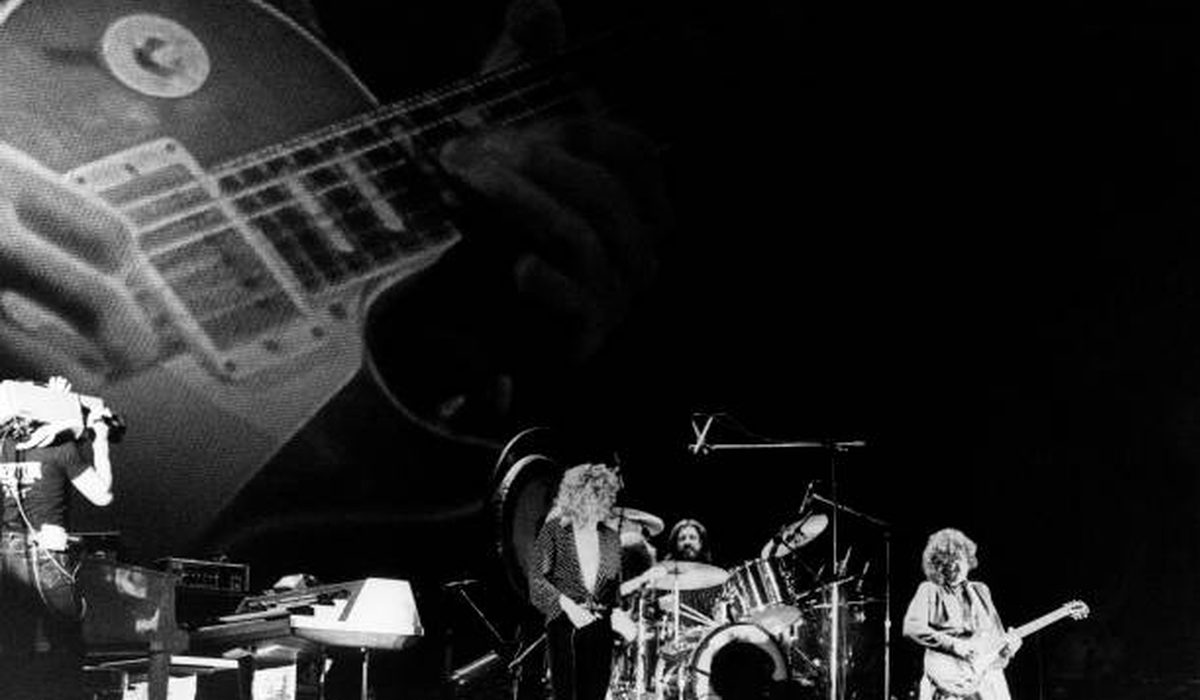
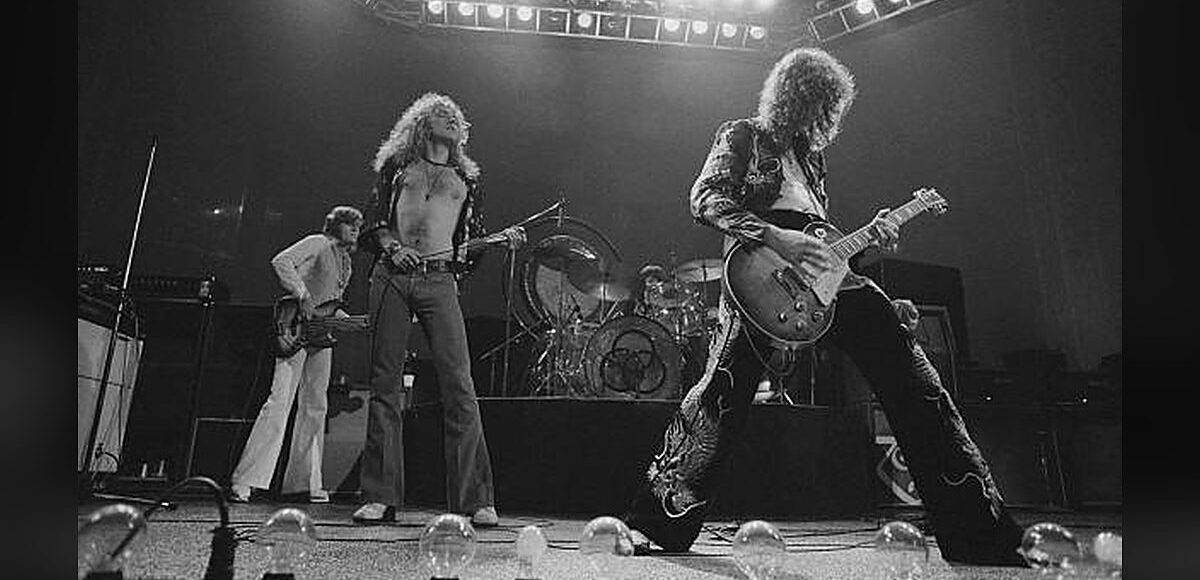
What follows is scale. Houses of the Holy in 1973 opens the palette, and the Madison Square Garden shows of that July become, three years later, the film The Song Remains the Same, part concert, part private legend. Physical Graffiti, the 1975 double album, is the band at full acreage. Kashmir does not speed up to impress anyone. It advances, orchestral and dry, with Jones’s arrangement holding the horizon while Plant sings as if the desert were a memory he had earned. Earl’s Court, May 1975, is the proof in public: five nights, a city treating a rock group as architecture. Page in the dragon suit. Plant bare-chested under the lights. Bonham’s three circles on the bass drum. The riff has a street address.
Then the body intervenes. In August 1975, on Rhodes, Plant and his family are in a car crash. The singer spends the next season in a wheelchair, and Presence, recorded in a rush at Musicland in Munich and released in 1976, is the sound of a band playing through a fracture. Achilles Last Stand is ten minutes of nerve. The group does not cancel the idea of itself. It narrows. By 1979 they are at Polar Studios in Stockholm, the room Abba built, making In Through the Out Door, with Jones’s keyboards further forward and Bonham still the climate system. Knebworth that August is enormous and a little ghostly. The myth is intact. The drummer is not well.
On 25 September 1980, after a rehearsal, John Bonham dies at Page’s house, the Old Mill, in Windsor. He is thirty-two. On 4 December the band issues a short statement. They cannot continue as they were. There is no replacement narrative, no farewell tour staged for the camera. The refusal is the last arrangement. Later reunions, the 2007 O2 show above all, are visits, not restorations. The catalog does not need them. It already occupies the stairwell.
Led Zeppelin remains the argument that heaviness can be precise. Page’s production is not a fog. It is a set of decisions about distance: how far the voice sits from the guitar, how much air Bonham is allowed, how a song can last eight minutes without asking permission. Plant’s later solo work, Jones’s production, the endless court cases over blues sources, none of it edits the central fact. Four people, for a dozen years, made volume feel like a place you could walk into. The riff still weighs what it weighed. The room still answers.