A clavinet, a campaign, and a child who heard everything
Stevland Hardaway Judkins was born in Saginaw, Michigan, on 13 May 1950, and the name the world learned was Little Stevie Wonder. Blind from infancy, he signed to Motown at eleven, with Berry Gordy and Clarence Paul shaping a prodigy who already played drums, harmonica and keys as if they were one instrument. Fingertips (Pt. 2), recorded live, hit number one on the Billboard Hot 100 in 1963. He was thirteen. The scream in the middle of the song is a child who has just realized the room is his.
The hits of the sixties, Uptight, I Was Made to Love Her, My Cherie Amour, Signed, Sealed, Delivered I’m Yours, made him a star inside a system. When he turned twenty-one in 1971 he did the rarer thing: he renegotiated, took the publishing, and kept the masters’ future in his own hands. Music of My Mind and Talking Book, both 1972, were made with Malcolm Cecil and Robert Margouleff and their TONTO synthesizer. The clavinet on Superstition, a riff he had first offered toward Jeff Beck and then kept, is the sound of that freedom. It went to number one in 1973. Funk had a new spine, and it belonged to a singer.
Innervisions, 1973, is the conscience arriving at the same volume as the groove. Living for the City, Higher Ground, Don’t You Worry ’bout a Thing: social detail and joy in the same bar. On 6 August 1973, near Salisbury, North Carolina, a log truck hit the car he was in. He spent days in a coma and lost his sense of smell. The music that followed did not turn the accident into a brand. Fulfillingness’ First Finale in 1974 simply continued, a little duskier, still exact.
Songs in the Key of Life, 1976, is the summit people mean when they say he could do anything. A double album plus the EP A Something’s Extra, it debuted at number one on the Billboard 200. Sir Duke, I Wish, Isn’t She Lovely, As, Pastime Paradise: a suite that holds a birth, a childhood, a city and a tribute to Ellington without dropping the pocket. He won the Grammy for Album of the Year three years running, for Innervisions, Fulfillingness’ First Finale and this one. The shelf is not the point. The run is.
The eighties did not shrink him. Hotter than July, 1980, carried Master Blaster and, more importantly, Happy Birthday, the campaign song for a national holiday in Martin Luther King’s name. Reagan signed the bill in 1983. The first official observance came in 1986. A pop single had done legislative work, which is a strange sentence and a true one. I Just Called to Say I Love You, from The Woman in Red in 1984, won an Oscar and annoyed purists. He did not apologize for a melody that simple. He has never confused difficulty with value.
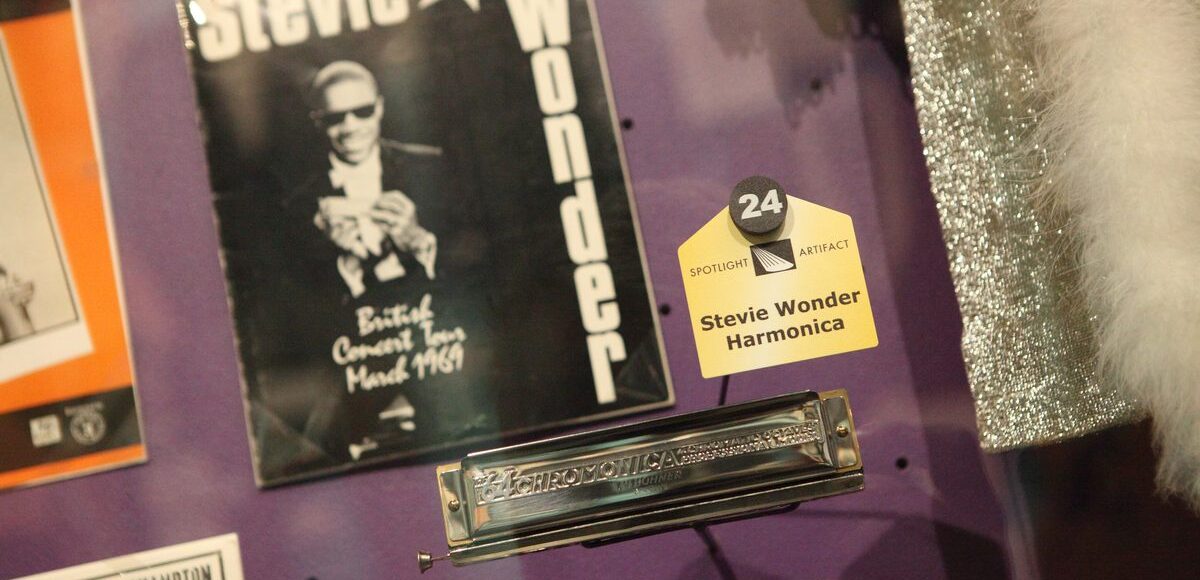
The collaborations are a map of the era: Paul McCartney on Ebony and Ivory, a less convincing truce than the friendship; the harmonica that lifts so many other people’s records; the songs he gave away, Tell Me Something Good to Rufus, It’s a Shame in the Motown orbit. He plays like a band even when he is alone, because he often was the band. Drums, bass, clavinet, harmonica, the voice that can be a grin or a sermon. Sunshine, in his music, is not naivety. It is a decision made with the lights already known.
Later albums, In Square Circle, Characters, Conversation Peace, kept the craft without repeating the seventies’ shock. He has remained a presence rather than a nostalgia act, turning up when a room needs both musicianship and a moral. The Grammys accumulated. The more durable fact is that a child signed in 1961 was still, decades on, the person other singers called when they wanted the real instrument in the room.
Keys, sunshine, conscience: the three words are not a slogan if you listen in order. The keys are the clavinet, the TONTO, the harmonica cupped in a hand. The sunshine is You Are the Sunshine of My Life and every chorus that refuses gloom as a default. The conscience is Living for the City and a birthday song that helped move a holiday. He heard the century more clearly than most people who could see it, and he played it back with the pocket intact.